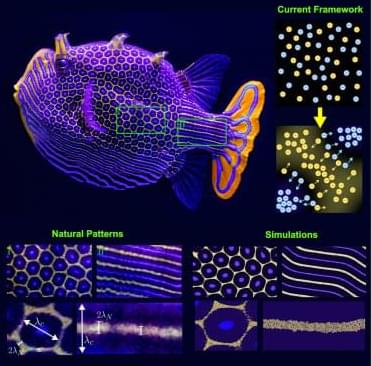
Natural patterns are rarely perfect. We couple classical Turing patterns in chemical gradients to cell motion via diffusiophoresis, showing that this interplay naturally yields textured and multiscale patterns. The patterns are dependent on parameters such as cell size distribution, Péclet number, volume fraction, and cell-cell interactions. These insights bridge idealized theory with real systems and point to routes for programmable materials, surfaces, and soft robotics.