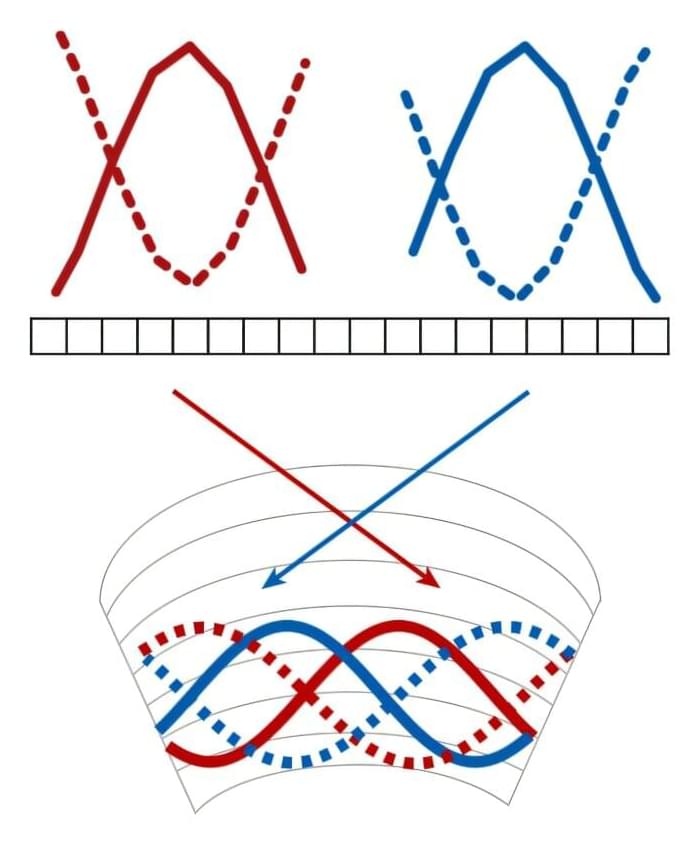
Navigating the world is no mean feat, especially when the world pushes back. For instance, airflow hitting a fly on its right side can, after a turn, become a headwind. To stay on course, the fly’s brain must interpret sensations that constantly shift with each turn of its body.
Indeed, transforming changing sensory inputs into a more stable, map-like understanding of the world is intimately connected to an animal’s ability to survive and navigate within its environment. How do flies make it look so easy?
Now, a study published in Cell shows that the fly brain uses a surprisingly economical strategy. Earlier work had demonstrated that flies calculate their direction of travel by combining four neural signals, each encoding motion along a different axis. The new research finds that when it comes to wind direction, the brain doesn’t need four neuronal populations, but only two. This is because each population can handle two opposite directions in the wind system.