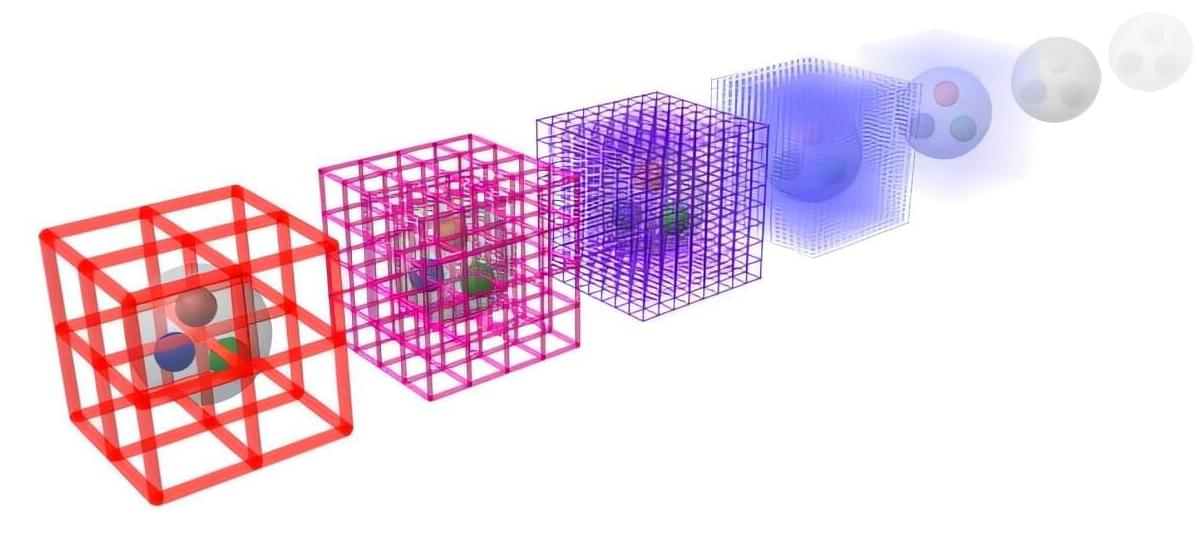
An old puzzle in particle physics has been solved: How can quantum field theories be best formulated on a lattice to optimally simulate them on a computer? The answer comes from AI.
Quantum field theories are the foundation of modern physics. They tell us how particles behave and how their interactions can be described. However, many complicated questions in particle physics cannot be answered simply with pen and paper, but only through extremely complex quantum field theory computer simulations.
This presents exceptionally complex problems: Quantum field theories can be formulated in different ways on a computer. In principle, all of them yield the same physical predictions—but in radically different ways. Some variants are computationally completely unusable, inaccurate, or inefficient, while others are surprisingly practical. For decades, researchers have been searching for the optimal way to embed quantum theories in computer simulations. Now, a team from TU Wien, together with teams from the U.S. and Switzerland, has shown that artificial intelligence can bring about tremendous progress in this area. Their paper is published in Physical Review Letters.