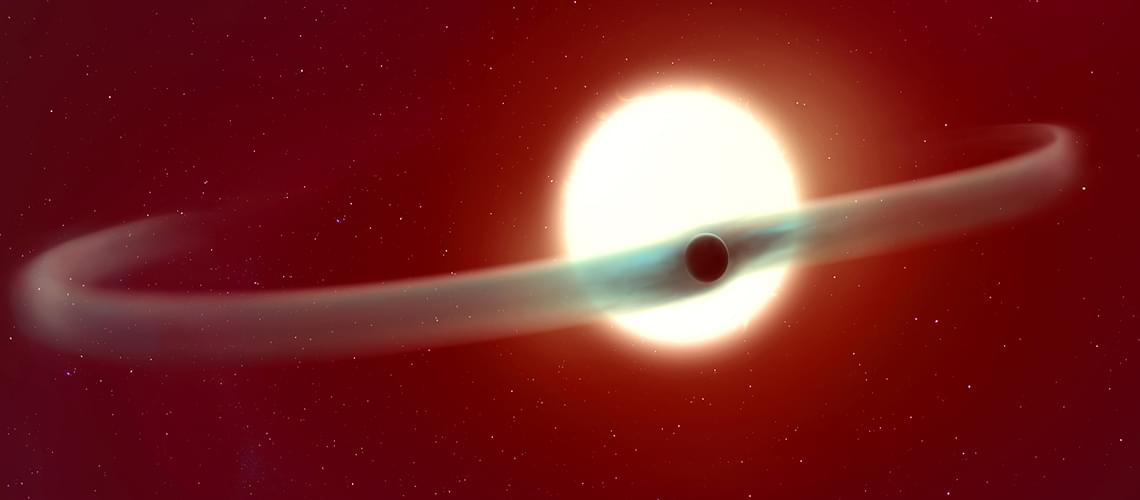
“We were incredibly surprised to see how long the helium escape lasted,” said Dr. Romain Allart.
What effects can an exoplanet orbiting close to its star have on the former’s atmosphere? This is what a recent study published in Nature Communications hopes to address as a team of scientists investigated a unique atmospheric phenomenon of an ultra-hot Jupiter, the latter of which are exoplanets that orbit extremely close to their stars, and the intense heat causes their atmospheres to slowly strip away. This study has the potential to help scientists better understand the formation and evolution of ultra-hot Jupiters and their solar systems, and where we could search for life beyond Earth.
For the study, the researchers analyzed data obtained by NASA’s James Webb Space Telescope (JWST) for the ultra-hot Jupiter WASP-121b, which is located approximately 880 light-years from Earth and orbits its F-type star in only 1.3 days. For context, F-type stars are larger and hotter than our Sun—which is a G-type star—and the closest planet to our Sun—Mercury—orbits our Sun in 88 days. What makes WASP-121b intriguing is not only is its helium atmosphere is slowly being stripped away, also called atmospheric escape, but the data revealed that this has resulted in two helium tails wrapping around WASP-121b while circling approximately 60 percent of the exoplanet’s orbit.