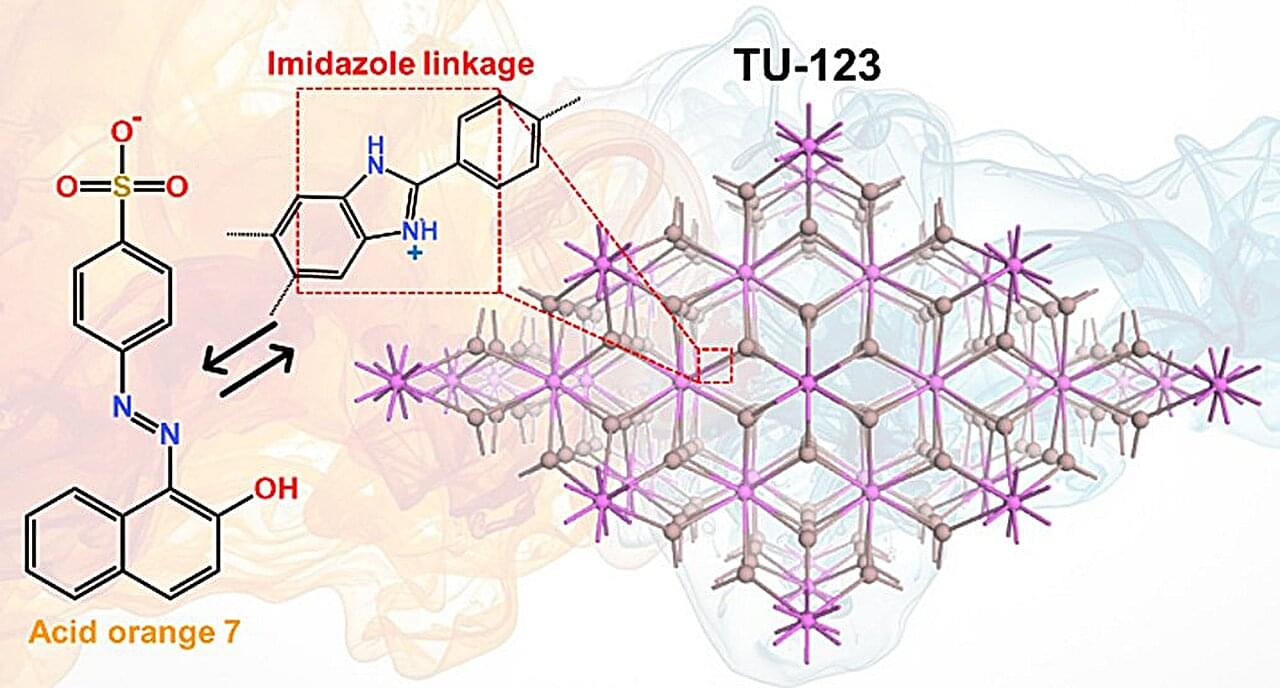
Industrial dye pollution remains one of the most persistent and hazardous challenges in global wastewater management. The dyes from textile and chemical manufacturing sectors are difficult to remove, non-biodegradable, and can be toxic to plants, animals, and humans. However, conventional treatment technologies for dyes often fail to efficiently purify the wastewater without significant trade-offs.
To remedy this issue, researchers from Tohoku University developed a three-dimensional covalent organic framework (COF), TU-123, that enables highly efficient and selective removal of anionic dyes from contaminated water.
The highly porous COF acts like a sponge—trapping dyes for easier separation. This work establishes a new structural blueprint for constructing highly connected imidazole-linked three-dimensional COFs. Furthermore, it opens sustainable pathways for advanced wastewater purification technologies.