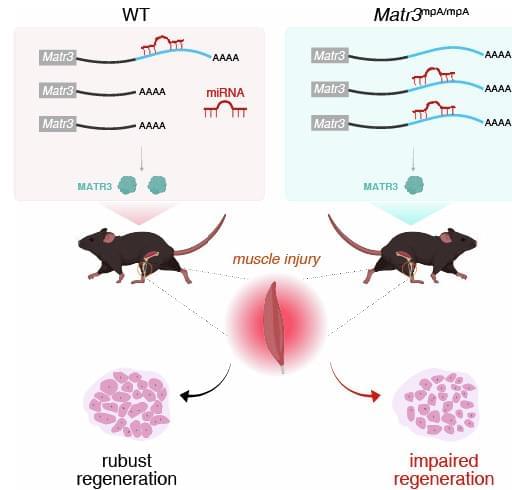
3′UTR shortening in muscle stem cell differentiation.
Global changes in alternative polyadenylation (APA) leads to alterations in 3′ untranslated region (3′UTR) length and is accompanied by cell differentiation. However, APA role in muscle stem cell differentiation remain unclear.
The authors show that preferential 3′UTR shortening during stem cell differentiation occurs via CFI-mediated APA regulation.
They also demonstrate that 3′UTR shortening is a general strategy to escape repression by myomiRs.
This study reveals a tendency toward 3′UTR shortening, which alleviates miRNA repression of mRNAs critical for differentiation, ensuring efficient muscle differentiation and regeneration.
The authors used Matr3 expression to demonstrate the APA and miR-1/206 antagonistic role in myogenesis and they show that mutating the proximal Matr3 polyadenylation site in mice impairs muscle regeneration. sciencenewshighlights ScienceMission https://sciencemission.com/3%E2%80%B2UTR-shortening-alleviates-miRNA-repression
Alternative polyadenylation (APA) modulates gene expression by altering 3′ untranslated region (3′UTR) length. Although 3′UTR lengthening typically accompanies cell differentiation, we unexpectedly observed preferential APA-mediated 3′UTR shortening events during muscle stem cell (satellite cell, SC) differentiation, coinciding with increased muscle-specific miRNAs (myomiRs) targeting at alternative 3′UTRs. Mechanistically, this shortening primarily results from reduced cleavage factor I (CFI) expression and allows transcripts to escape repression by differentiation-induced myomiRs. Interestingly, perturbation of mRNA 3′UTR shortening of multiple genes impairs myogenic differentiation. Focusing on Matr3—a gene linked to muscle disorders—we demonstrate that its APA-miRNA regulatory balance is critical for efficient SC differentiation in vitro.