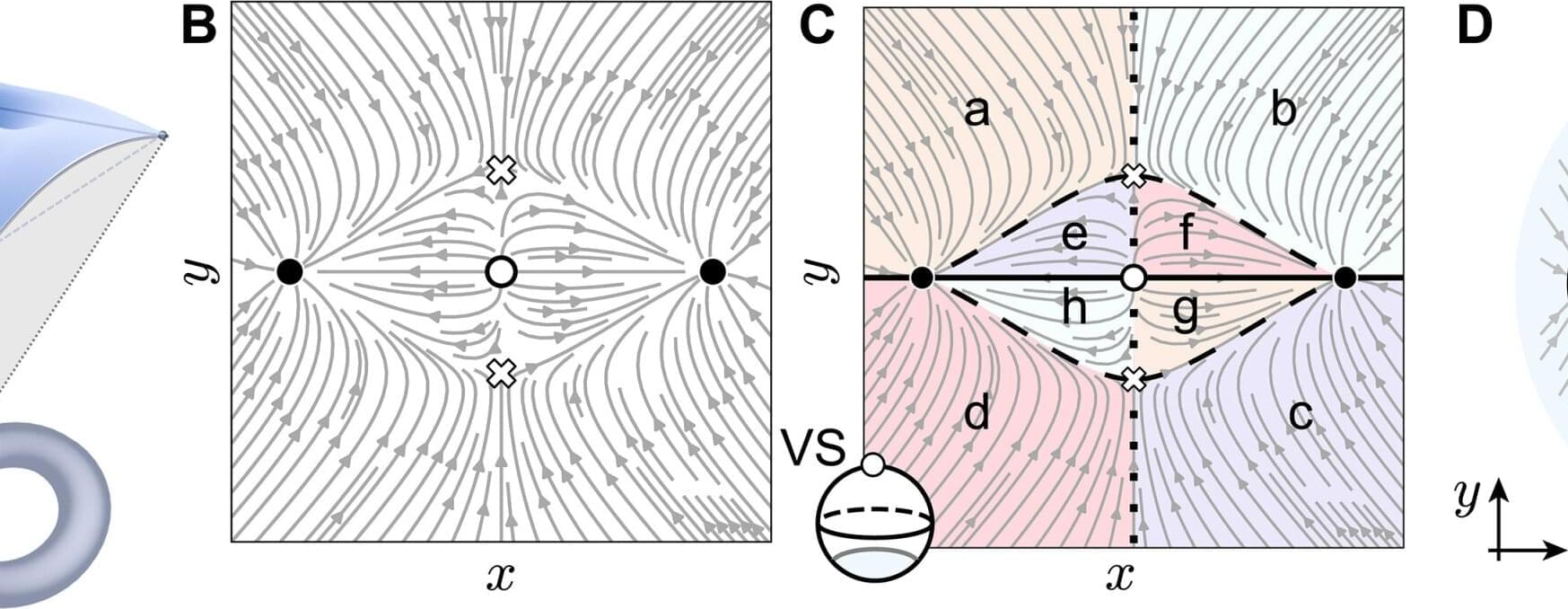
Imagine standing on top of a mountain. From this vantage point, we can see picturesque valleys and majestic ridges below, and streams wind their way downhill. If a drop of rain falls somewhere on this terrain, gravity guides it along a path until it settles in one of the valleys. The trajectory traced by this droplet is known as a flow line, a path that indicates the direction of movement determined by the landscape’s gradient.
The complete network of valleys, ridges, and flow lines forms a topographic (or cartographic) map that captures the organization of the landscape. This organization, which remains stable as long as the terrain does not change, corresponds to a kind of “topological invariant,” as physicists would call it: It characterizes the global structure of the flows without reference to local details.
Now imagine that a jolt goes through the landscape and it changes, with new valleys appearing, others merging and ridges shifting. The flow lines reorganize accordingly, forming a new pattern of connections. Comparing these patterns—like two maps placed next to each other—reveals how the system’s topology evolves when its underlying conditions change.