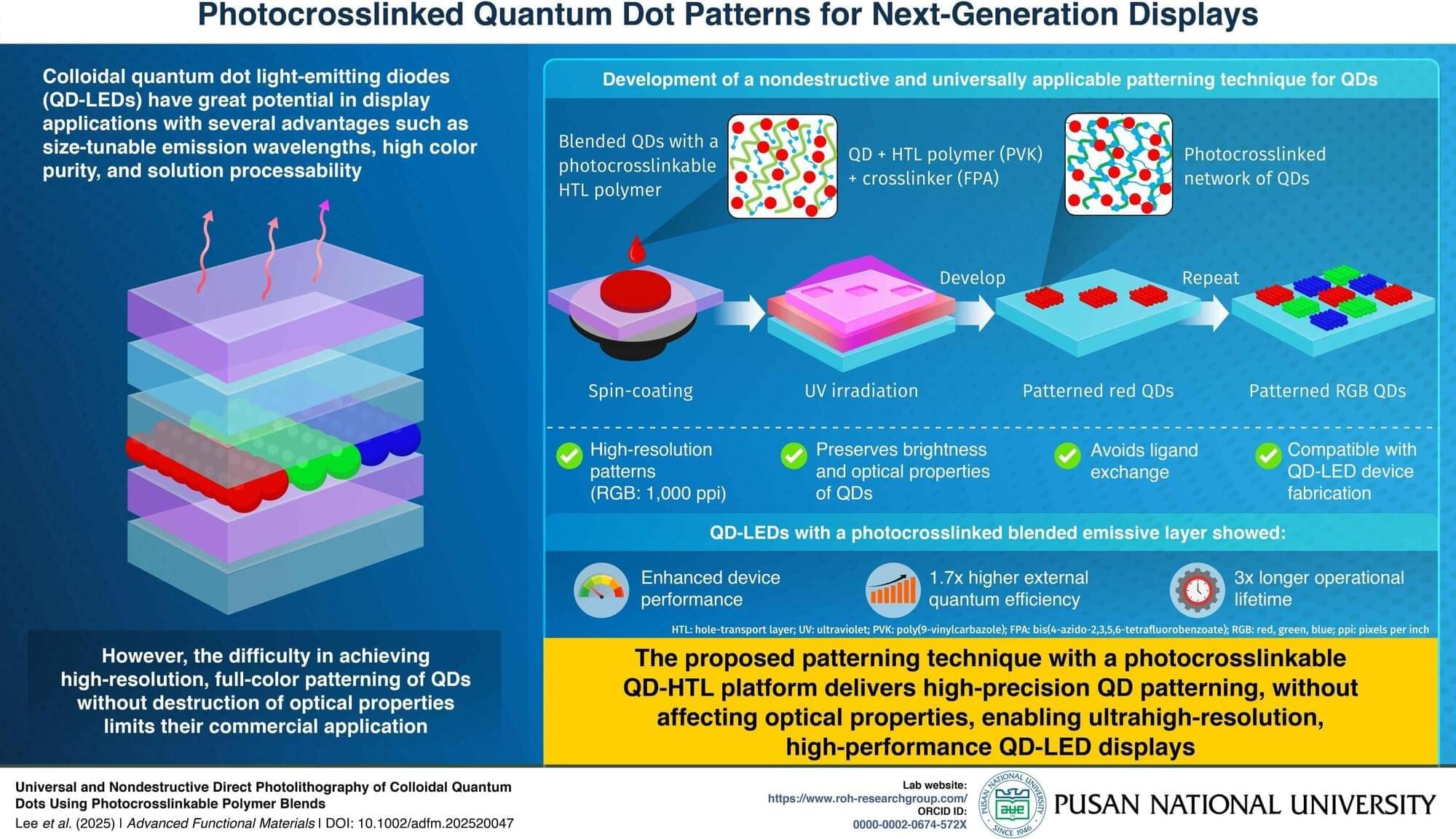
Over the past decade, colloidal quantum dots (QDs) have emerged as promising materials for next-generation displays due to their tunable emission, high brightness, and compatibility with low-cost solution processing. However, a major challenge is achieving ultrahigh-resolution patterning without damaging their fragile surface chemistry. Existing methods such as inkjet printing and photolithography-based processes either fall short in resolution or compromise QD performance.
To address this, a research team led by Associate Professor Jeongkyun Roh from the Department of Electrical Engineering, Pusan National University, Republic of Korea, has introduced a universal, photoresist-free, and nondestructive direct photolithography method for QD patterning. Instead of exposing QDs to harsh chemical modifications, the team engineered a photocrosslinkable blended emissive layer (b-EML).
This layer is formed by mixing QDs with a hole-transport polymer and a small fraction of an ultraviolet (UV)-activated crosslinker, enabling precise patterning while preserving QD integrity. The study was published in the journal of Advanced Functional Materials on 29 September 2025.