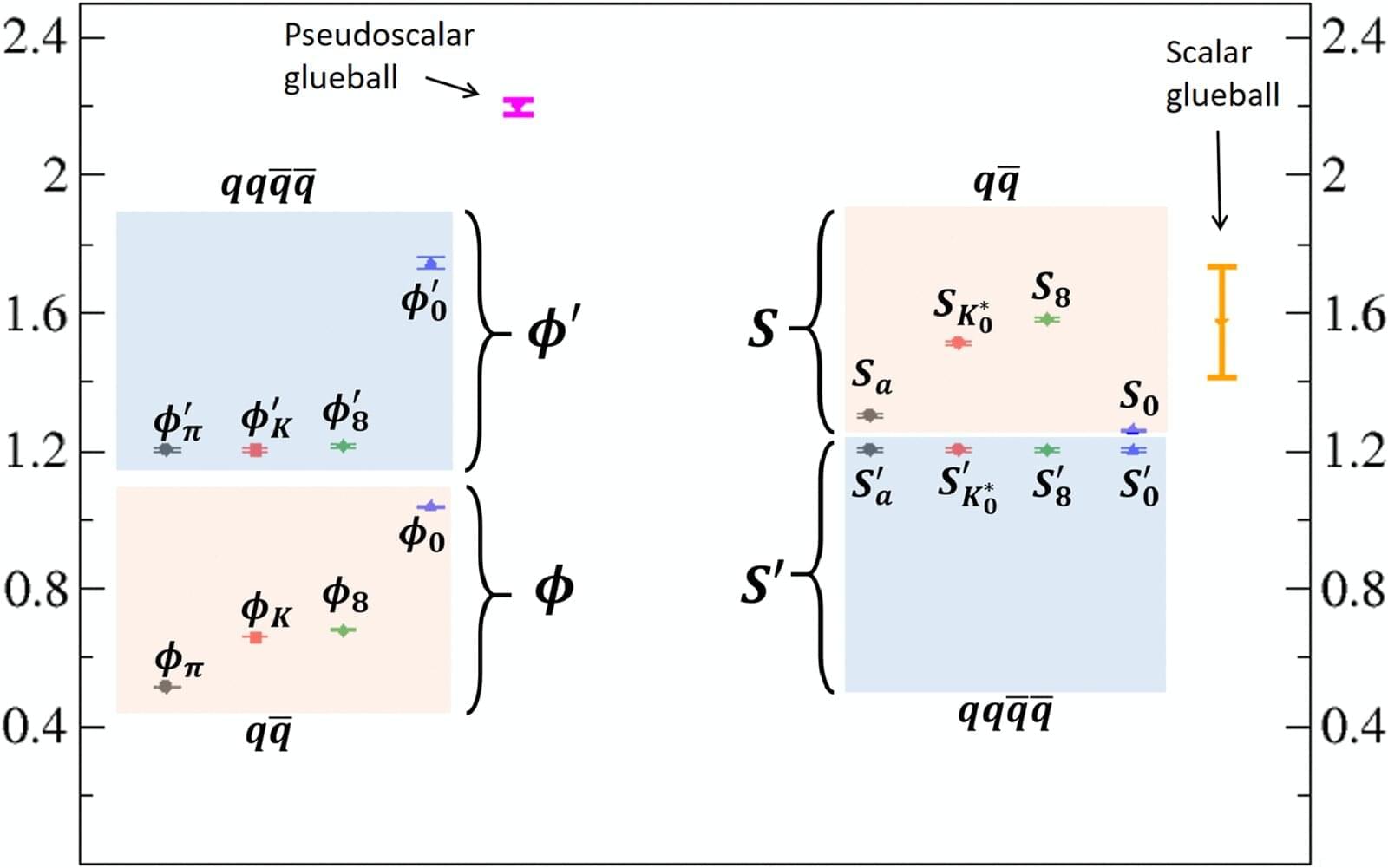
SUNY Poly Professor of Physics Dr. Amir Fariborz recently published a paper in Physical Review D titled “Spinless glueballs in generalized linear sigma model.” The work takes on a central challenge in modern physics: understanding how the strongest force in nature shapes the inner structure of matter, and how it may produce an unusual form of matter made entirely from the carriers of that force.
Here’s the quick background. Everything is made of atoms. Atoms have a nucleus made of protons and neutrons, and those are made of even smaller pieces called quarks. Quarks are held together by gluons, which carry the strong interaction described by quantum chromodynamics (QCD).
Composite subatomic particles—hadrons—are built from quarks and gluons. Hadrons fall into two main groups: mesons and baryons. QCD does a great job explaining what happens when particles collide at very high energies, but at lower energies it becomes much harder to calculate, so researchers use well-tested models that still follow QCD’s rules.