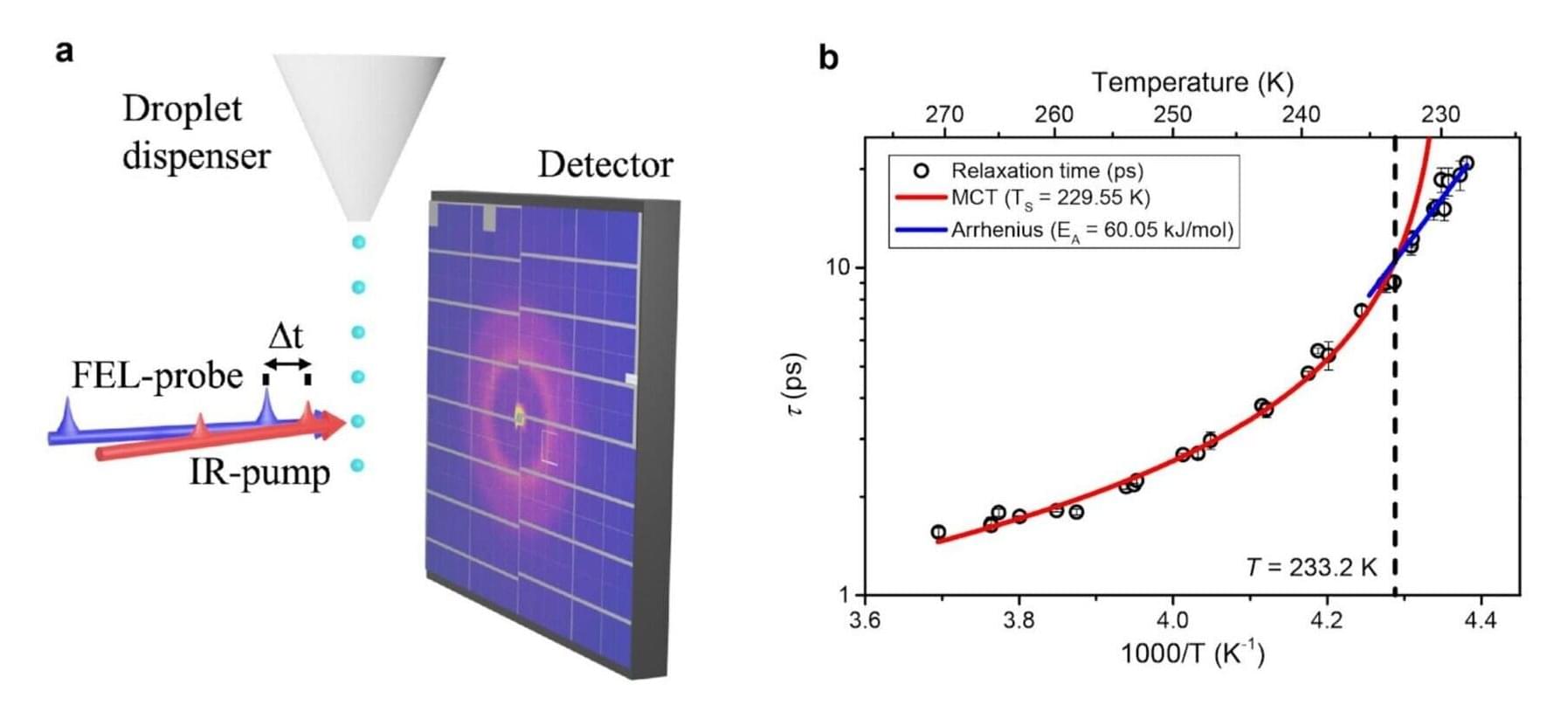
In a new study published in Nature Physics, researchers have achieved the first experimental observation of a fragile-to-strong transition in deeply supercooled water, resolving a scientific puzzle that has persisted for nearly three decades.
Water has anomalous properties when cooled below freezing without crystallization. Previous studies have tracked how water’s viscosity changes with temperature, predicting it would diverge to infinity around ~227 K (−46°C), meaning liquid water’s motion would essentially freeze.
However, this prediction conflicted with other known properties of water. As a result, scientists proposed that the viscosity trend must undergo a change at a specific low temperature—the so-called fragile-to-strong transition (FST).