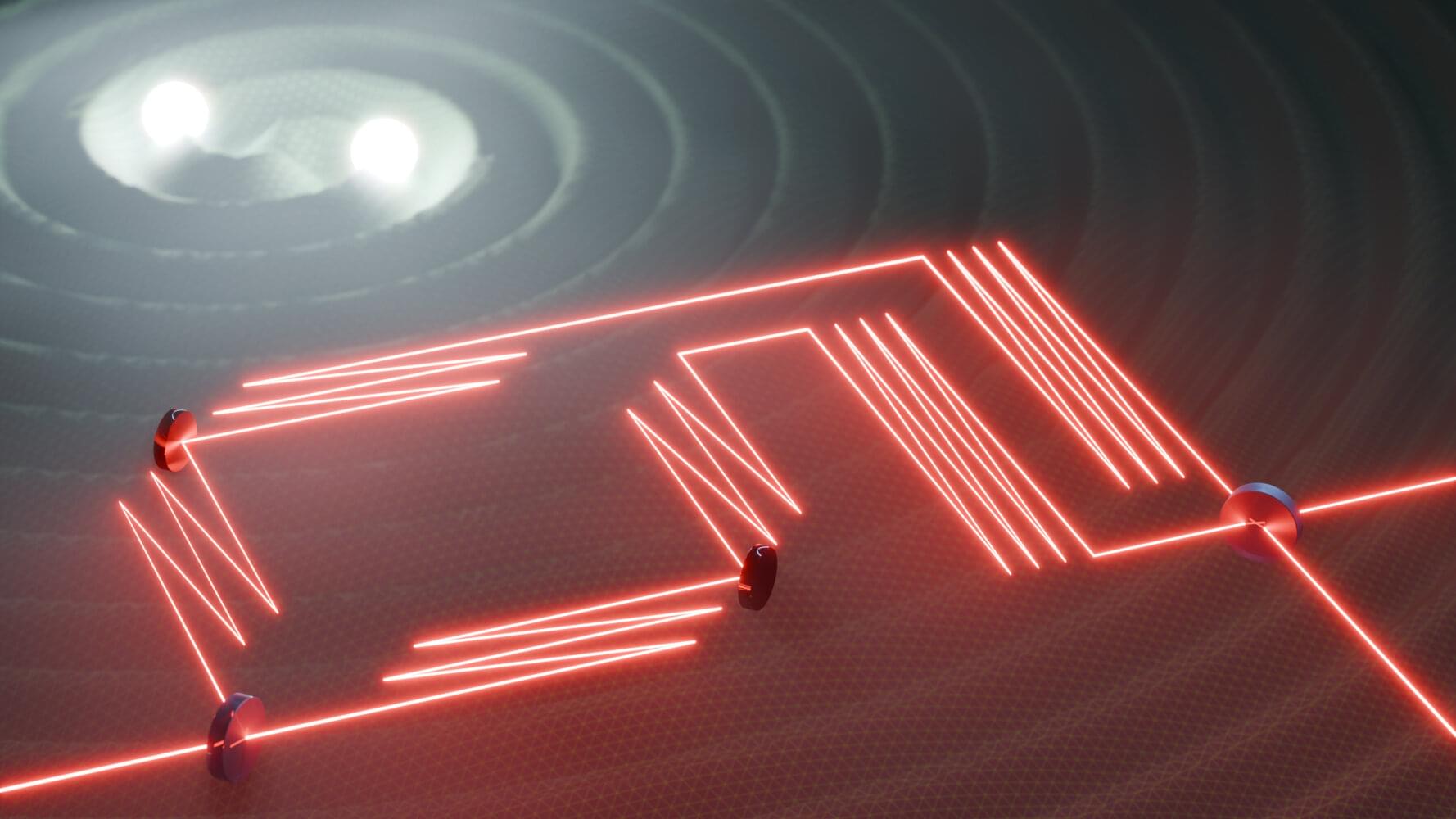
When two black holes merge or two neutron stars collide, gravitational waves can be generated. They spread at the speed of light and cause tiny distortions in space-time. Albert Einstein predicted their existence, and the first direct experimental observation dates from 2015.
Now, Prof. Ralf Schützhold, theoretical physicist at the Helmholtz-Zentrum Dresden-Rossendorf (HZDR), is going one step further. He has conceived an experiment through which gravitational waves can not only be observed but even manipulated. Published in the journal Physical Review Letters, the idea could also deliver new insights into the hitherto only conjectured quantum nature of gravity.
“Gravity affects everything, including light,” says Schützhold. And this interaction also occurs when gravitational waves and light waves meet.