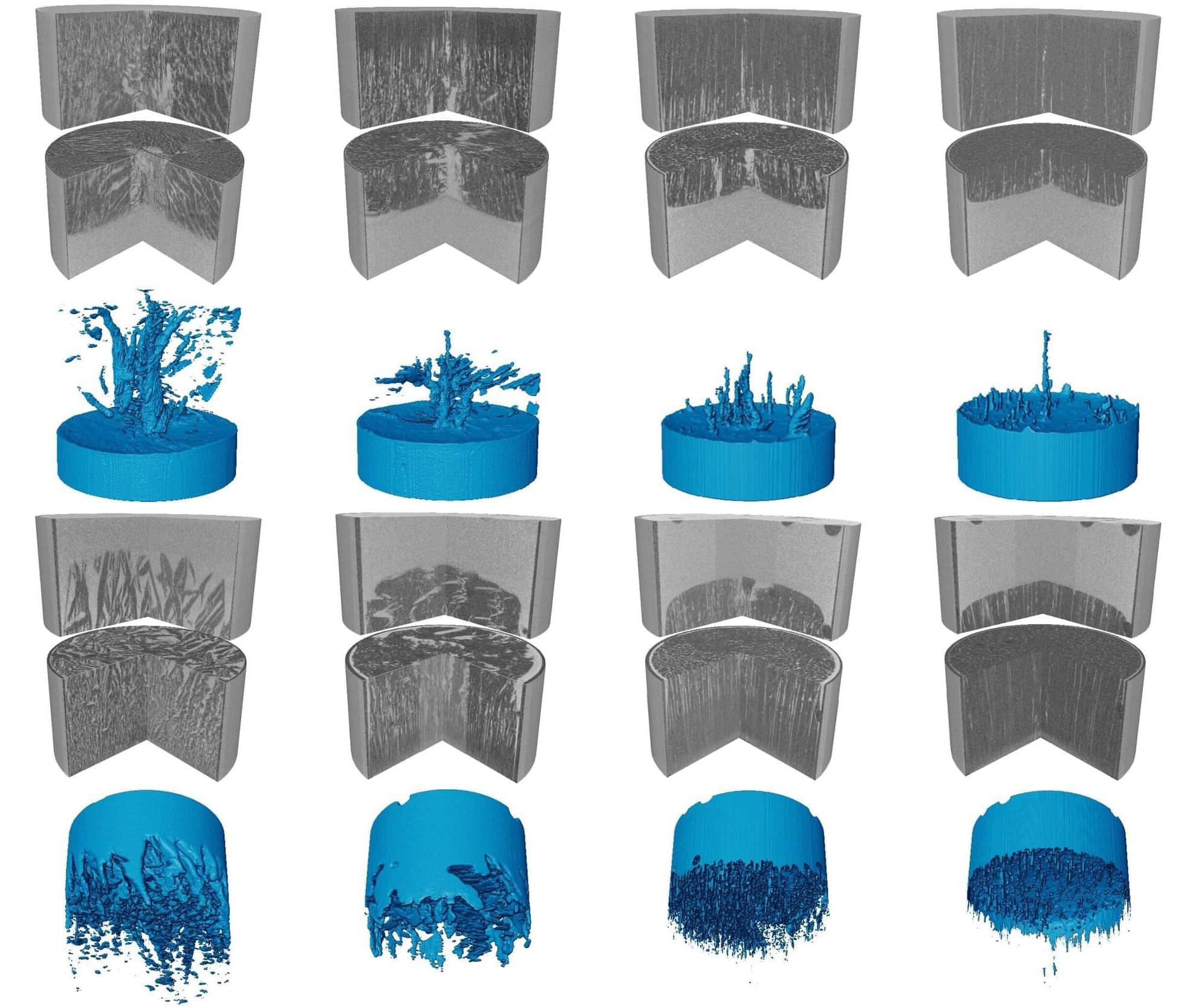
Imagine holding a narrow tube filled with salty water and watching it begin to freeze from one end. You might expect the ice to advance steadily and push the salt aside in a simple and predictable way. Yet the scene that unfolded was unexpectedly vivid.
Based on X-ray computed tomography (Micro-CT), our study, published in the Journal of Fluid Mechanics, realized the 4D (3D + time) dynamic observation and modeling of the whole process of ice crystal growth and salt exclusion.
When we monitored brine as it froze, the microstructure evolved far more dynamically than expected. Immediately after nucleation, ice crystals (dark areas) formed rapidly and trapped brine (bright areas) within a porous network. As freezing progressed, this network reorganized into striped patterns that moved either downward or upward depending on boundary conditions.