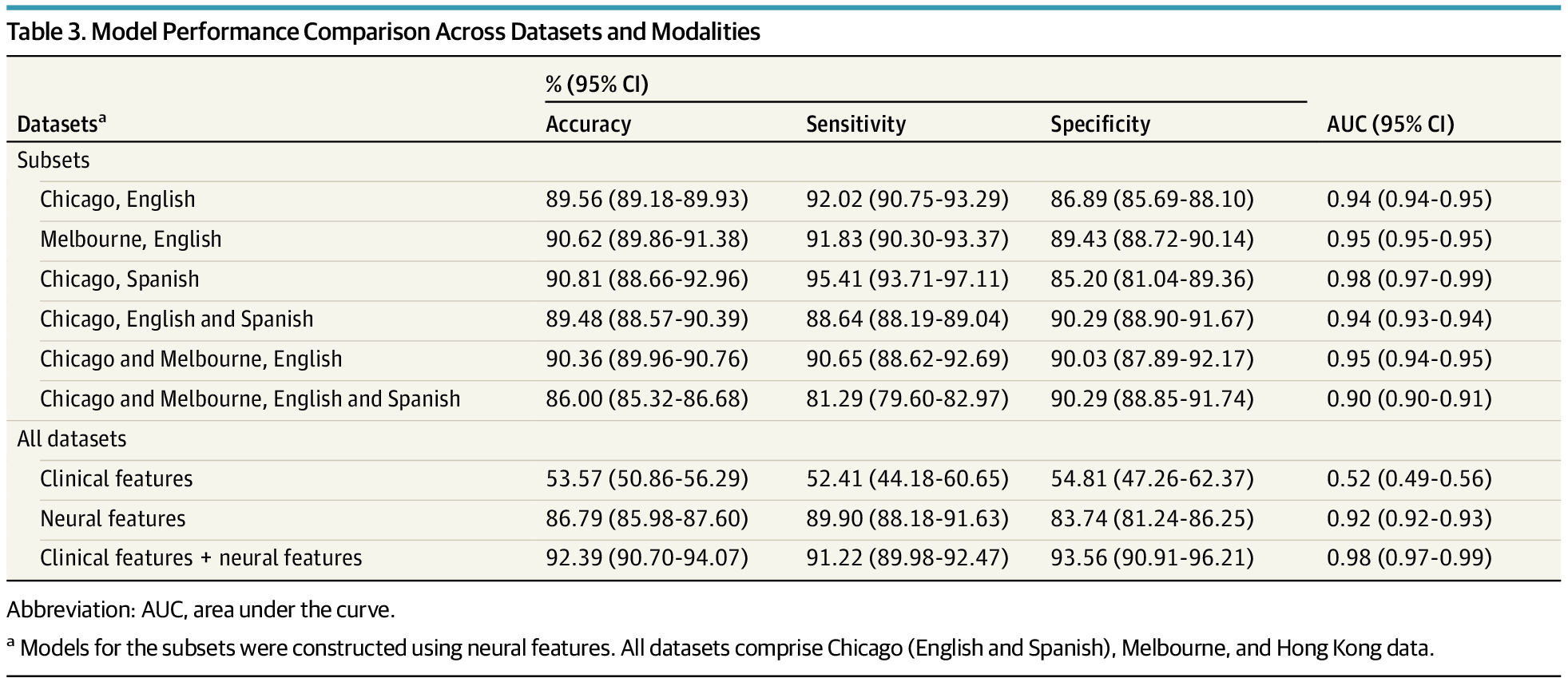
Deep transfer learning using presurgical brain MRI features predicted post–cochlear implant language improvement in children with 92% accuracy, outperforming traditional ML.
Importance Cochlear implants substantially improve spoken language in children with severe to profound sensorineural hearing loss, yet outcomes remain more variable than in children with healthy hearing. This variability cannot be reliably predicted for individual children using age at implant or residual hearing. Development of an artificial intelligence clinical tool to predict which patients will exhibit poorer improvements in language skills may enable an individualized approach to improve language outcomes.
Objective To compare the accuracy of traditional machine learning (ML) with deep transfer learning (DTL) algorithms to predict post–cochlear implant spoken language development in children with bilateral sensorineural hearing loss using a binary classification model of high vs low language improvers.
Design, Setting, and Participants This multicenter diagnostic study enrolled children from English-, Spanish-, and Cantonese-speaking families across 3 independent clinical centers in the US, Australia, and Hong Kong. A total of 278 children with cochlear implants were enrolled from July 2009 to March 2022 with 1 to 3 years of post–cochlear implant outcomes data. All children underwent pre–cochlear implant 3-dimensional volumetric brain magnetic resonance imaging (MRI). ML and DTL algorithms were trained to predict high vs low language improvers in children with cochlear implants using neuroanatomical features from presurgical brain MRI. Data were analyzed from August 2023 to April 2025.