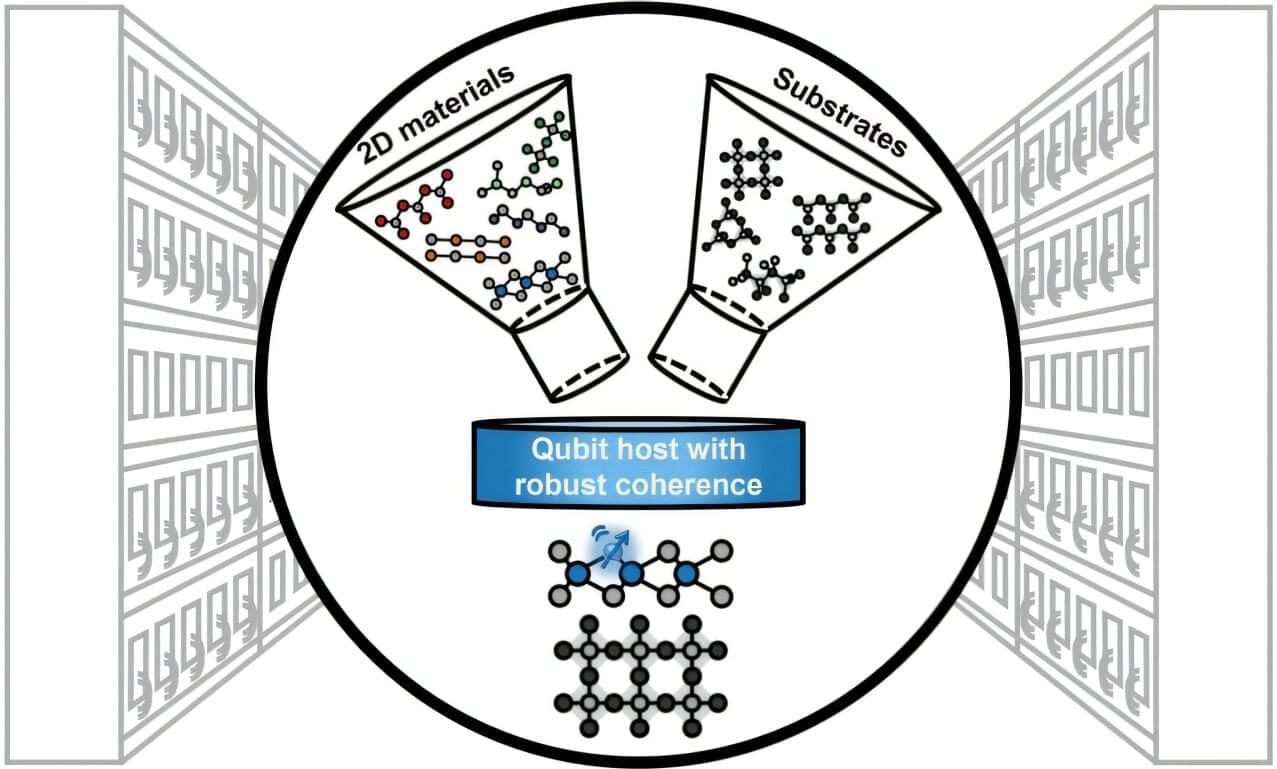
Quantum technologies from ultrasensitive sensors to next-generation information processors depend on the ability of quantum bits, or qubits, to maintain their delicate quantum states for a sufficiently long time to be useful.
One of the most important measures of this stability is the spin coherence time. Unfortunately, qubits may lose coherence because their environment is “noisy,” for example, due to the presence of nuclear isotopes or other interference that disturbs the qubit.
Two-dimensional (2D) materials—or atomically thin sheets—can offer quiet environments for qubits, as their reduced thickness naturally lowers the number of isotopes that interact with the qubit.