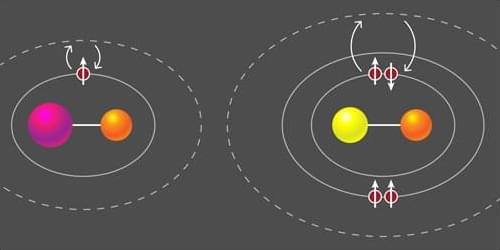
A class of molecules with two valence electrons has been laser cooled and trapped for the first time.
Over the past 70 years, physicists have developed laser-based methods for controlling atoms and molecules, but much of this success has been concentrated on a few columns of the periodic table. For molecules, laser cooling has been limited to diatomic species that have a single unpaired valence electron for interacting with light. Extending laser cooling to molecules with two valence electrons has long been sought after (Fig. 1). The most promising nonreactive candidates are diatomic molecules that partner a halogen, such as fluorine (F) or chlorine (Cl), with a p-block atom, such as aluminum (Al) or thallium (Tl). Several research groups have specifically targeted AlF, AlCl, and TlF, but these molecules are difficult to work with because of their deep-ultraviolet transitions, complicated energy-level structures, and small magnetic moments.