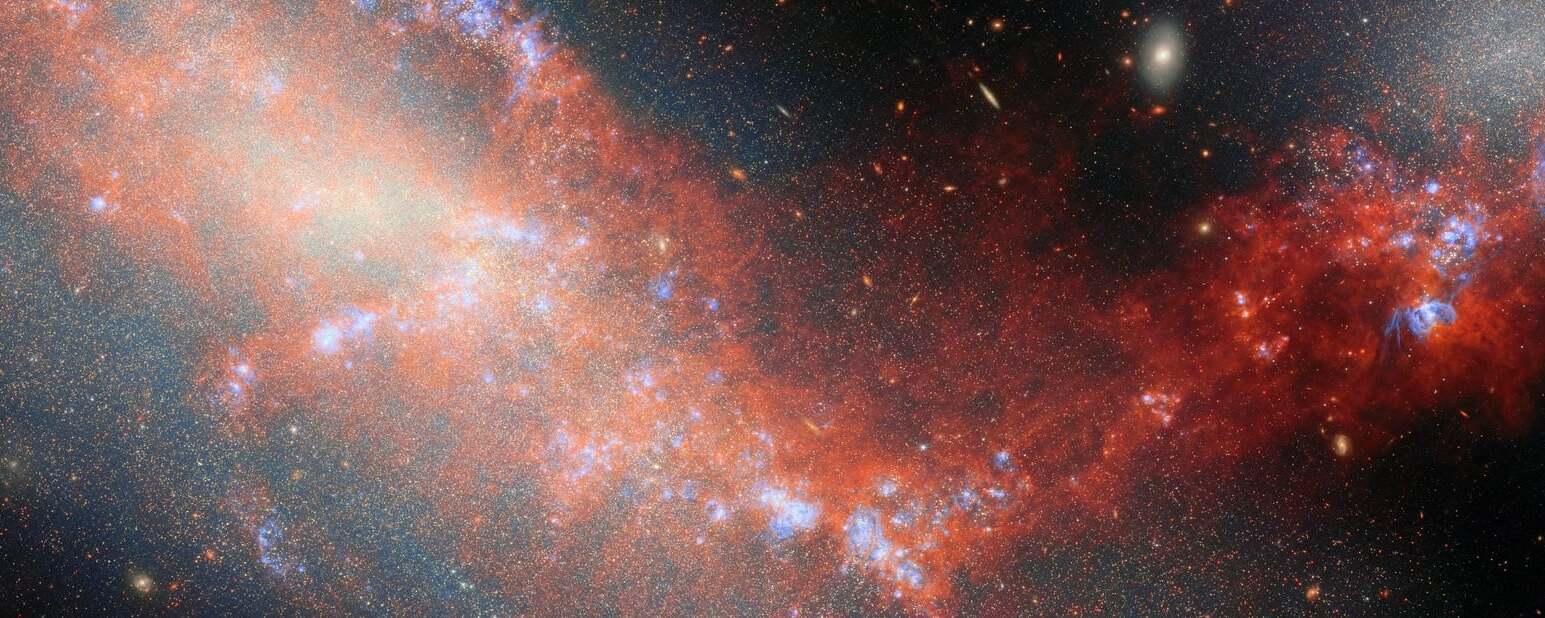
An international team led by the University of Oxford has identified one of the largest rotating structures ever reported: a ‘razor-thin’ string of galaxies embedded in a giant spinning cosmic filament, 140 million light-years away. The findings, published today in Monthly Notices of the Royal Astronomical Society, could offer valuable new insights into how galaxies formed in the early Universe.
Cosmic filaments are the largest known structures in the Universe: vast, thread-like formations of galaxies and dark matter that form a cosmic scaffolding. They also act as ‘highways’ along which matter and momentum flow into galaxies. Nearby filaments containing many galaxies spinning in the same direction-and where the whole structure appears to be rotating – are ideal systems to explore how galaxies gained the spin and gas they have today. They can also provide a way to test theories about how cosmic rotation builds up over tens of millions of light-years.
What makes this structure exceptional is not just its size, but the combination of spin alignment and rotational motion. You can liken it to the teacups ride at a theme park. Each galaxy is like a spinning teacup, but the whole platform-the cosmic filament-is rotating too.