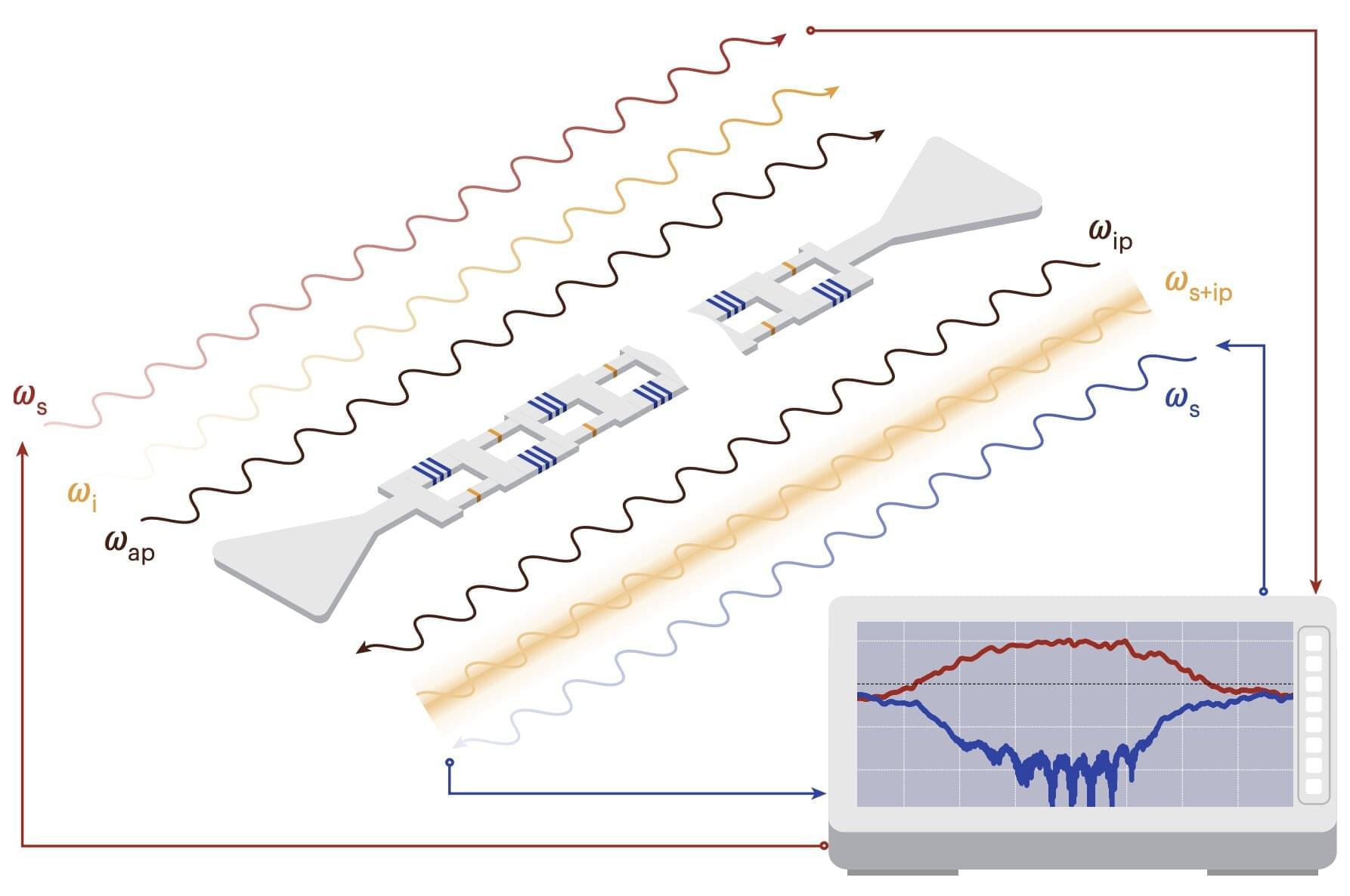
Traveling-wave parametric amplifiers (TWPAs) are electronic devices that boost weak microwave signals (i.e., electromagnetic waves with frequencies typically ranging between 1 and 100 GHz). Recently, many engineers have been developing TWPAs based on superconductors, materials that conduct electricity with a resistance of zero at low temperatures.
Superconductor-based TWPAs can process signals with high efficiency, typically adding little noise to amplified signals. However, conventional amplifier designs lack directionality, which essentially means that electromagnetic energy can propagate backward towards the input, adversely impacting their performance.
Researchers at University Grenoble Alpes, CNRS, Silent Waves and Karlsruhe Institute of Technology recently developed a new TWPA based on nanoscale superconducting components known as Josephson junctions. This device, introduced in a paper published in Nature Electronics, can shift backward-traveling waves to higher frequencies, preventing the backward propagation that typically degrades the performance of TWPAs.