Now they’re learning how these “markers of resilience” could help you live long too.

In Stroke due to medium or distal vessel occlusion, endovascular treatment plus best medical treatment preserved more brain tissue and was linked to improved imaging outcomes and better clinical recovery compared with medical treatment alone.
Interventions EVT plus BMT compared with BMT alone.
Main Outcomes and Measures Primary outcome was calculated as the difference in volume of tissue at risk and the final infarct volume divided by the tissue at risk (change in Vrel). We defined a Vrel of 0.8 or greater as a good imaging outcome, meaning that at least 80% of the brain tissue initially at risk was not infarcted at 24 hours. Additionally, the association between brain tissue preserved and clinical outcome at 90 days was investigated.
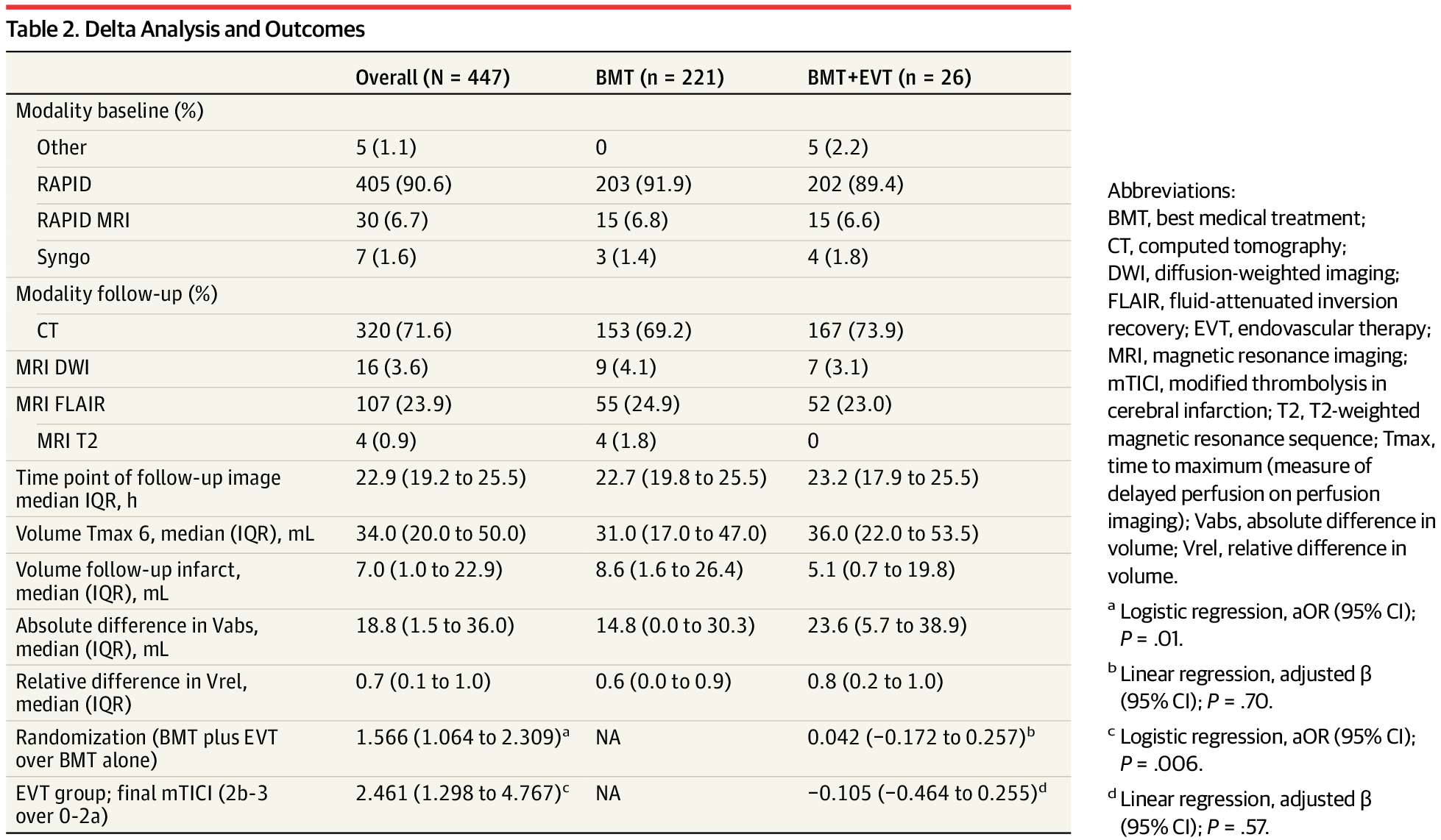
Results From the 447 patients (252 [56.4%] male; median [IQR] age, 77.0 [68.0–84.0] years) included in this secondary analysis, 226 received EVT plus BMT and 221 received BMT alone. Median (IQR) time of the follow-up imaging was 22.9 (19.2−25.5) hours. Median (IQR) Time to maximum less than 6 seconds (Tmax6) volume was 34.0 (20.0−50.0) mL. Median follow-up infarct volume was 7.0 (1.0−22.9) mL. The median (IQR) change in absolute volume in the EVT plus BMT group was 23.6 (5.7−38.9) mL and 14.8 (0−30.3) mL in the BMT group. Median (IQR) change in Vrel was 0.8 (0.2−1.0) in the EVT plus BMT group and 0.6 (0−0.9) in the BMT group. Odds for reaching a change in Vrel of 0.8 or greater were higher in the EVT plus BMT group compared with BMT (adjusted odds ratio [aOR], 1.6; 95% CI, 1.1−2.3) and with successful reperfusion compared with no successful reperfusion (aOR, 2.5; 95% CI, 1.3−4.8). Patients with a change in Vrel of 0.8 or greater had a better clinical outcome at 90 days.

A popular Korean skincare ingredient may be far more powerful than anyone realized. Scientists have discovered that madecassic acid—derived from the herb Centella asiatica—can stop antibiotic-resistant bacteria in their tracks, including dangerous strains of E. coli. By targeting a bacterial protein that humans don’t have, the compound disrupts the microbes’ ability to survive, making it a promising new type of antibiotic.
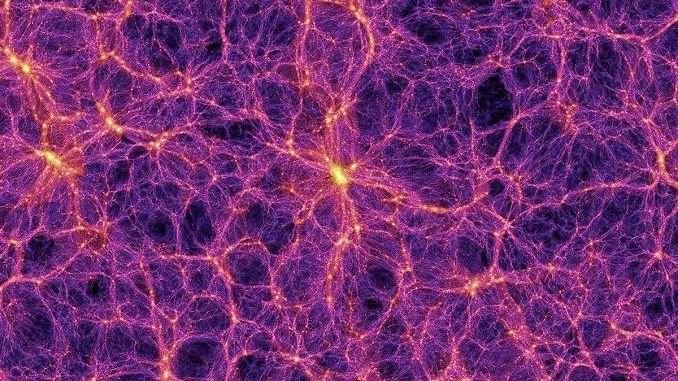
There’s something quietly unsettling about placing a photograph of a human neuron next to a simulated image of the large-scale cosmic web. The two look almost identical: delicate, branching filaments connecting dense clusters, with vast open spaces in between. One fits inside your skull. The other stretches across billions of light-years. The resemblance is hard to dismiss, and for a growing number of researchers, it’s far more than a visual coincidence.
What started as a striking observation in cosmology and neuroscience has evolved into a serious theoretical question. Could the universe, at its most fundamental level, operate the way a brain does? The ideas being put forward aren’t purely philosophical. Some of them come with testable mathematics, published peer-reviewed papers, and the names of well-regarded physicists attached. What follows is an honest look at where the science currently stands.
The estimated 200 billion detectable galaxies aren’t distributed randomly, but are lumped together by gravity into clusters that form even larger clusters, which are connected to one another by “galactic filaments,” long thin threads of galaxies. This vast architecture is what scientists call the cosmic web. When you zoom far enough out, the structure of the entire observable universe begins to take on a shape that looks startlingly familiar.
Einstein’s picture of spacetime, a four-dimensional fabric uniting space and time, breaks down at the smallest scales, where quantum mechanics takes over. For decades, physicists have searched for an account of how spacetime “emerges” from this deeper quantum reality. But philosopher Sam Baron argues that the whole idea of spacetime “emerging” from something else makes no sense. All our accounts of how things “emerge” from something more fundamental presuppose spacetime, so the idea that spacetime itself emerges is circular. His radical conclusion is that we must abandon the project of reconciling spacetime and quantum mechanics, and accept that spacetime, at least as Einstein described it, does not exist.
What if perfection came at the cost of individuality? The Borg Cube isn’t just a ship — it’s one of the most terrifying feats of engineering ever imagined. A massive, city-sized structure drifting through space with no visible weapons, no clear command center… and yet, it conquers entire civilizations with terrifying efficiency.
In this deep dive, we break down the impossible engineering behind the Borg Cube — from its decentralized architecture and self-repairing systems to its adaptive shielding and near-infinite scalability. How can a cube survive in the harsh vacuum of space? Why abandon traditional ship design? And what makes it almost unstoppable in battle?
We’ll explore the science, the theory, and the terrifying plausibility behind one of sci-fi’s most iconic creations. Because the real question isn’t how the Borg Cube works… it’s whether something like it could ever exist.
Resistance… might not be as futile as you think.
🔥 If you enjoy deep, dark explorations of futuristic technology and sci-fi realism, hit LIKE and SUBSCRIBE for more.
💬 Comment below: Could humanity ever build something like the Borg Cube?

Japanese entertainment company Toei has established Toei Games, an in-house publishing label.
The company aims to make its games business a new pillar alongside its film, television, and events divisions.
Toei Games will initially release titles on Steam, entering the PC market. The company plans to expand soon to home consoles such as the Nintendo Switch, PlayStation, and Xbox.