Toggle light / dark theme

Get the latest international news and world events from around the world.

Log in for authorized contributors

How Bose-Einstein condensates replicate Shapiro steps

The microscopic processes taking place in superconductors are difficult to observe directly. Researchers at the RPTU University of Kaiserslautern-Landau have therefore implemented a quantum simulation of the Josephson effect: They separated two Bose-Einstein condensates (BECs) by means of an extremely thin optical barrier.

The characteristic Shapiro steps were observed in the atomic system. The research was published in the journal Science.

Two superconductors separated by a wafer-thin insulating layer—that’s how simple a Josephson junction looks. But despite its simple structure, it harbors a quantum mechanical effect that is now one of the most important tools of modern technology: Josephson contacts form the heart of many quantum computers and enable high-precision measurements—such as the measurement of very weak magnetic fields.
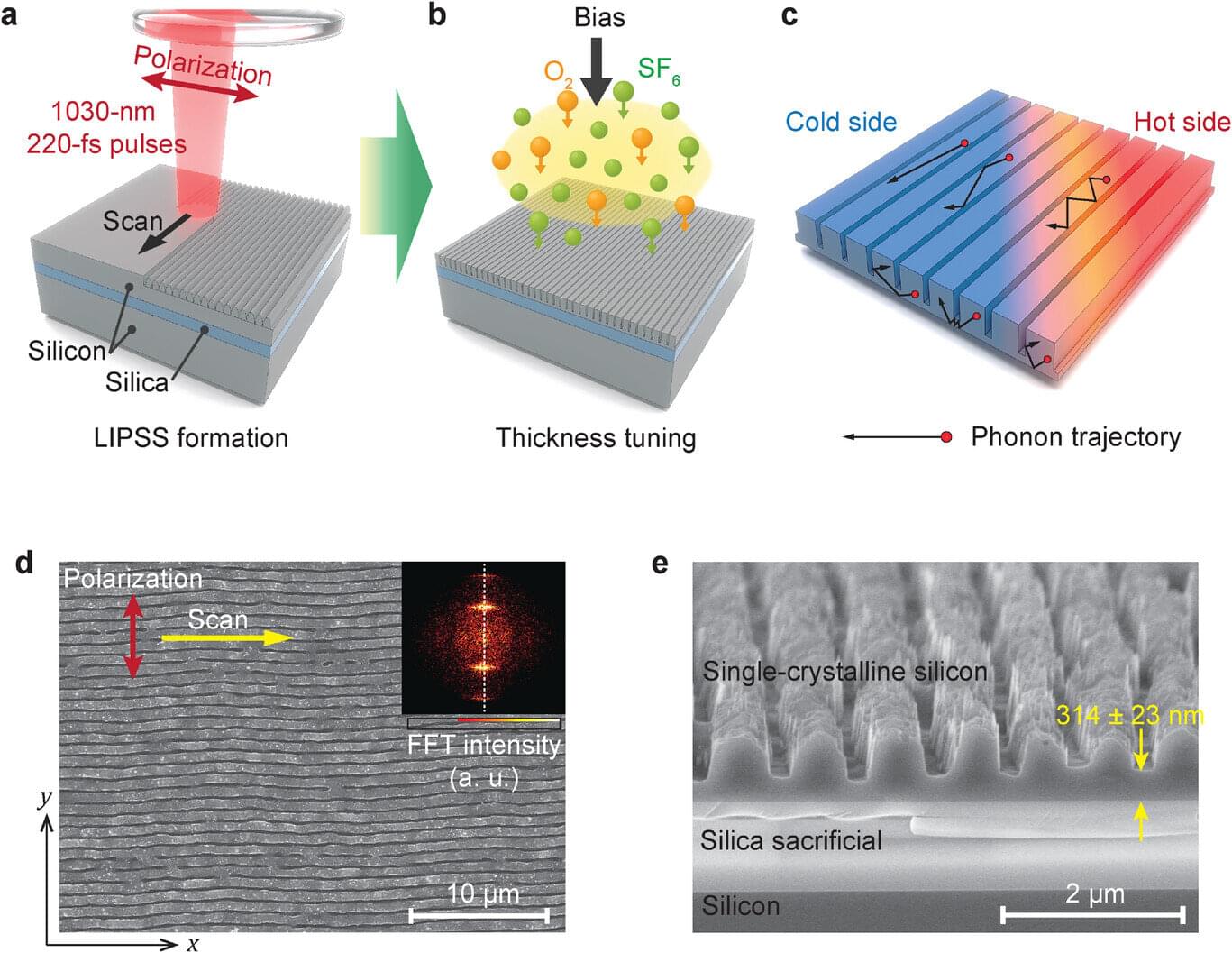
Femtosecond lasers push the limits of nanostructures for thermal engineering

Femtosecond laser-induced periodic surface structures can be used to control thermal conductivity in thin film solids, report researchers from Japan. Their innovative method, which leverages high-speed laser ablation, produces parallel nanoscale grooves with unprecedented throughput that is 1,000 times stronger than conventional approaches, strategically altering phonon scattering in the material.

This scalable and semiconductor-ready approach could make it possible to mass-produce thermal engineering structures while maintaining laboratory-level precision.

Lab-grown neural circuits reveal thalamus’s key role in cortex development

A Japanese research team has successfully reproduced the human neural circuit in vitro using multi-region miniature organs known as assembloids, which are derived from induced pluripotent stem (iPS) cells. With this circuit, the team demonstrated that the thalamus plays a crucial role in shaping cell type-specific neural circuits in the human cerebral cortex.

These findings were published in the journal Proceedings of the National Academy of Sciences.

Our brain’s cerebral cortex contains various types of neurons, and effective communication among these neurons and other brain regions is crucial for activating functions like perception and cognition.

Pinpointing the glow of a single atom to advance quantum emitter engineering

Researchers have discovered how to design and place single-photon sources at the atomic scale inside ultrathin 2D materials, lighting the path for future quantum innovations.

Like perfectly controlled light switches, quantum emitters can turn on the flow of single particles of light, called photons, one at a time. These tiny switches—the “bits” of many quantum technologies—are created by atomic-scale defects in materials.

Their ability to produce light with such precision makes them essential for the future of quantum technologies, including quantum computing, secure communication and ultraprecise sensing. But finding and controlling these atomic light switches has been a major scientific challenge—until now.

Breakthrough Shows How Cells Detect Stress Before Damage Spreads

Researchers at LMU have uncovered how ribosomes, the cell’s protein builders, also act as early warning sensors when something goes wrong inside a cell.

When protein production is disrupted, and ribosomes begin to collide, a molecule called ZAK detects the pileup and switches on protective stress responses.

Ribosomes as protein builders and stress sensors.

/* */