Toggle light / dark theme

Get the latest international news and world events from around the world.

Log in for authorized contributors

Windows 10 OOB update released to fix Message Queuing (MSMQ) issues

This month’s extended security update for Windows 10 broke Message Queuing (MSMQ), which is typically used by enterprises to manage background tasks.

Microsoft says it identified a fix and is now rolling out an out-of-band update (KB5074976) via Update Catalog to address it.

You won’t find the OOB on Windows Update or WSUS, as it’s only offered via Update Catalog, but if you are affected, you should download the out-of-band release.

Clop ransomware targets Gladinet CentreStack in data theft attacks

The Clop ransomware gang (also known as Cl0p) is targeting Internet-exposed Gladinet CentreStack file servers in a new data theft extortion campaign.

Gladinet CentreStack enables businesses to securely share files hosted on on-premises file servers through web browsers, mobile apps, and mapped drives without requiring a VPN. According to Gladinet, CentreStack “is used by thousands of businesses from over 49 countries.”

Since April, Gladinet has released security updates to address several other security flaws that were exploited in attacks, some of them as zero-days.

New password spraying attacks target Cisco, PAN VPN gateways

An automated campaign is targeting multiple VPN platforms, with credential-based attacks being observed on Palo Alto Networks GlobalProtect and Cisco SSL VPN.

On December 11, threat monitoring platform GreyNoise observed the number of login attempts aimed at GlobalProtect portals peaked at 1.7 million during a period of 16 hours.

Collected data showed that the attacks originated from more than 10,000 unique IP addresses and were aimed at infrastructure located in the United States, Mexico, and Pakistan.

France arrests Latvian for installing malware on Italian ferry

French authorities arrested two crew members of an Italian passenger ferry suspected of infecting the ship with malware that could have enabled them to remotely control the vessel.

As the Paris prosecutor’s office announced this week, a Bulgarian national has been released without any charge, while a Latvian suspect who recently joined the crew of the Fantastic ferry (owned by Italian shipping company Grandi Navi Veloci) remains detained and was transferred to Paris on Sunday.

The Latvian crew member now faces charges of conspiring to infiltrate computer systems on behalf of a foreign power after a remote access tool was discovered aboard the ferry, as Le Parisien first reported.

Hidden cellular layers in the brain’s memory center

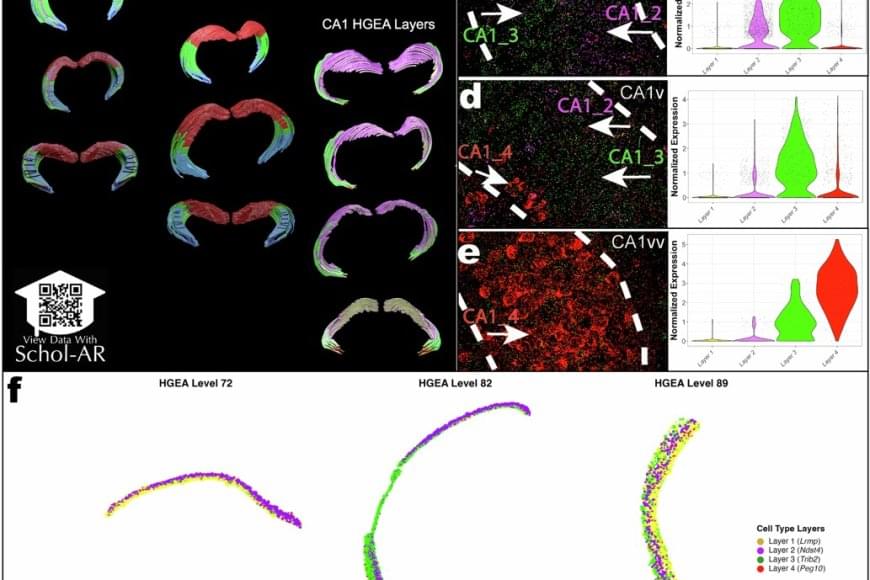
Using a powerful RNA labeling method called RNAscope with high-resolution microscopy imaging, the team captured clear snapshots of single-molecule gene expression to identify CA1 cell types inside mouse brain tissue. Within 58.065 CA1 pyramidal cells, they visualized more than 330,000 RNA molecules—the genetic messages that show when and where genes are turned on. By tracing these activity patterns, the researchers created a detailed map showing the borders between different types of nerve cells across the CA1 region of the hippocampus.

The results showed that the CA1 region consists of four continuous layers of nerve cells, each marked by a distinct set of active genes. In 3D, these layers form sheets that vary slightly in thickness and structure along the length of the hippocampus. This clear, layered pattern helps make sense of earlier studies that saw the region as a more gradual mix or mosaic of cell types.

“When we visualized gene RNA patterns at single-cell resolution, we could see clear stripes, like geological layers in rock, each representing a distinct neuron type,” said a co–first author of the paper. “It’s like lifting a veil on the brain’s internal architecture. These hidden layers may explain differences in how hippocampal circuits support learning and memory.”

The hippocampus is among the first regions affected in Alzheimer’s disease and is also implicated in epilepsy, depression, and other neurological conditions. By revealing the CA1’s layered structure, the study provides a roadmap to investigate which specific neuron types are most vulnerable in these disorders.

The new CA1 cell-type atlas, built using data from the Hippocampus Gene Expression Atlas (HGEA), is freely available to the global research community. The dataset includes interactive 3D visualizations accessible through the Schol-AR augmented-reality app, which allows scientists to explore hippocampal layers in unprecedented detail.


Researchers have identified a previously unknown pattern of organization in one of the brain’s most important areas for learning and memory. The study, published in Nature Communications, reveals that the CA1 region of a mouse’s hippocampus, a structure vital for memory formation, spatial navigation, and emotions, has four distinct layers of specialized cell types. This discovery changes our understanding of how information is processed in the brain and could explain why certain cells are more vulnerable in diseases like Alzheimer’s and epilepsy.

Anil Seth — What is Consciousness: Data or Information?

Sign up for a free Closer To Truth membership to receive exclusives like early access to new episodes: https://closertotruth.com/register/

To study consciousness comprehensively and rigorously, what kinds of data or information are relevant? Data/information for Materialism theories, which are subject to the scientific method, can be well defined. But what about non-Materialism theories?

This holiday, make a tax-deductible donation of any amount to help Closer To Truth continue making content like this: https://shorturl.at/OnyRq.

Anil Seth is Professor of Cognitive and Computational Neuroscience at the University of Sussex, where he is also Director of the Sussex Centre for Consciousness Science. Seth is also Co-Director of the Canadian Institute for Advanced Research (CIFAR) Program on Brain, Mind, and Consciousness. Seth’s mission is to advance the science of consciousness, and to use its insights for the benefit of society, technology, and medicine.

Closer To Truth, hosted by Robert Lawrence Kuhn and directed by Peter Getzels, presents the world’s greatest thinkers exploring humanity’s deepest questions. Discover fundamental issues of existence. Engage new and diverse ways of thinking. Appreciate intense debates. Share your own opinions. Seek your own answers.

/* */