Toggle light / dark theme

Get the latest international news and world events from around the world.

Log in for authorized contributors

Novel ‘XFELO’ laser system produces razor-sharp X-ray light

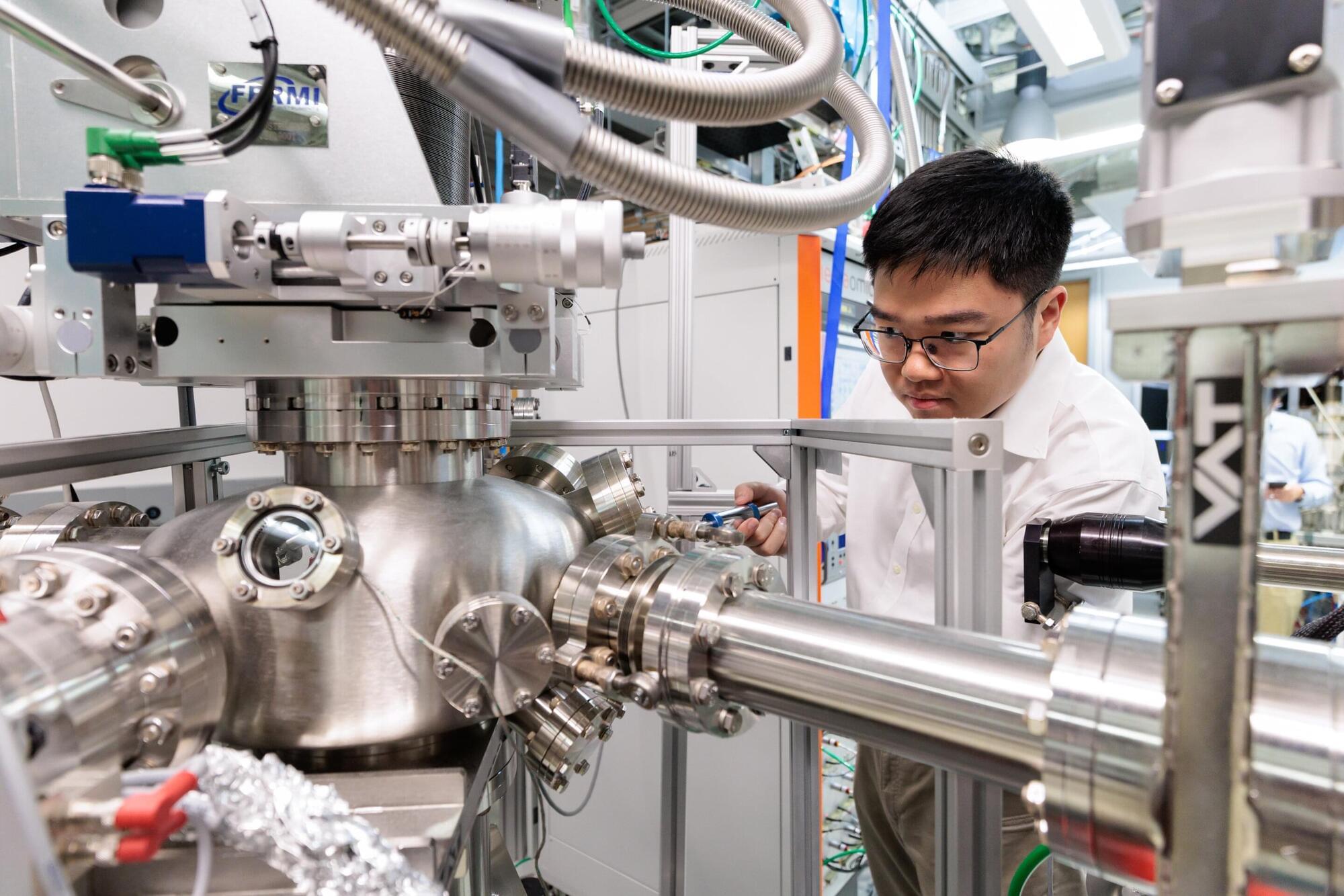
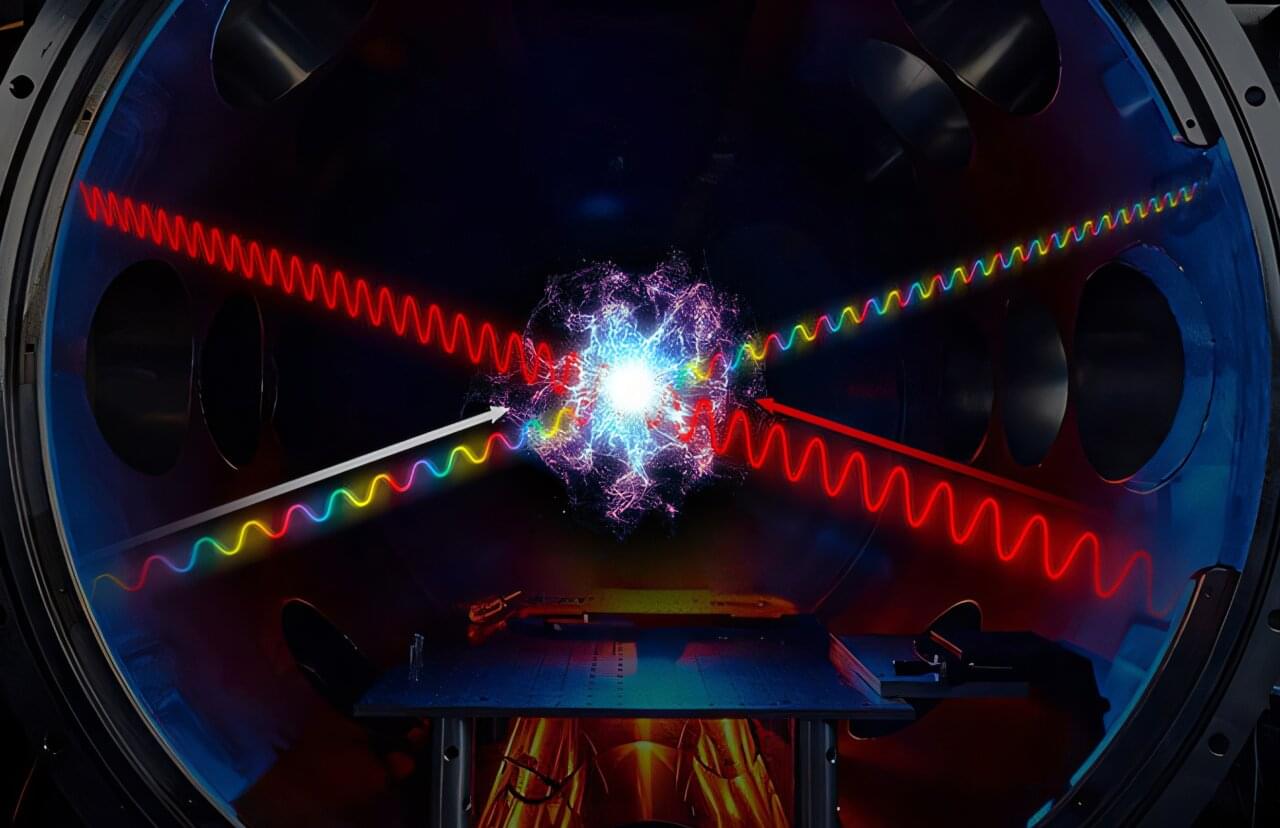
A team of engineers and scientists has shown for the first time that a hard-X-ray cavity can provide net X-ray gain, with X-ray pulses being circulated between crystal mirrors and amplified in the process, much like happens with an optical laser. The result of the proof-of-concept at European XFEL is a particularly coherent, laser-like light of a quality that is unprecedented in the hard X-ray spectrum.

Lasing inside a cavity had been challenging to achieve with short-wavelength X-rays for a variety of reasons, including—on a basic level—that the nature of the light makes it difficult to reflect the beam at large angles. The “XFELO” (short for: X-Ray Free-Electron Laser Oscillator) technique opens new perspectives for scientific investigations, from ultrafast chemical reactions to detailed analyses of the smallest biological structures. The research is published in the journal Nature.

Chip-sized optical amplifier can intensify light 100-fold with minimal energy

Light does a lot of work in the modern world, enabling all types of information technology, from TVs to satellites to fiber-optic cables that carry the internet across oceans. Stanford physicists recently found a way to make that light work even harder with an optical amplifier that requires low amounts of energy without any loss of bandwidth, all on a device the size of a fingertip.

Similar to sound amplifiers, optical amplifiers take a light signal and intensify it. Current small-sized optical amplifiers need a lot of power to function. The new optical amplifier, detailed in the journal Nature, solves this problem by using a method that essentially recycles the energy used to power it.

“We’ve demonstrated, for the first time, a truly versatile, low-power optical amplifier, one that can operate across the optical spectrum and is efficient enough that it can be integrated on a chip,” said Amir Safavi-Naeini, the study’s senior author and associate professor of physics in Stanford’s School of Humanities and Sciences. “That means we can now build much more complex optical systems than were possible before.”

New light-based platform sets the stage for future quantum supercomputers

A light has emerged at the end of the tunnel in the long pursuit of developing quantum computers, which are expected to radically reduce the time needed to perform some complex calculations from thousands of years down to a matter of hours.

A team led by Stanford physicists has developed a new type of “optical cavity” that can efficiently collect single photons, the fundamental particle of light, from single atoms. These atoms act as the building blocks of a quantum computer by storing “qubits”—the quantum version of a normal computer’s bits of zeros and ones. This work enables that process for all qubits simultaneously, for the first time.

In a study published in Nature, the researchers describe an array of 40 cavities containing 40 individual atom qubits as well as a prototype with more than 500 cavities. The findings indicate a way to ultimately create a million-qubit quantum computer network.

New ABF crystal delivers high-performance vacuum ultraviolet nonlinear optical conversion

Vacuum ultraviolet (VUV, 100–200 nm) light sources are indispensable for advanced spectroscopy, quantum research, and semiconductor lithography. Although second harmonic generation (SHG) using nonlinear optical (NLO) crystals is one of the simplest and most efficient methods for generating VUV light, the scarcity of suitable NLO crystals has long been a bottleneck.

To address this problem, a research team led by Prof. Pan Shilie at the Xinjiang Technical Institute of Physics and Chemistry of the Chinese Academy of Sciences (CAS) has developed the fluorooxoborate crystal NH4B4O6F (ABF)—offering an effective solution to the practical challenges of VUV NLO materials. The team’s findings were recently published in Nature.

The team’s key achievement is the development of centimeter-scale, high-quality ABF crystal growth and advanced anisotropic crystal processing technologies. Notably, ABF uniquely integrates a set of conflicting yet critical properties required for VUV NLO materials—excellent VUV transparency, a strong NLO coefficient, and substantial birefringence for VUV phase-matching—while fulfilling stringent practical criteria: large crystal size for fabricating devices with specific phase-matching angles, stable physical/chemical properties, a high laser-induced damage threshold, and suitable processability. This breakthrough resolves the long-standing field challenge where no prior crystal has met all these criteria simultaneously.

Laser beam flips a ferromagnet’s polarity without heating the material

Researchers at the University of Basel and the ETH in Zurich have succeeded in changing the polarity of a special ferromagnet using a laser beam. In the future, this method could be used to create adaptable electronic circuits with light.

In a ferromagnet, combined forces are at work. In order for a compass needle to point north or a fridge magnet to stick to the fridge door, countless electrons spin inside them, each of which only creates a tiny magnetic field, all need to line up in the same direction. This happens through interactions between the spins, which have to be stronger than the disordered thermal motion inside the ferromagnet. If the temperature of the material is below a critical value, it becomes ferromagnetic.

Conversely, to change the polarity of a ferromagnet, one usually needs to first heat it up above its critical temperature. The electron spins can then reorient themselves, and after cooling down, the magnetic field of the ferromagnet eventually points in a different direction.

Establishing design principles for achieving ultralow thermal conductivity via controlled chemical disorder

A major challenge in thermal-management and thermal-insulation technologies, across multiple industries, is the lack of materials that simultaneously offer low thermal conductivity, mechanical robustness, and scalable fabrication routes.

Discovering materials that exhibit completely insulating thermal behavior—or, conversely, extraordinarily high thermal conductivity—has long been a dream for researchers in materials physics. Traditionally, amorphous materials are known to possess very low thermal conductivity.

This naturally leads to an important question: Can a crystalline material be engineered to achieve thermal conductivity close to that of an amorphous solid? Such a material would preserve the structural stability of a crystal while achieving exceptionally low thermal conductivity.

Ultrathin kagome metal hosts robust 3D flat electronic band state

A team of researchers at Monash University has uncovered a powerful new way to engineer exotic quantum states, revealing a robust and tunable three-dimensional flat electronic band in an ultrathin kagome metal, an achievement long thought to be nearly impossible. The study, “3D Flat Band in Ultra-Thin Kagome Metal Mn₃Sn Film,” by M. Zhao, J. Blyth, T. Yu and collaborators appears in Advanced Materials.

The discovery centers on Mn₃Sn films just three nanometers thick. Despite their extreme thinness, these films host a 3D flat band that spans the entire momentum space, offering an unprecedented platform for exploring strongly correlated quantum phases and designing future low-energy electronic technologies.

“Until now, 3D flat bands had only been observed in a few bulk materials with special lattice geometries,” said Ph.D. candidate and co-lead author James Blyth, from the Monash University School of Physics and Astronomy.

Scientists May Have Found How the Brain Becomes One Intelligent System

New research suggests intelligence arises not from a single brain region, but from how networks across the brain work together as an integrated system. Neuroscientists often describe the brain as a collection of specialist teams. Skills like attention, perception, memory, language, and thinking h

Webb pushes boundaries of observable Universe closer to Big Bang

The NASA/ESA/CSA James Webb Space Telescope has topped itself once again, delivering on its promise to push the boundaries of the observable Universe closer to cosmic dawn with the confirmation of a bright galaxy that existed 280 million years after the Big Bang.

By now Webb has established that it will eventually surpass virtually every benchmark it sets in these early years, but the newly confirmed galaxy, MoM-z14, holds intriguing clues to the Universe’s historical timeline and just how different a place the early Universe was than astronomers expected.

“With Webb, we are able to see farther than humans ever have before, and it looks nothing like what we predicted, which is both challenging and exciting,” said Rohan Naidu of the Massachusetts Institute of Technology’s (MIT) Kavli Institute for Astrophysics and Space Research, lead author of a paper on galaxy MoM-z14 published in the Open Journal of Astrophysics.

Researchers discover hundreds of cosmic anomalies with help from AI

A team of astronomers have used a new AI-assisted method to search for rare astronomical objects in the Hubble Legacy Archive. The team sifted through nearly 100 million image cutouts in just two and a half days, uncovering nearly 1400 anomalous objects, more than 800 of which had never been documented before.

/* */