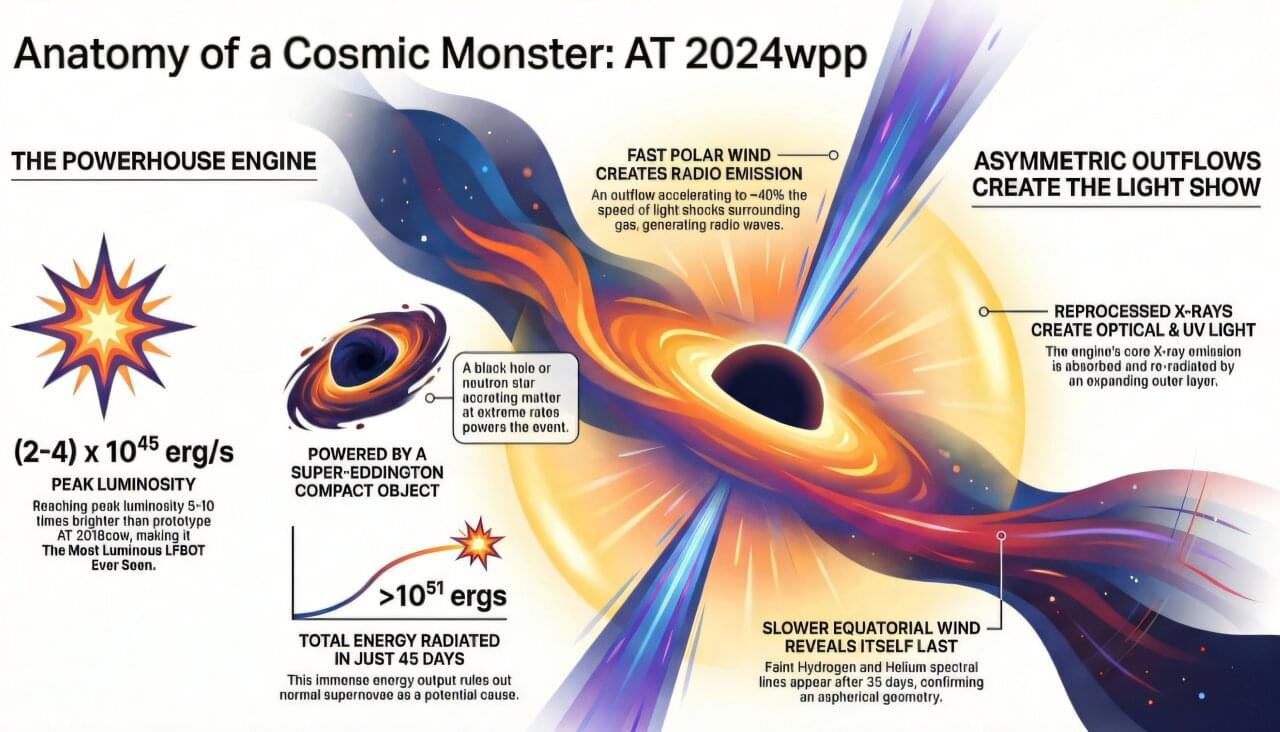
Among the more puzzling cosmic phenomena discovered over the past few decades are brief and very bright flashes of blue and ultraviolet light that gradually fade away, leaving behind faint X-ray and radio emissions. With slightly more than a dozen discovered so far, astronomers have debated whether they are produced by an unusual type of supernova or by interstellar gas falling into a black hole.
Analysis of the brightest such burst to date, discovered last year, shows that they’re neither.
Instead, a team of astronomers led by researchers from the University of California, Berkeley, concluded that these so-called luminous fast blue optical transients (LFBOTs) are caused by an extreme tidal disruption, where a black hole of up to 100 times the mass of our sun completely shreds its massive star companion within days.