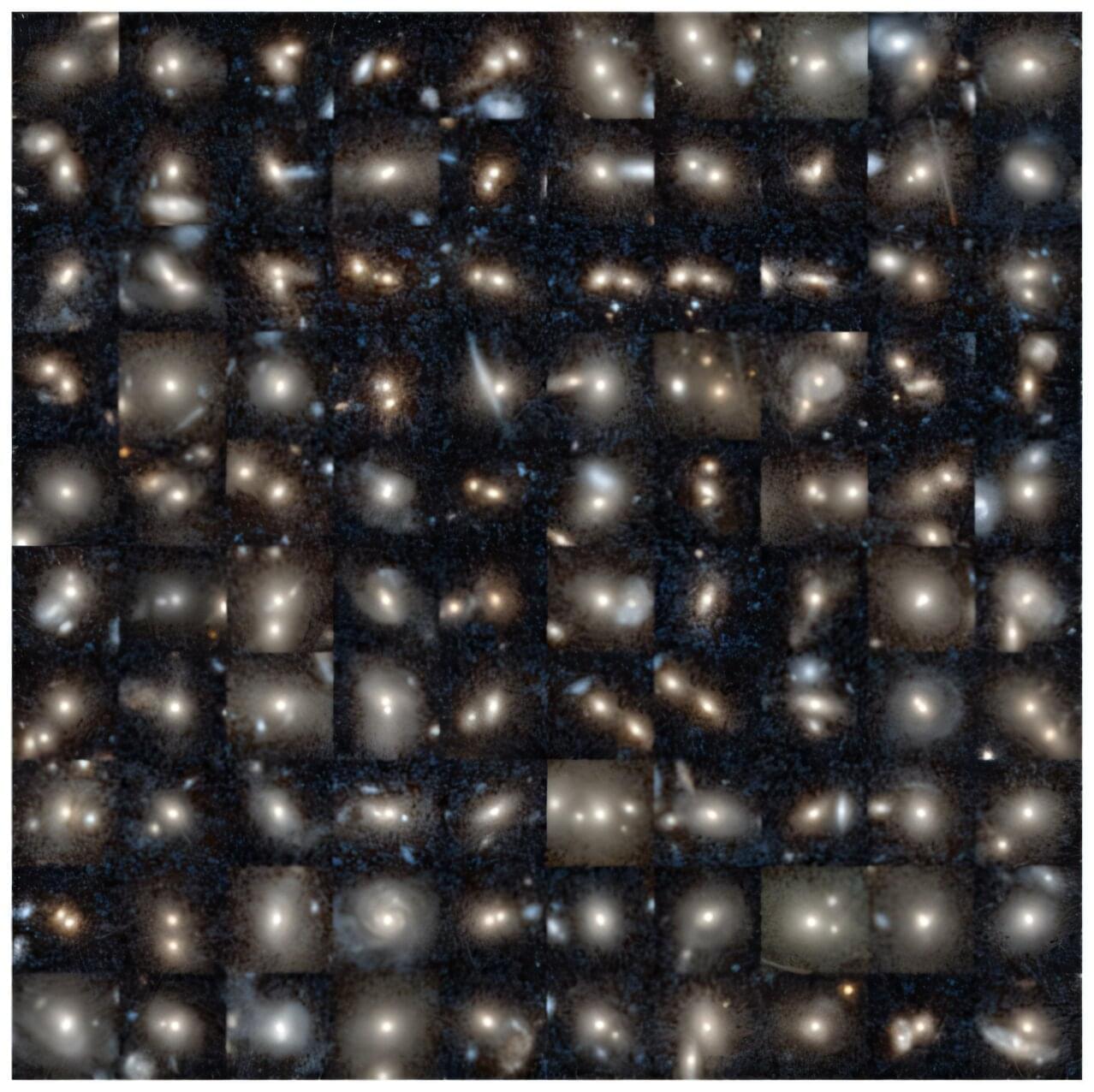
Astronomers have long debated the role of galaxy mergers in powering active supermassive black holes. Now an unprecedented dataset of a million galaxies from the Euclid telescope provides evidence that mergers play a dominant role and are even the primary trigger for the most luminous black holes.
Almost all massive galaxies harbor a supermassive black hole (SMBH) at their centers. Most of them simply lurk in the dark while quietly reeling in gas, dust and stars from their surroundings. These materials gather in the black hole’s accretion disk before their irreversible dive into the abyss, thereby emitting the only slight hint of radiation that gives away the black hole’s location.
A small fraction of galaxies possess an SMBH that shines brightly or even pushes out material from its poles. These are called active galactic nuclei (AGN). Some astronomers have hypothesized that violent collisions between galaxies may play an important role in the ignition of AGN. The resulting turbulence could cause the extra material to pile up in an SMBH’s accretion disk, where friction and compression make it hot enough to shine brightly. In the most extreme cases, the AGN are so bright that they completely outshine their host galaxies.