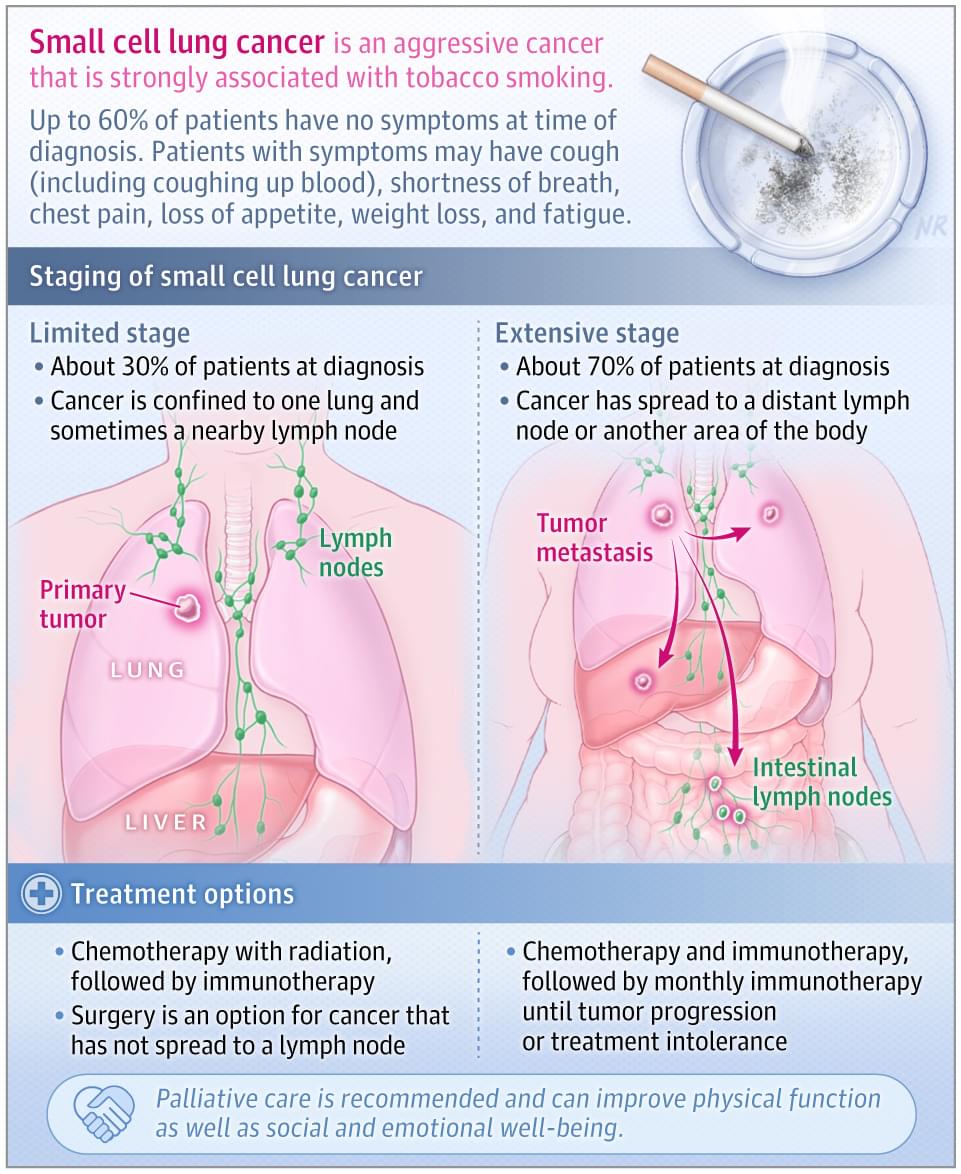
This JAMA Patient Page describes small cell lung cancer and its symptoms, diagnosis and staging, treatment, and prognosis.
The study was led by Emily McDougall, an astrophysicist who conducted the work while at the University of New Hampshire. McDougall’s research focuses on a phenomenon called magnetic reconnection, in which nearby magnetic fields—like those of the Earth and the Sun—interact and release huge amounts of energy. These energy releases, far from our planet, kickstart processes that produce phenomena here on Earth, such as dramatic auroras.
Switchbacks are kink-shaped plasma structures that form out of reconnection events. Switchbacks have been previously found near the Sun, by missions like the Parker Solar Probe, but not near Earth.
Astronomers using data from the Very Large Telescope (VLT) have revealed that the initial “breakout” phase of a supernova is elongated, not perfectly spherical.

Researchers at Rice University have developed a sophisticated 3D photonic-crystal cavity that can trap and control light in unprecedented ways, unlocking powerful light-matter interactions. Their work explores how photons and electrons interact under intense conditions — revealing exotic quantum states like polaritons and entering the realm of “ultrastrong coupling.”
Patreon: https://www.patreon.com/seanmcarroll.
Blog post with audio player, show notes, and transcript: https://www.preposterousuniverse.com/podcast/2023/07/10/242-…formation/
Complexity scientists have been able to make an impressive amount of progress despite the fact that there is not universal agreement about what “complexity” actually is. We know it when we see it, perhaps, but there are a number of aspects to the phenomenon, and different researchers will naturally focus on their favorites. Today’s guest, David Krakauer, is president of the Santa Fe Institute and a longtime researcher in complexity. He points the finger at the concept of agency. A ball rolling down a hill just mindlessly obeys equations of motion, but a complex system gathers information and uses it to adapt. We talk about what that means and how to think about the current state of complexity science.
David Krakauer received his D.Phil. in evolutionary biology from Oxford University. He is currently President and William H. Miller Professor of Complex Systems at the Santa Fe Institute. Previously he was at the University of Wisconsin, Madison, where he was the founding director of the Wisconsin Institute for Discovery and the Co-director of the Center for Complexity and Collective Computation. He was included in Wired magazine’s list of “50 People Who Will Change the World.”
Mindscape Podcast playlist: https://www.youtube.com/playlist?list=PLrxfgDEc2NxY_fRExpDXr87tzRbPCaA5x.
Sean Carroll channel: https://www.youtube.com/c/seancarroll.
#podcast #ideas #science #philosophy #culture


