Toggle light / dark theme

The Military’s Big Bet on Artificial Intelligence

Number 4 Hamilton Place is a be-columned building in central London, home to the Royal Aeronautical Society and four floors of event space. In May, the early 20th-century Edwardian townhouse hosted a decidedly more modern meeting: Defense officials, contractors, and academics from around the world gathered to discuss the future of military air and space technology.

Things soon went awry. At that conference, Tucker Hamilton, chief of AI test and operations for the United States Air Force, seemed to describe a disturbing simulation in which an AI-enabled drone had been tasked with taking down missile sites. But when a human operator started interfering with that objective, he said, the drone killed its operator, and cut the communications system.

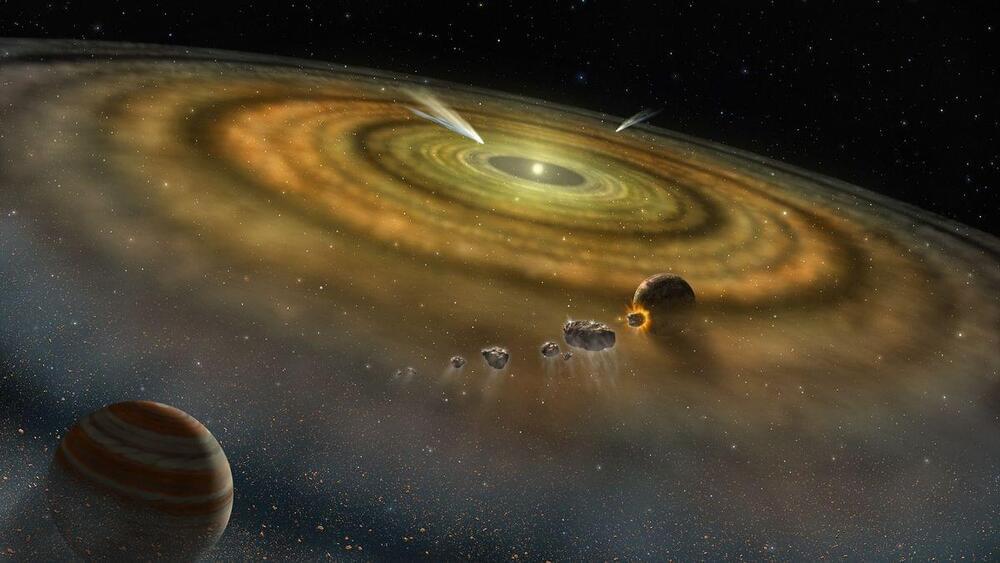
ESA’s Cheops mission uncovers rare star system 100 light-years away

The European Space Agency (ESA) has a number of missions ongoing to discover and study exoplanets, which are planets outside of our solar system.

One of those missions, Cheops (CHaracterising ExOPlanet Satellite), has uncovered a rare star system that lies around 100 light-years away.

It’s an important find because it can tell us about the formation and evolution of the planetary system, according to ESA.

A gamma-ray pulsar milestone inspires innovative astrophysics and applications

The U.S. Naval Research Laboratory (NRL), in conjunction with the international Fermi Large Area Telescope Collaboration, announce the discovery of nearly 300 gamma ray pulsars in the publication of their Third Catalog of Gamma Ray Pulsars. This milestone comes 15 years after the launch of Fermi in 2008 when there were fewer than ten known gamma-ray pulsars.

“Work on this important catalog has been going on in our group for years,” said Paul Ray, Ph.D., head of the High Energy Astrophysics and Applications Section at NRL. “Our scientists and postdocs have been able to both discover and analyze the timing behavior and spectra of many of these newfound pulsars as part of our quest to further our understanding of these exotic stars that we are able to use as cosmic clocks.”

Pulsars are formed when have burned through their fuel supply and become unable to resist the inward pull of their own gravity. This results in the star collapsing into a dense, spinning, magnetized neutron star. Their spinning magnetic fields send out beams of gamma rays, the most energetic form of light. As these beams sweep across the Earth, the highly sensitive Fermi gamma-ray telescope can observe their periodic energy pulses. With more than 15 years of data, Fermi has transformed the field of research.

Mars horizon captured in new image: “No Mars spacecraft has ever had this kind of view before”

NASA revealed multiple new panoramic images of clouds and dust in Mars’ skies and one of its two tiny moons taken by the spacecraft last May. They were captured by the Odyssey’s camera, called the Thermal Emission Imaging System, or THEMIS.

The rare images were taken from an altitude of about 250 miles, the same altitude at which the International Space Station flies above Earth, according to NASA.

“If there were astronauts in orbit over Mars, this is the perspective they would have,” said Jonathon Hill, the operations lead of THEMIS. “No Mars spacecraft has ever had this kind of view before.”

The Interplanetary War

Space Warfare concepts from science fiction often involve war between planets, and we will discuss the science of that, and war inside a fully colonized solar system or Dyson Swarm.

Visit our Website: http://www.isaacarthur.net.
Join Nebula: https://go.nebula.tv/isaacarthur.
Support us on Patreon: https://www.patreon.com/IsaacArthur.
Support us on Subscribestar: https://www.subscribestar.com/isaac-arthur.
Facebook Group: https://www.facebook.com/groups/1583992725237264/
Reddit: https://www.reddit.com/r/IsaacArthur/
Twitter: https://twitter.com/Isaac_A_Arthur on Twitter and RT our future content.
SFIA Discord Server: https://discord.gg/53GAShE
Listen or Download the audio of this episode from Soundcloud: https://soundcloud.com/isaac-arthur-148927746/interplanetary-warfare.
Cover Art by Jakub Grygier: https://www.artstation.com/artist/jakub_grygier.

Graphics Team:
Edward Nardella.
Jarred Eagley.
Justin Dixon.
Katie Byrne.
Kris Holland of Mafic Stufios: www.maficstudios.com.
Misho Yordanov.
Pierre Demet.
Sergio Botero: https://www.artstation.com/sboterod?fref=gc.
Stefan Blandin.

Script Editing:
Andy Popescu.
Connor Hogan.
Edward Nardella.
Eustratius Graham.
Gregory Leal.
Jefferson Eagley.
Luca de Rosa.
Mark Warburton.
Michael Gusevsky.
Mitch Armstrong.
MolbOrg.
Naomi Kern.
Philip Baldock.
Sigmund Kopperud.
Steve Cardon.
Tiffany Penner.

Music:
Markus Junnikkala, “Leaving the Galaxy“
AJ Prasad, “Staring Through“
Lombus, “Amino”

/* */