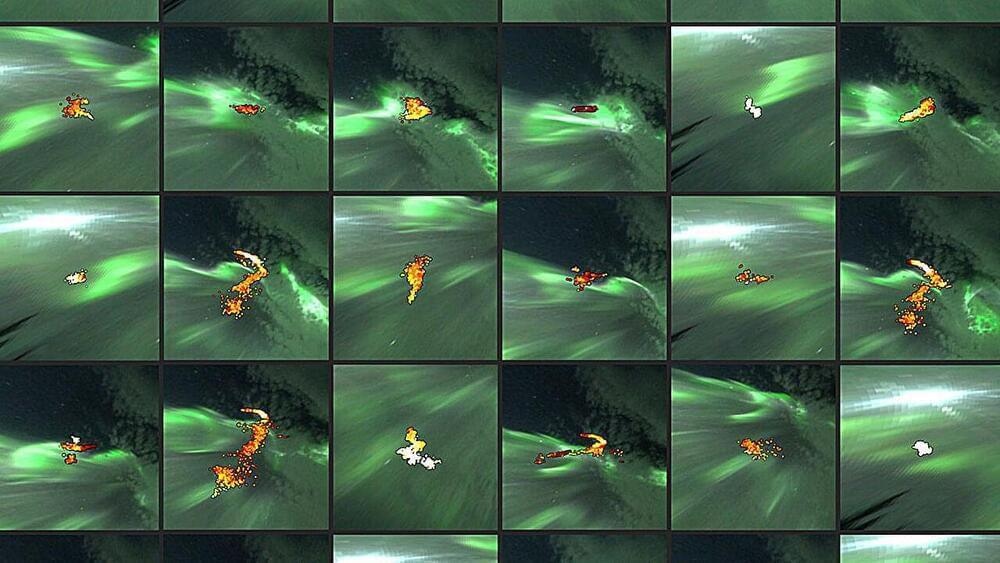
At night, charged particles from the sun caught by Earth’s magnetosphere rain down into the atmosphere. The impacting particles rip electrons from atoms in the atmosphere, creating both beauty and chaos. These high-energy interactions cause the northern and southern lights, but they also scatter radio signals, wreaking havoc on ground-based and satellite communications.
Scientists would like to track electrical activity in the ionosphere by measuring the distribution of plasma, the form matter takes when positive ions are separated from their electrons, to help better predict how communications will be affected by electromagnetic energy.
But analyzing plasma in the ionosphere is a challenge because its distribution changes quickly and its movements are often unpredictable. In addition, collisional physics makes detecting true motion in the lower ionosphere exceedingly difficult.
Non-personalized content and ads are influenced by things like the content you’re currently viewing and your location (ad serving is based on general location). Personalized content and ads can also include things like video recommendations, a customized YouTube homepage, and tailored ads based on past activity, like the videos you watch and the things you search for on YouTube. We also use cookies and data to tailor the experience to be age-appropriate, if relevant.
Select “More options” to see additional information, including details about managing your privacy settings. You can also visit g.co/privacytools at any time.
We often imagine that our planet might be a sentient entity — Gaia — but could something like this evolve under known science? And might a conscious world be something we might create in the future?
Credits: Sentient Planets \& World Consciousnesses. Science \& Futurism with Isaac Arthur. Episode 312a, October 17, 2021 Written, Produced \& Narrated by Isaac Arthur.
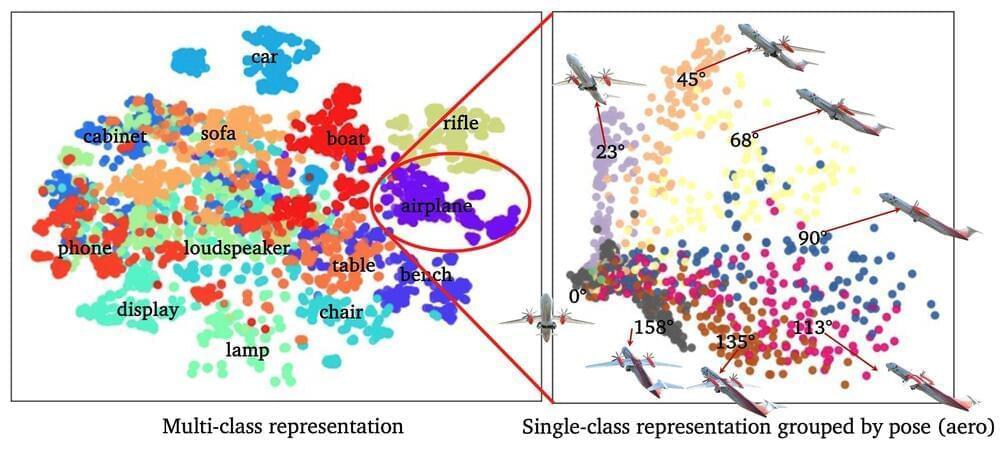
A new visual recognition approach improved a machine learning technique’s ability to both identify an object and how it is oriented in space, according to a study presented in October at the European Conference on Computer Vision in Milan, Italy.
Self-supervised learning is a machine learning approach that trains on unlabeled data, extending generalizability to real-world data. While it excels at identifying objects, a task called semantic classification, it may struggle to recognize objects in new poses.
This weakness quickly becomes a problem in situations like autonomous vehicle navigation, where an algorithm must assess whether an approaching car is a head-on collision threat or side-oriented and just passing by.
Human minibrains in little vials surprised scientists by surviving a stint in low-Earth orbit.
US researchers sent lab-grown blobs of human neural tissue known as organoids for a short holiday on the International Space Station back in 2019. What they got back a month later amazed them.
Not only were the cells healthy and thriving after weeks of weightlessness – they had matured faster than the same cells here on Earth.
Researchers at NASAs Armstrong Center are advancing an atmospheric probe for potential space missions.
Utilizing innovative designs based on past aircraft research, the team has successfully tested the probe, planning further improvements to increase its functionality and data-gathering capabilities.
Jupiter’s moon Io is the most volcanically active body in our Solar System, with around 400 volcanoes and extensive lava flows spread across its surface – but contrary to what scientists thought, a new study suggests this geological chaos is not powered by a global, moonwide ocean of magma below the surface.
Using images snapped by NASA’s Juno spacecraft, gravitational measurements, and historical data about Io’s tidal deformations, an international team of researchers has determined that the moon’s volcanoes are powered by a scattering of magma chambers in an otherwise solid mantle.
The findings counter previous theories about how Io’s volcanoes are powered, and point to a mostly solid mantle for the moon. With magma oceans believed to be present on many worlds, especially early in their formation – including our own Moon – we may need to rethink how planets form and evolve.
I believe that vertical farming will be able to meet the demand of 9.7 billion people by 2050 or even be able to feed eventually the entire globe or even space stations. The leading vertical farming company I like is aero farms:3.
By 2050, we’ll need to produce 70% more food to feed over 9 billion mouths. Luckily, a wide range of vertical farming companies are developing innovative solutions to redefine production, expand urban agriculture and transform consumers into green-fingered growers.
Dive into a universe of scientific research and innovation spanning diverse topics from astronomy to zoology. Stay ahead with our timely updates, learn from expert insights, and ignite your curiosity. Explore the wonders of science with us today.
The notion of entropy grew out of an attempt at perfecting machinery during the industrial revolution. A 28-year-old French military engineer named Sadi Carnot set out to calculate the ultimate efficiency of the steam-powered engine. In 1824, he published a 118-page book(opens a new tab) titled Reflections on the Motive Power of Fire, which he sold on the banks of the Seine for 3 francs. Carnot’s book was largely disregarded by the scientific community, and he died several years later of cholera. His body was burned, as were many of his papers. But some copies of his book survived, and in them lay the embers of a new science of thermodynamics — the motive power of fire.
Carnot realized that the steam engine is, at its core, a machine that exploits the tendency for heat to flow from hot objects to cold ones. He drew up the most efficient engine conceivable, instituting a bound on the fraction of heat that can be converted to work, a result now known as Carnot’s theorem. His most consequential statement comes as a caveat on the last page of the book: “We should not expect ever to utilize in practice all the motive power of combustibles.” Some energy will always be dissipated through friction, vibration, or another unwanted form of motion. Perfection is unattainable.
Reading through Carnot’s book a few decades later, in 1865, the German physicist Rudolf Clausius coined a term for the proportion of energy that’s locked up in futility. He called it “entropy,” after the Greek word for transformation. He then laid out what became known as the second law of thermodynamics: “The entropy of the universe tends to a maximum.”
Physicists of the era erroneously believed that heat was a fluid (called “caloric”). Over the following decades, they realized heat was rather a byproduct of individual molecules bumping around. This shift in perspective allowed the Austrian physicist Ludwig Boltzmann to reframe and sharpen the idea of entropy using probabilities.
Boltzmann distinguished the microscopic properties of molecules, such as their individual locations and velocities, from bulk macroscopic properties of a gas like temperature and pressure…