Japan’s space agency has released photos and videos taken on board the International Space Station (ISS) by its grapefruit-sized robot drone. The drone, called Internal Ball Camera (or Int-Ball), can be maneuvered by controllers and researchers from Earth, according a press release from the Japan Aerospace Exploration Agency (JAXA).
Category: space – Page 1,146
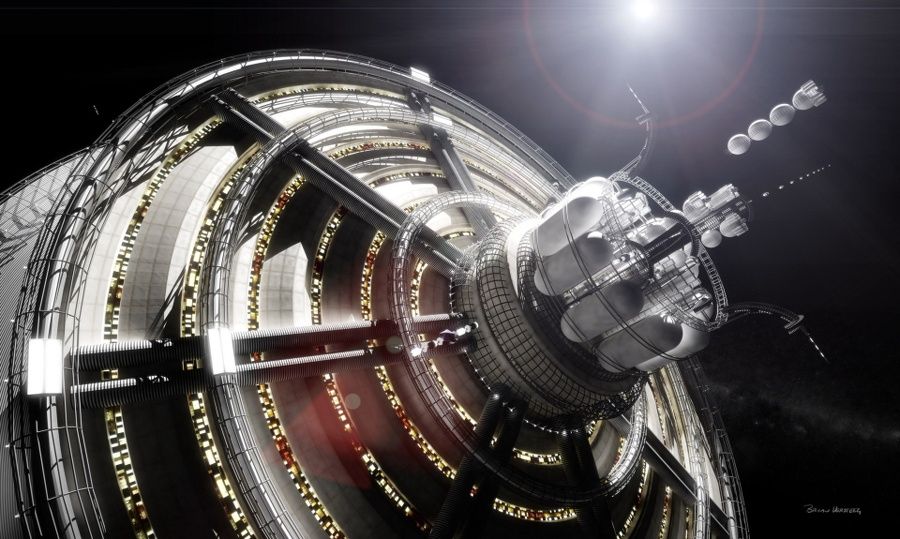
Kalpana One: My New Vision Of Space Settlement
As an artist and science/tech enthusiast who has spent most of his life imagining the future of public spaces, homes, cities, and the effect of technological innovations on each, I’ve always tried to project a logical but optimistic path for human progress. Not just where we may go, but why we would go and what it would be like once we got there.
To me, space is a logical step in our collective path. Humans have always wanted to climb the next hill or sail uncharted waters to see what awaited us over the horizon. We have spread to all ‘corners’ of this earth, at times to the detriment of the life that was already there. In space, we fulfill an entirely different role. When we build a space station and bring life to it, we are actually “planting” a beautiful habitat is where once there was none. This is what inspired me to imagine these spaces.
US-Australia had a successful Mach 8 HiFire 4 hypersonic missile test last week
The US-Australia Hypersonic International Flight Research Experimentation (HiFIRE) program had at least one successful hypersonic flight at Woomera testing range in South Australia last week. A round of experiments concluded on 12 July, confirmed Australian defense minister Marise Payne.
UQ hypersonics researchers collaborated with the Defence Science and Technology Group (DST Group) and US Air Force Research Laboratory (AFRL), Boeing, and BAE Systems for test flights in July 2017. This vehicle is a free-flying hypersonic glider, designed to fly at Mach 8 (8000 km/hr). It is designed to separate from its rocket booster in space and perform controlled manoeuvres as it enters the atmosphere. The test flight was intended to enable learning about how to fly a hypersonic vehicle at high altitude.
BAE Systems Australia said in a statement that “the successful flight trial [was] the most complex of all HIFiRE flights conducted to date”.
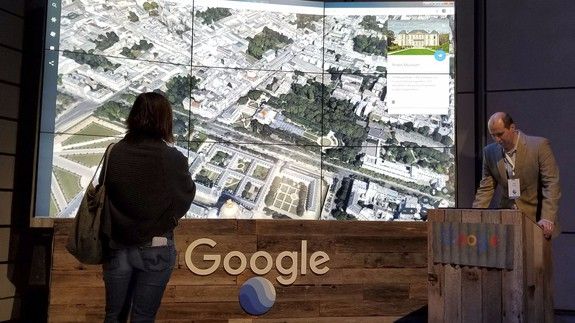
Google Earth could become the next great social network — By Brett Williams | Mashable
“Google Earth could become your next go-to platform to share a story in the not-so-distant future — but your posts won’t be restricted to a timeline like other, less terrestrially-focused social networks.”
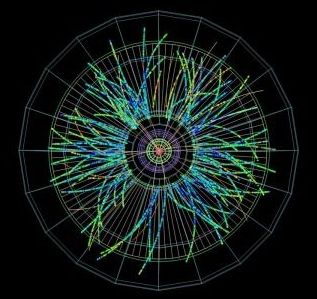
AI is Changing Everything – Even Science Itself
AI is being used for much more than many realize. In fact, particle physicists are currently pushing the limits of our understanding of the universe with the help of these technologies.
Many might associate current artificial intelligence (AI) abilities with advanced gameplay, medical developments, and even driving. But AI is already reaching far beyond even these realms. In fact, AI is now helping particle physicists to discover new subatomic particles.
UK government investing over £100 million in the space industry to ensure the UK remains a world leader in space tech
The UK government has revealed how investing in the space industry will form a key part of its strategy for boosting economic growth.
At the heart of the government’s strategy is a pledge to invest £99 million to create a National Satellite Testing Facility (NSTF) and another £4 million investment for a new National Space Propulsion Facility (NSPF).
The UK government hopeS the significant funding boost will enable the space industry to competitively bid for more national and international contracts and ensure it remains a world-leader for space technologies for decades to come.