Toggle light / dark theme

IBM Stuffs a Whopping 330TB of Data into a Tiny Cartridge

Some of the earliest computers relied upon tape drives for storage, but we’ve since moved on to faster and more versatile storage technologies. Still, tape drives continue to exist in enterprise, and they’ve been advancing by leaps and bounds while you haven’t been paying attention. IBM just announced a new record in data storage density — 201 gigabits per square inch on a magnetic tape (that’s one square inch of it above). That works out to a whopping 330TB of uncompressed data on a single tape drive cartridge.

IBM reached this plateau in magnetic tape density by developing several new technologies. Older versions of IBM’s magnetic tape used a thin film of barium ferrite particles applied to the surface like paint. “Sputtered tape” uses several layers of thin metal film that are applied using a new vacuum technology. A layer of lubricant is also applied to the reading surface of the tape to keep the tape in good working order as it’s run through the drive. The higher density arrangement of magnetic nanoparticles will, of course, require new drive technology to read.

Scientists demonstrate one of largest quantum simulators

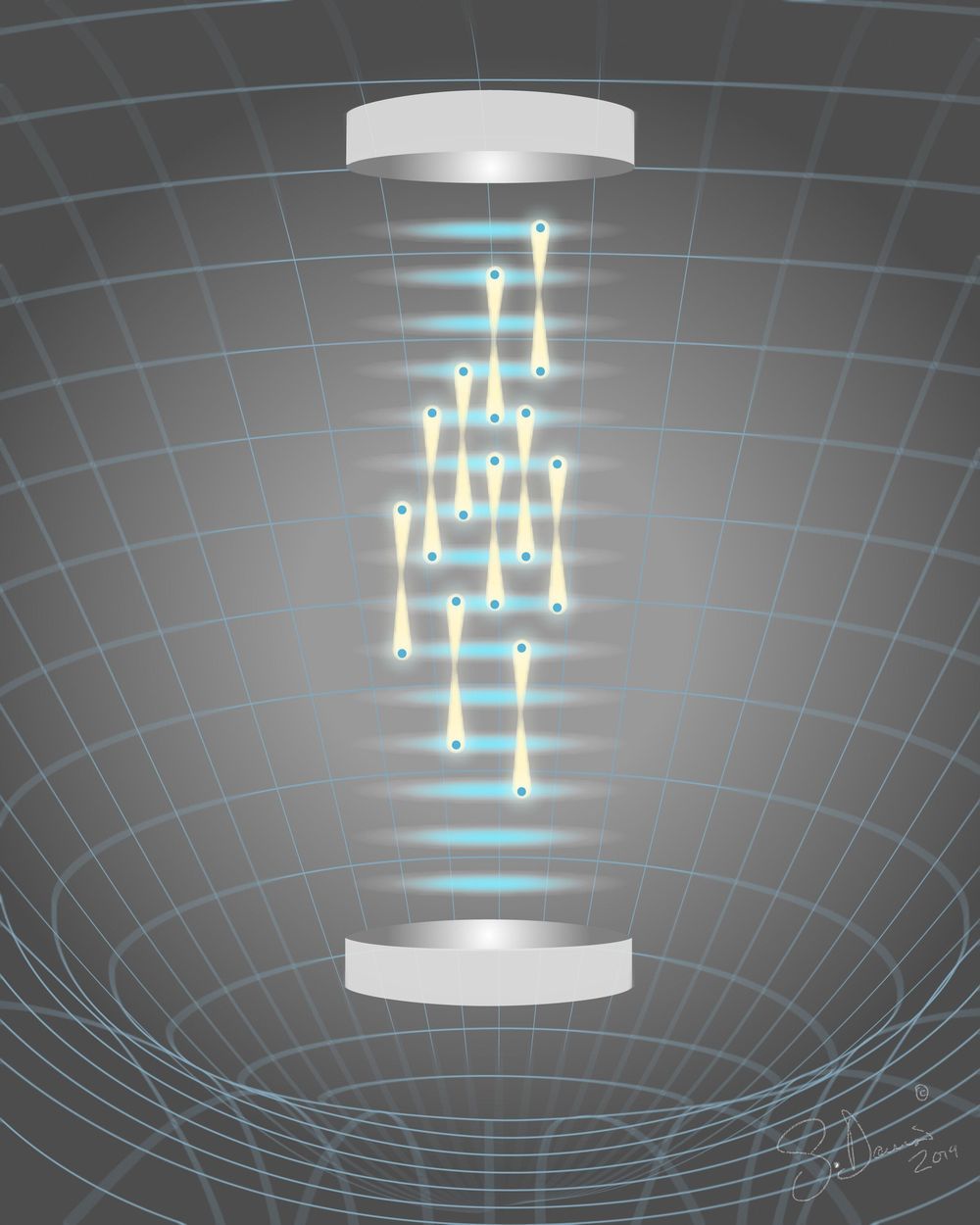
Physicists at MIT and Harvard University have demonstrated a new way to manipulate quantum bits of matter. In a paper published today in the journal Nature, they report using a system of finely tuned lasers to first trap and then tweak the interactions of 51 individual atoms, or quantum bits.

The team’s results represent one of the largest arrays of quantum bits, known as qubits, that scientists have been able to individually control. In the same issue of Nature, a team from the University of Maryland reports a similarly sized system using trapped ions as quantum bits.

In the MIT-Harvard approach, the researchers generated a chain of 51 atoms and programmed them to undergo a quantum phase transition, in which every other atom in the chain was excited. The pattern resembles a state of magnetism known as an antiferromagnet, in which the spin of every other atom or molecule is aligned.

Traveling back in time could be possible, physicist says

As the common tropes of science fiction continue to break out into reality, from humanoid robots to self-driving cars, there’s one concept that has seemingly remained beyond our grasp: time travel.

But, jumping through time might not be impossible, after all, according to one astrophysicist.

By the rules of theoretical physics, certain conditions exist that would allow for the construction of elaborate wormholes, which could transport humans back to different eras.


While scientists have yet to discover the conditions needed to travel back in time, and construction a system large enough for humans certainly wouldn’t be easy, ‘there’s nothing forbidding it’ in the laws of theoretical physics, explains astrophysicist Ethan Siegel of Lewis & Clark College in the Forbes blog Starts With A Bang.

Backward time travel would rely on the elusive counterpart to the known positive energy / positive or zero mass particles found all throughout the universe – the negative mass/energy particles, which have long been theorized but never yet found.

Moon, Mars, Asteroid and orbital colonzation and cities

He looked at the science and economics of a lunar colony.

Eighty-five percent of the rocks on the surface of the lunar highlands are anorthite, which contains aluminum as well as a massive supply of oxygen. Smelting aluminum in the quantities necessary to construct and maintain Artemis would produce so much excess oxygen—eight atoms for every two of aluminum—that they would be constantly venting it.

For every kilogram of payload, you need an additional 3.73 kilos of fuel. So a one-way ticket to the moon is calculated to eventually cost about $33,000.

Hidden structure found inside the Great Pyramid of Giza

The Great Pyramid of Giza has been shrouded in mystery for millennia, but now a long-held secret of its structure might be known thanks to particle physics.

A narrow void lying deep within the ancient Wonder of the World has been found by scientists using cosmic-ray based imaging.

The internal structure is located above the Grand Gallery — which links two of the Pyramid’s chambers — and traces a similar route for at least 30 metres (100ft).

/* */