Brian Armstrong said the exchange will “happily defend” its Coinbase Earn staking service in court days after competitor Kraken paid a $30 million fine and ended its program.




In a recent study posted to the bioRxiv preprint server, researchers identified a novel antiviral pathway different from the interferon (IFN) pathway that inhibited poxvirus(es) replication.
Study: A FACT-ETS-1 Antiviral Response Pathway Restricts Viral Replication and is Countered by Poxvirus A51R Proteins. Image Credit: Kateryna Kon / Shutterstock.



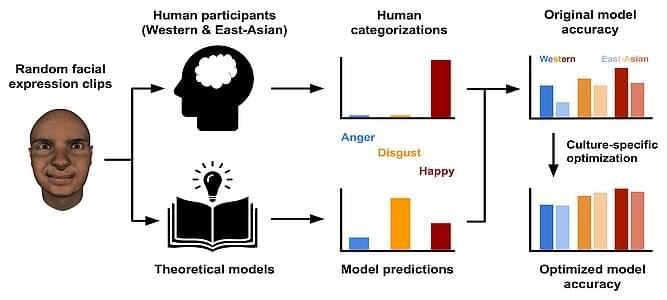
Does someone look angry or sad? You can probably offer an answer to that question based on the information you can see just by looking at their face. That’s because facial expressions—or a combination of different small facial movements—can be read by other humans to help understand what a person might be feeling at that exact moment.
Since Darwin’s seminal work on the evolutionary origins of facial expressions of emotion, scientists have been trying to find out which specific combinations of facial movements best represent our six basic emotions: happy, surprise, fear, disgust, anger and sadness. So far, researchers have offered a range of theories—or models—to define which facial movements best match each emotion, but until now no one has been able to show which one is most accurate.
Now, a new study by a team of European researchers led by the University of Glasgow and University of Amsterdam has begun to answer that question. The new study, which is published in Science Advances, shows that even the best models for predicting emotions from facial expressions fall short of the judgment of real human participants. Moreover, different humans themselves may read different emotions from the same facial expression, making it even harder to pinpoint exactly which facial movements are systematically linked with certain emotions.