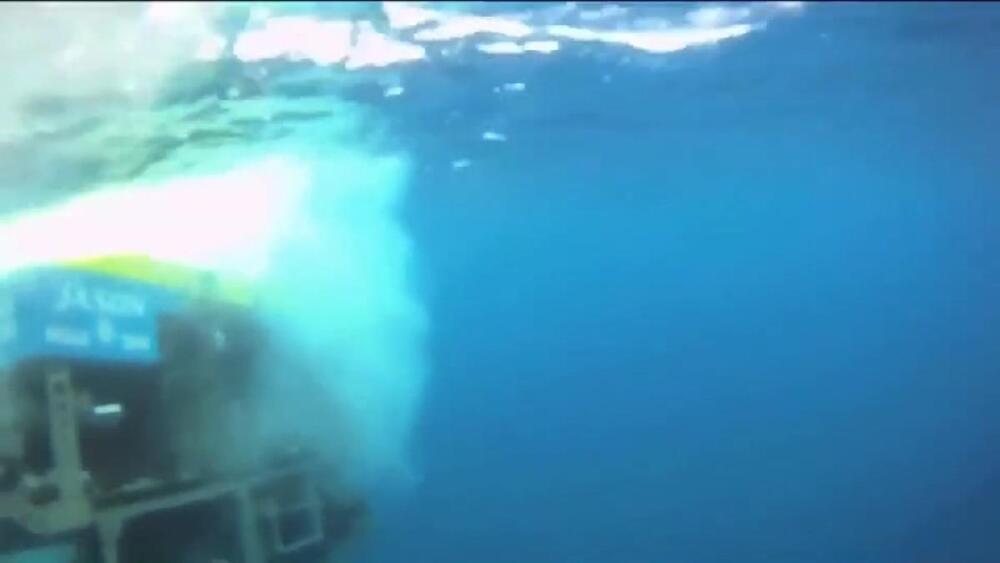
By looking for tiny bumps in sea level caused by the gravity of subsurface mountains, researchers have roughly doubled the number of known seamounts.
Angel_nt/iStock.
Today we will learn all there is to know about tractor beams’ past, present, and future.
Two specialized researchers, one with the Leibniz-Institut für Wissensmedien (the Knowledge Media Research Center), the other with the Applied Face Cognition Lab at the University of Lausanne, have validated reports that some people have super-recognizing abilities. In their study, reported in Proceedings of the National Academy of Sciences, Maren Mayer and Meike Ramon analyzed data from eyewitnesses of ongoing bank robberies in Fribourg, Switzerland, helping to identify two suspects.
Anecdotal evidence and reports from multiple criminal tracking organizations have suggested that some people can recognize another person’s face with high accuracy after time has elapsed, even after seeing a face for just a few seconds. Such people have become known by police officials as super-recognizers (SRs). But as the researchers with this new effort noted, little if any research has sought to verify that self-described SRs or those described as such by others, do indeed have such abilities.
Mayer and Ramon were not actively seeking to test the skill of SRs. They were approached by officials from the Cantonal Criminal Police of Fribourg looking for help in solving robberies that had been captured on video.
‘Star Trek: Picard’ is set 400 years in the future, but, like most science fiction, it deals with issues in the here and now. The show’s third and final season provides a lens on cybersecurity.
Helion, the clean energy company with its eye firmly on the fusion prize, announced a couple of years ago that it had secured $2.2 billion of funding to help it develop cleaner, safer energy at a commercial scale in November 2021. Today, it is starting to reap the fruits of its labor, announcing an agreement to provide Microsoft with electricity from its first fusion power plant, with Constellation serving as the power marketer and managing the transmission for the project.
Fusion has been the energy goal for over 60 years, as it produces next to no waste or radioactivity while processing and is far less risky than fission. But achieving the same process that occurs in stars has proved mighty difficult to contain, with it taking more energy to keep the reaction under control than it can generate. Progress has been slow and steady, with the potential rewards keeping companies such as Helion focused on the reaction. Helion has been working on its fusion technology for over a decade. To date, it has built six working prototypes and it expects its seventh prototype to demonstrate the ability to produce energy in 2024.
With this in mind, Helion’s plant is expected to be online by 2028 and has a power generation target of 50MW, or greater, with a one-year ramp-up period. While that might seem a long way into the future still, it’s significantly sooner than the projections had suggested.