Category: cyborgs – Page 87
What my household robot is teaching my kids about cyborgs
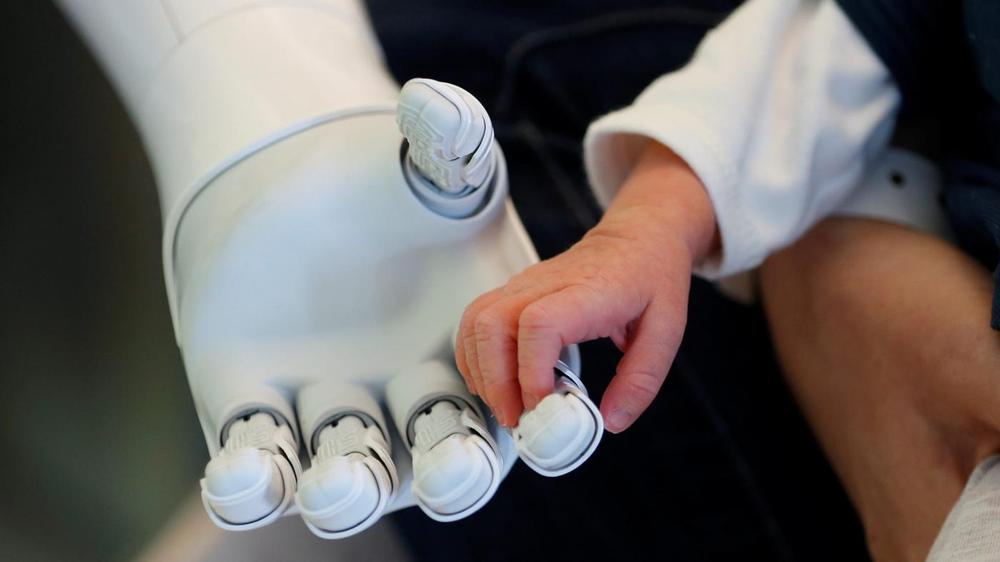
I have a four-foot-tall robot in my house that plays with my kids. Its name is Jethro.
Both my daughters, aged 5 and 9, are so enamored with Jethro that they have each asked to marry it. For fun, my wife and I put on mock weddings. Despite the robot being mainly for entertainment, its very basic artificial intelligence can perform thousands of functions, including dance and teach karate, which my kids love.
The most important thing Jethro has taught my kids is that it’s totally normal to have a walking, talking machine around the house that you can hang out with whenever you want to.

Transhumanist Zoltan Istvan joins presidential race as ‘a new type of Republican’
Is there room for one more in the 2020 presidential race? Transhumanist Zoltan Istvan has declared he’s running for the White House as a Republican, complete with the campaign motto “Upgrading America” — a task he believes can be accomplished through futuristic technology and science.
One new press report describes him as “the cyborg who is running against Donald Trump.” Mr. Istvan appears ready.
“My team and I are ready to really push hard, get on primary ballots, and see if we can get conservatives to be more open-minded about the future. We’re excited that they will open up so that the far-left doesn’t totally own radical science and tech in the future. We think we can be instrumental in getting to GOP and libertarian conservatives to broaden their perspectives about these things,” Mr. Istvan told The Washington Times.

Research sheds light on the underlying mechanics of soft filaments
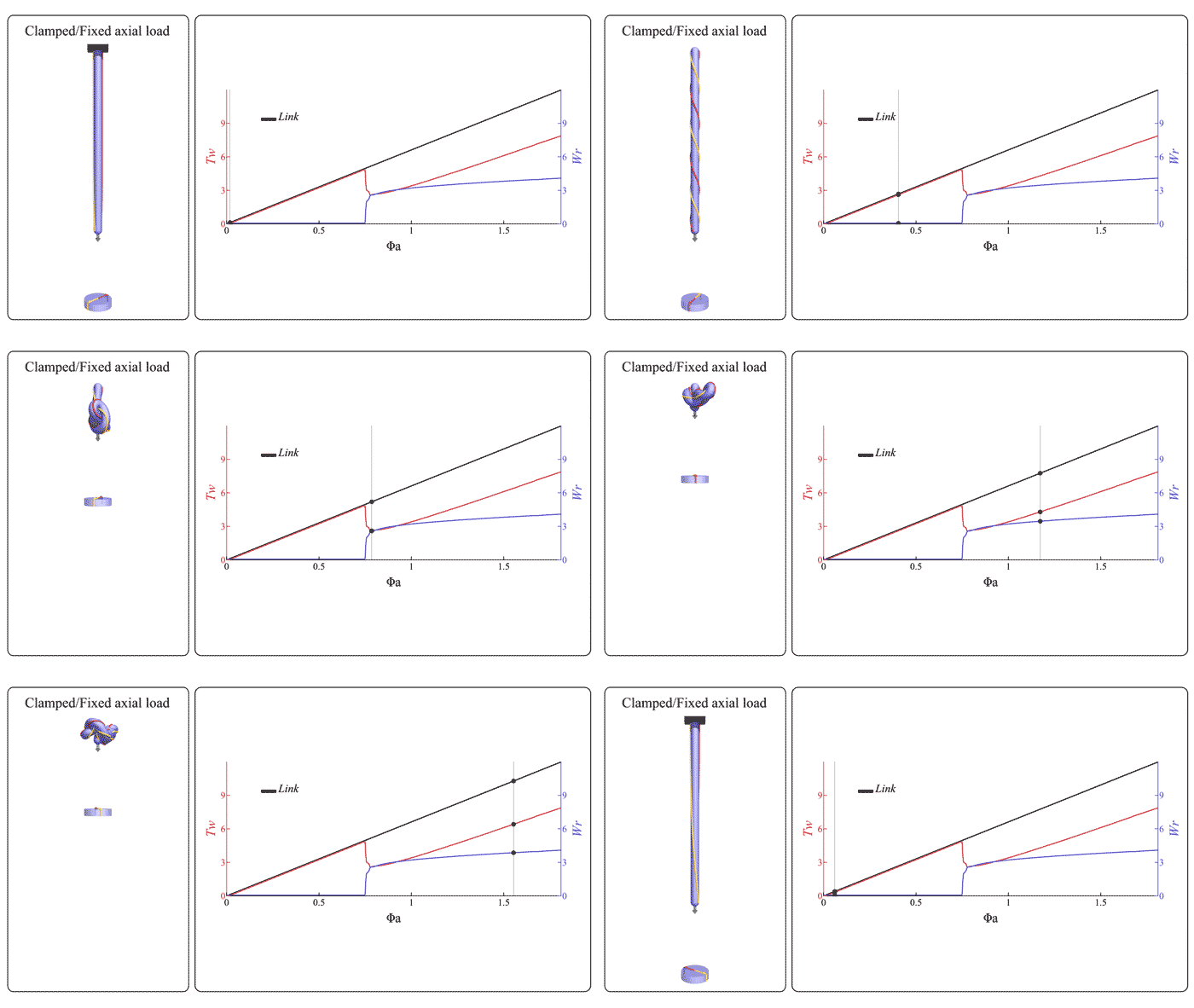
Artificial muscles will power the soft robots and wearable devices of the future. But more needs to be understood about the underlying mechanics of these powerful structures in order to design and build new devices.
Now, researchers from the Harvard John A. Paulson School of Engineering and Applied Sciences (SEAS) have uncovered some of the fundamental physical properties of artificial muscle fibers.
“Thin soft filaments that can easily stretch, bend, twist or shear are capable of extreme deformations that lead to knot-like, braid-like or loop-like structures that can store or release energy easily,” said L. Mahadevan, the Lola England de Valpine Professor of Applied Mathematics, of Organismic and Evolutionary Biology, and of Physics. “This has been exploited by a number of experimental groups recently to create prototypical artificial muscle fibers. But how the topology, geometry and mechanics of these slender fibers come together during this process was not completely clear. Our study explains the theoretical principles underlying these shape transformations, and sheds light on the underlying design principles.”
Realistic arm prosthetic
This 3D-printed robotic arm could be the most advanced and most realistic yet.
The world’s first medically approved 3D-printed bionic arm is now available in the UK, USA, France, Spain and Ireland for children and adults with below-elbow limb differences
More countries coming very soon! Start your bionic journey here: http://
Do transhumanists need their own bill of rights?
Here’s my new story for Quartz on cyborg and #transhumanist bill of rights! It offers a look at the various ideas around the world surrounding this provocative issue:
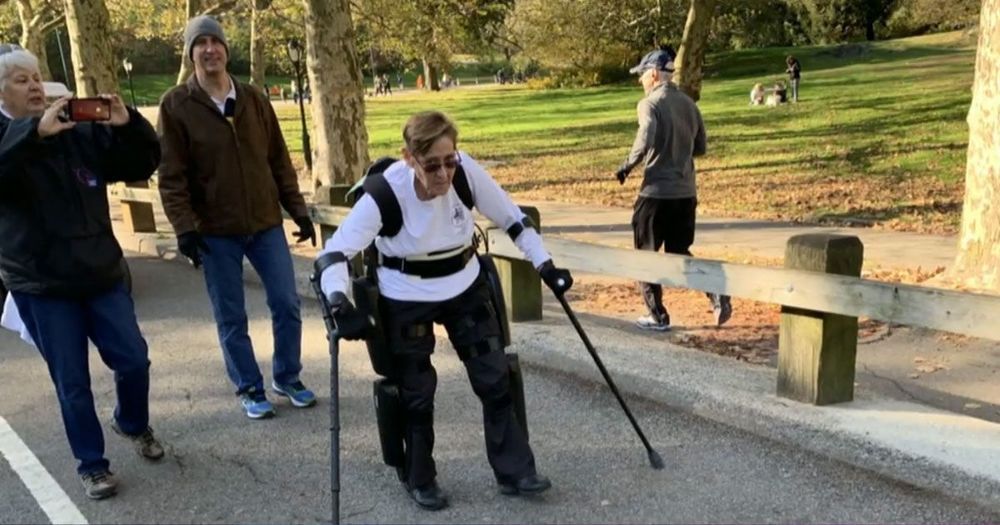
Transhumanists are pushing the boundaries of what it means to be human. Our governing principles may need to progress along with them.
First bilateral brain implant gives paraplegic a two-handed sense of touch
Brain-connected machines that capture and translate electrical signals are showing great promise across a number of areas, but one with massive potential is the world of prosthetics. Scientists exploring these possibilities at Johns Hopkins University are now reporting a big breakthrough, demonstrating a system that enables a quadriplegic to control two prosthetics arms at once using only his thoughts, and also feel a sense of touch coming back the other way.
The team at Johns Hopkins University has been making some exciting progress in this area through its Revolutionizing Prosthetics program, which was launched by DARPA in 2006. In 2016, we saw a double amputee use his brain to control two of the team’s Modular Prosthetic Limbs (MPLs), bilateral shoulder-level prosthetics that enabled him to do things like move cups between shelves, a first for this kind of research.
This system worked via custom sockets which both supported the artificial limbs and hooked them up to nerves in the patient’s torso which, following a treatment regime, had been trained to provide specific control movements for the prosthetic limbs. Five years on, the team has made some advances.