:ooo
Astronomers have seen what appears to the first light ever detected from a black hole merger.
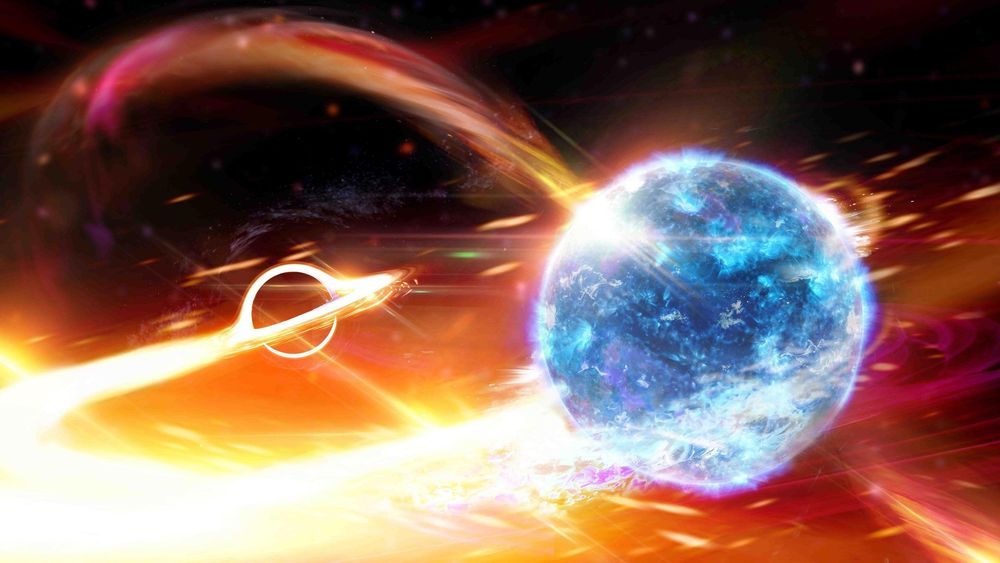
When two black holes spiral around each other and ultimately collide, they send out ripples in space and time called gravitational waves. Because black holes do not give off light, these events are not expected to shine with any light waves, or electromagnetic radiation. Graduate Center, CUNY astrophysicists K. E. Saavik Ford and Barry McKernan have posited ways in which a black hole merger might explode with light. Now, for the first time, astronomers have seen evidence of one of these light-producing scenarios. Their findings are available in the current issues of Physical Review Letters.
A team consisting of scientists from The Graduate Center, CUNY; Caltech’s Zwicky Transient Facility (ZTF); Borough of Manhattan Community College (BMCC); and The American Museum of Natural History (AMNH) spotted what appears to be a flare of light from a pair of coalescing black holes. The event (called S190521g) was first identified by the National Science Foundation’s (NSF) Laser Interferometer Gravitational-wave Observatory (LIGO) and the European Virgo detector on May 21, 2019. As the black holes merged, jiggling space and time, they sent out gravitational waves. Shortly thereafter, scientists at ZTF — which is located at the Palomar Observatory near San Diego — reviewed their recordings of the same the event and spotted what may be a flare of light coming from the coalescing black holes.
“At the center of most galaxies lurks a supermassive black hole. It’s surrounded by a swarm of stars and dead stars, including black holes,” said study coauthor Ford, a professor with the Graduate Center, BMCC and AMNH. “These objects swarm like angry bees around the monstrous queen bee at the center. They can briefly find gravitational partners and pair up but usually lose their partners quickly to the mad dance. But in a supermassive black hole’s disk, the flowing gas converts the mosh pit of the swarm to a classical minuet, organizing the black holes so they can pair up,” she says.