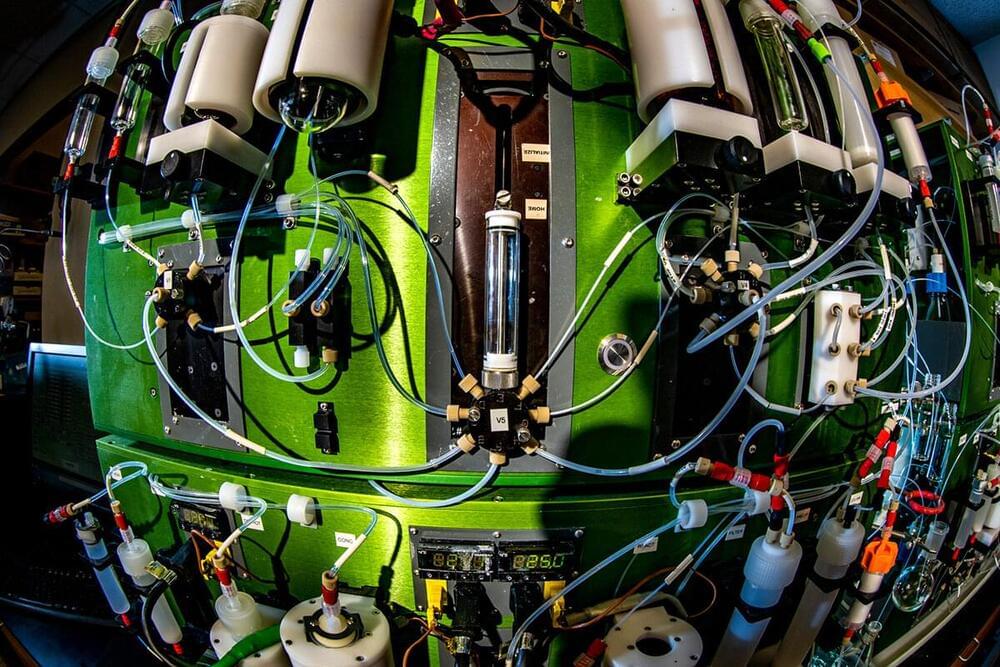
A new class of chemical instrumentation seeks to alleviate the tedium and complexity of organic syntheses.
Wave function represents the quantum state of an atom, including the position and movement states of the nucleus and electrons. For decades researchers have struggled to determine the exact wave function when analyzing a normal chemical molecule system, which has its nuclear position fixed and electrons spinning. Fixing wave function has proven problematic even with help from the Schrödinger equation.
Previous research in this field used a Slater-Jastrow Ansatz application of quantum Monte Carlo (QMC) methods, which takes a linear combination of Slater determinants and adds the Jastrow multiplicative term to capture the close-range correlations.
Now, a group of DeepMind researchers have brought QMC to a higher level with the Fermionic Neural Network — or Fermi Net — a neural network with more flexibility and higher accuracy. Fermi Net takes the electron information of the molecules or chemical systems as inputs and outputs their estimated wave functions, which can then be used to determine the energy states of the input chemical systems.
Researchers have designed a machine learning algorithm that predicts the outcome of chemical reactions with much higher accuracy than trained chemists and suggests ways to make complex molecules, removing a significant hurdle in drug discovery.
University of Cambridge researchers have shown that an algorithm can predict the outcomes of complex chemical reactions with over 90% accuracy, outperforming trained chemists. The algorithm also shows chemists how to make target compounds, providing the chemical “map” to the desired destination. The results are reported in two studies in the journals ACS Central Science and Chemical Communications.
A central challenge in drug discovery and materials science is finding ways to make complicated organic molecules by chemically joining together simpler building blocks. The problem is that those building blocks often react in unexpected ways.
Tesla’s battery research group led by Jeff Dahn in Halifax has applied for a patent that describes a new battery cell chemistry that would result in faster charging and discharging, better longevity, and even lower cost.
Jeff Dahn is considered a pioneer in Li-ion battery cells. He has been working on the Li-ion batteries pretty much since they were invented. He is credited for helping increase the life cycle of the cells, which helped their commercialization. His work now focuses mainly on a potential increase in energy density and durability.
In 2016, Dahn transitioned his research group from their 20-year research agreement with 3M to a new association with Tesla under the newly formed ‘NSERC/Tesla Canada Industrial Research’.
The future of technology relies, to a great extent, on new materials, but the work of developing those materials begins years before any specific application for them is known. Stephen Wilson, a professor of materials in UC Santa Barbara’s College of Engineering, works in that “long before” realm, seeking to create new materials that exhibit desirable new states.
In the paper “Field-tunable quantum disordered ground state in the triangular-lattice antiferromagnet NaYbO2,” published in the journal Nature Physics, Wilson and colleagues Leon Balents, of the campus’s Kavli Institute for Theoretical Physics, and Mark Sherwin, a professor in the Department of Physics, describe their discovery of a long-sought “quantum spin liquid state” in the material NaYbO2 (sodium ytterbium oxide). The study was led by materials student Mitchell Bordelon and also involved physics students Chunxiao Liu, Marzieh Kavand and Yuanqi Lyu, and undergraduate chemistry student Lorenzo Posthuma, as well as collaborators at Boston College and at the U.S. National Institute of Standards and Technology.
At the atomic level, electrons in one material’s lattice structure behave differently, both individually and collectively, from those in another material. Specifically, the “spin,” or the electron’s intrinsic magnetic moment (akin to an innate bar magnet) and its tendency to communicate and coordinate with the magnetic moments of nearby electrons differs by material. Various types of spin systems and collective patterns of ordering of these moments are known to occur, and materials scientists are ever seeking new ones, including those that have been hypothesized but not yet shown to exist.
A team of scientists has discovered a new possible pathway toward forming carbon structures in space using a specialized chemical exploration technique at the Department of Energy’s Lawrence Berkeley National Laboratory (Berkeley Lab).
The team’s research has now identified several avenues by which ringed molecules known as polycyclic aromatic hydrocarbons, or PAHs, can form in space. The latest study is a part of an ongoing effort to retrace the chemical steps leading to the formation of complex carbon-containing molecules in deep space.
PAHs—which also occur on Earth in emissions and soot from the combustion of fossil fuels—could provide clues to the formation of life’s chemistry in space as precursors to interstellar nanoparticles. They are estimated to account for about 20 percent of all carbon in our galaxy, and they have the chemical building blocks needed to form 2-D and 3D carbon structures.
It’s a cosmic collision that has astronomers rethinking one of the universe’s most colossal events: the collision of massive stars.
In a new paper published in the journal Monthly Notices of the Royal Astronomical Society, astronomers reveal the finding of a kilonova produced by the collision of two massive stellar objects called neutron stars. The collision is roughly 1,000 times brighter than the death of a massive star called a supernova. And they say it produced several hundred planets’ worth of gold and platinum.
But astronomers almost missed it.
Scientists have identified a class of drugs that may have potential to treat a rare and deadly form of brain cancer that affects young children.
The research team, led by Ranjit Bindra, MD, PhD, and colleagues at the Yale Cancer Center, also included co-senior authors Charles Brenner, PhD, professor and DEO of biochemistry at the University of Iowa Carver College of Medicine, and Michael E. Berens, PhD, from the Translational Genomics Research Institute in Phoenix.
The findings, published Aug. 22 in Nature Communications, focus on Diffuse Intrinsic Pontine Glioma (DIPG), a rare, incurable cancer that affects the brainstem in children under age 10. Previous work had identified mutations in a gene called PPM1D as a cause of this cancer.
The periodic table contains a wide array of elements, numbered from one (hydrogen) to 118 (oganesson), with each number representing the number of protons stored within an atom’s nucleus. Scientists are constantly working to create new elements by cramming more and more protons into nuclei, expanding the periodic table. The effort sparks curiosity and questions: Can the table be enlarged in the opposite direction? Is it possible to make an element zero? Does it already exist?
“Element zero” has been a matter of conjecture for nearly a century, and no scientist searched more ardently for it than German chemist Andreas von Antropoff. It was Antropoff who placed the theoretical element atop a periodic table of his own devising, and it was also he who thought up a prescient name for it: neutronium.
You don’t widely hear Antropoff’’s name today, as his Nazi leanings earned the scientist international disgrace. You do, however, hear about neutronium. Today, the term commonly refers to a gaseous substance composed almost purely of neutrons, found within the tiniest, densest stars known to exist: neutron stars.