Science Daily reports that the astronomers found out that the mass of this lone white dwarf is equivalent to 56% of the sun’s weight. It aligns with previous theoretical predictions regarding the white dwarf’s mass, and it also sheds light on persisting theories regarding the evolution of these white dwarfs as a result of usual star evolution. The interesting observation grants further understanding of theories regarding white dwarf composition and structure.
According to the Space Academy, the astronomers made use of the renowned Hubble Space Telescope to gauge this lone white dwarf’s mass. The dwarf is known as LAWD 37.
Yes, the world has some serious problems, but if we did not have problems, we would never be forced to find new solutions. Problems push progress forward. Let’s embrace our ultimate existential challenges and come together to solve them. It is time to forget our differences and think of ourselves only as humans, engaged in a common biological and moral struggle. If the cosmic perspective, and the philosophy of poetic meta-naturalism, or some similar world-view of evolution and emergence, can build a bridge between the reductionist worldview and the religions of the world, then we can be optimistic that a new level of order and functionality will emerge from the current sea of chaos.
Knowledge is enlightenment, knowledge is transcendence, and knowledge is power. The tendency toward disorder described by the second law requires that life acquire knowledge forever, giving us all an individual and collective purpose by creating the constraint that forces us to create. By becoming aware of our emergent purpose, we can live more meaningful lives, in harmony with one another and with the aspirations of nature. You are not a cosmic accident. You are a cosmic imperative.
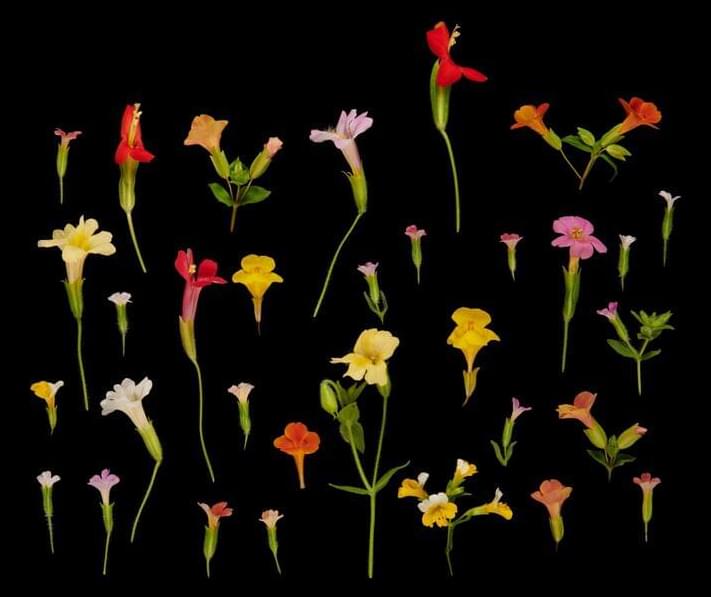
Monkeyflowers glow in a rich assortment of colors, from yellow to pink to deep red-orange. But about 5 million years ago, some of them lost their yellow. In the Feb. 10 issue of Science, UConn botanists explain what happened genetically to jettison the yellow pigment, and the implications for the evolution of species.
Monkeyflowers are famous for growing in harsh, mineral-rich soils where other plants can’t. They are also famously diverse in shape and color. Monkeyflowers also provide a textbook example of how a single-gene change can make a new species. In this case, a monkeyflower species lost the yellow pigments in the petals but gained pink about 5 million years ago, attracting bees for pollination. Later, a descendent species accumulated mutations in a gene called YUP that recovered the yellow pigments and led to production of red flowers. The species stopped attracting bees. Instead, hummingbirds pollinated it, isolating the red flowers genetically and creating a new species.
UConn botanist Yaowu Yuan and postdoctoral researcher Mei Liang (currently a professor at South China Agricultural University), with collaborators from four other institutes, have now shown exactly which gene changed to prevent monkeyflowers from making yellow. Their research, published this week in Science, adds weight to a theory that new genes create phenotypic diversity and even new species.
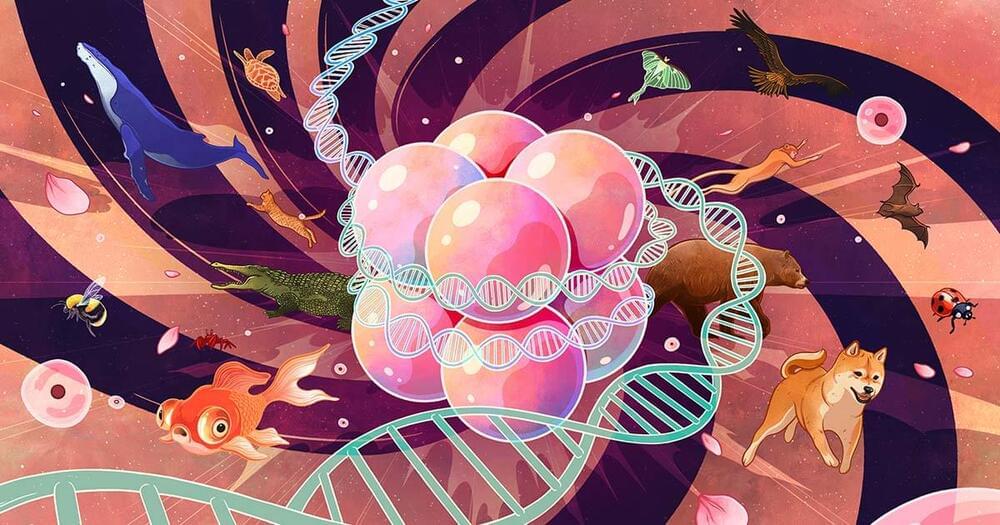
New work shows that histones, long treated as boring spools for DNA, sit at the center of the origin story of eukaryotes and continue to play important roles in evolution and disease.
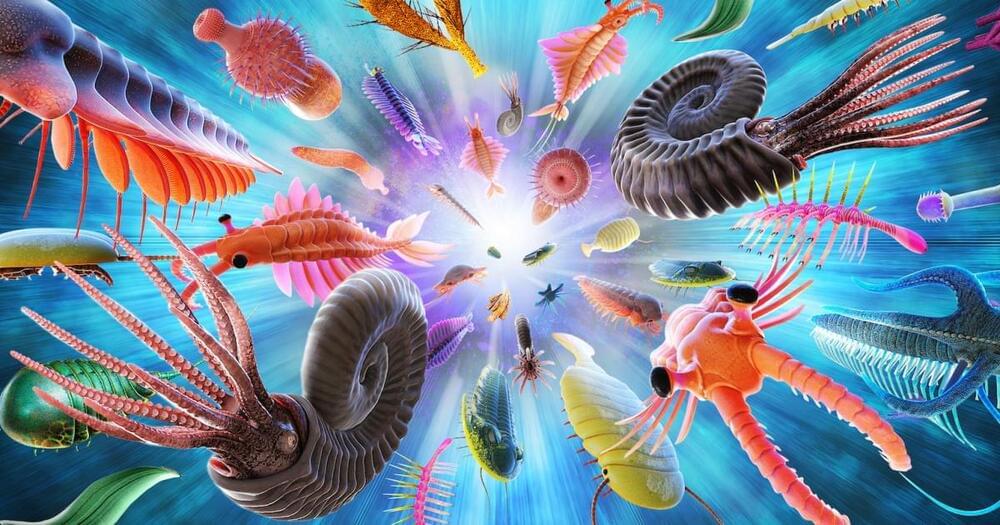
Evolution’s rapid pace after the Cambrian explosion
Though the work of Schopf and other paleobiologists continues to fill in the Precambrian fossil record, questions remain about the pace of the Cambrian explosion. What triggered life to evolve so fast?
The question has intrigued scientists of many disciplines for decades. Interdisciplinary collaboration has wrought a wealth of evidence from diverse perspectives — geochemical, paleoenvironmental, geological, anatomical, and taxonomic — that describes how biological organisms evolved in concert with changing environmental conditions.
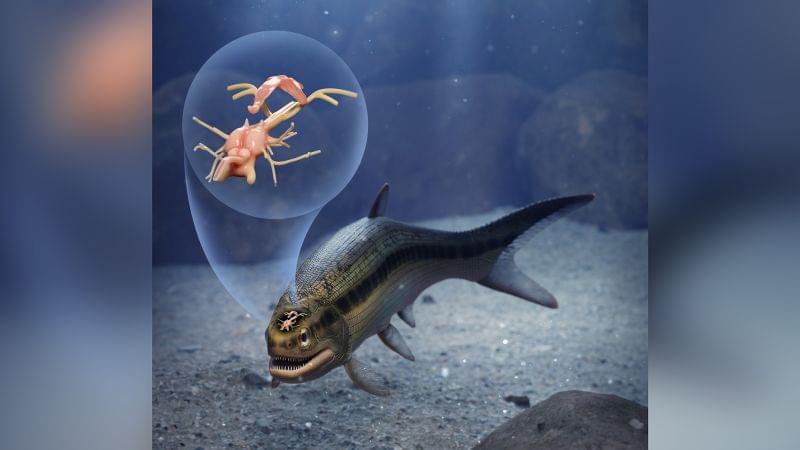
A scan of the skull of a 319-million-year-old fossilized fish has led to the discovery of the oldest example of a well-preserved vertebrate brain, shining a new light on the early evolution of bony fish.
The fossil of the skull belonging to the extinct Coccocephalus wildi was found in a coal mine in England more than a century ago, according to researchers of the study published in the journal Nature on Wednesday.
The fossil is the only known specimen of the fish species so scientists from the University of Michigan in the US and the University of Birmingham in the UK used the nondestructive imaging technique of computed tomography (CT) scanning to look inside its skull and examine its internal bodily structure.
Transhumanism is the idea that technology and evidence-based science can and should be used to augment and improve humans in order to overcome the limitations that evolution has left us with. As the name suggests, it stems from humanism, but it adds an optimism that cognitive and physical improvement is both possible and desirable.
On the face of it, the idea that humans should be permitted to use technology to live healthier and happier lives does not sound dangerous, or even contentious. But it does provoke strong opposition: in 2004, Francis Fukuyama called transhumanism “the world’s most dangerous idea”. The force of that claim is somewhat undermined when you consider how wildly wrong his previous big idea turned out to be: in 1992 he declared that because the Cold War ended with the collapse of the Soviet Union, history had come to an end. Nevertheless, Fukuyama is not alone in fearing transhumanism.
Some people object to transhumanism because they think we should strive to be “natural”, and to be content with what evolution – or their god — have given us. But of course the definition of what is “natural” changes over time. Nature didn’t endow us with spectacles, and few people now argue they should be banned. Now we have cochlear implants, and many people feel that their smartphones are extensions of themselves. In the future we will have the option of raising our IQ with smart drugs or with gene therapy, and these will be hotly debated.
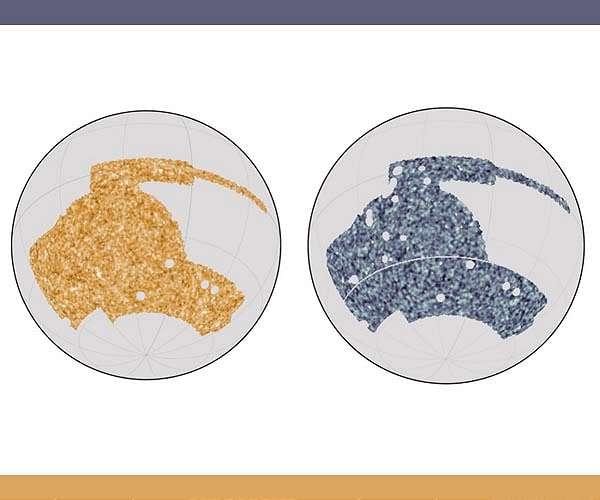
Sometimes to know what the matter is, you have to find it first. When the universe began, matter was flung outward and gradually formed the planets, stars and galaxies that we know and love today. By carefully assembling a map of that matter today, scientists can try to understand the forces that shaped the evolution of the universe.
A group of scientists, including several with the University of Chicago and Fermi National Accelerator Laboratory, have released one of the most precise measurements ever made of how matter is distributed across the universe today.
Combining data from two major telescope surveys of the universe, the Dark Energy Survey and the South Pole Telescope, the analysis involved more than 150 researchers and is published as a set of three articles Jan. 31 in Physical Review D.
God, they say, is in the details. But could God also be in our frontal lobes? Every culture from the dawn of humankind has imagined planes of existence beyond the reach of our senses, spiritual domains that shape our Earthly experiences. Why do beliefs of the fantastic hold such powerful sway over our species? Is there something in our evolutionary history that points to an answer? Does neuroscience hold the key? Straddling the gap between science and religion, Brian Greene is joined by renowned neuroscientists, anthropologists, and evolutionary biologists, to explore one of the most profound mysteries of our existence.
PARTICIPANTS: Lisa Barrett, Barbara J. King, Zoran Josipovic, Steven Pinker.
Dr. Bapteste has both a Ph.D. in evolutionary biology from Pierre and Marie Curie University and a Ph.D. in the philosophy of biology from Pantheon-Sorbonne University.
Dr. Bapteste is the Co-Director of the Adaptation, Intégration, Réticulation, Evolution (AIRE) team, which develops new methods and new concepts, in particular related to biological networks, in order to study evolution and aging. Specifically, the AIRE team works to enhance the evolutionary theory i) by expanding its scope by targeting additional objects of studies (such as novel units of selection and novel still unknown taxonomical groups from the microbial dark matter, and mobile elements) and ii) by expanding evolutionary studies towards more general models, able to in particular account for chimerism and interactions between biological elements, from molecules to ecosystems.
Dr. Bapteste is the author of 95 scientific articles and 4 books of popular sciences: “Les gènes voyageurs: l’odyssée de l’évolution”, “Conflits intérieurs: fable scientifique”, “Tous entrelacés! Des gènes aux super-organismes, les réseaux de l’évolution”, and “Tout se transforme! Comment marche l’évolution”.