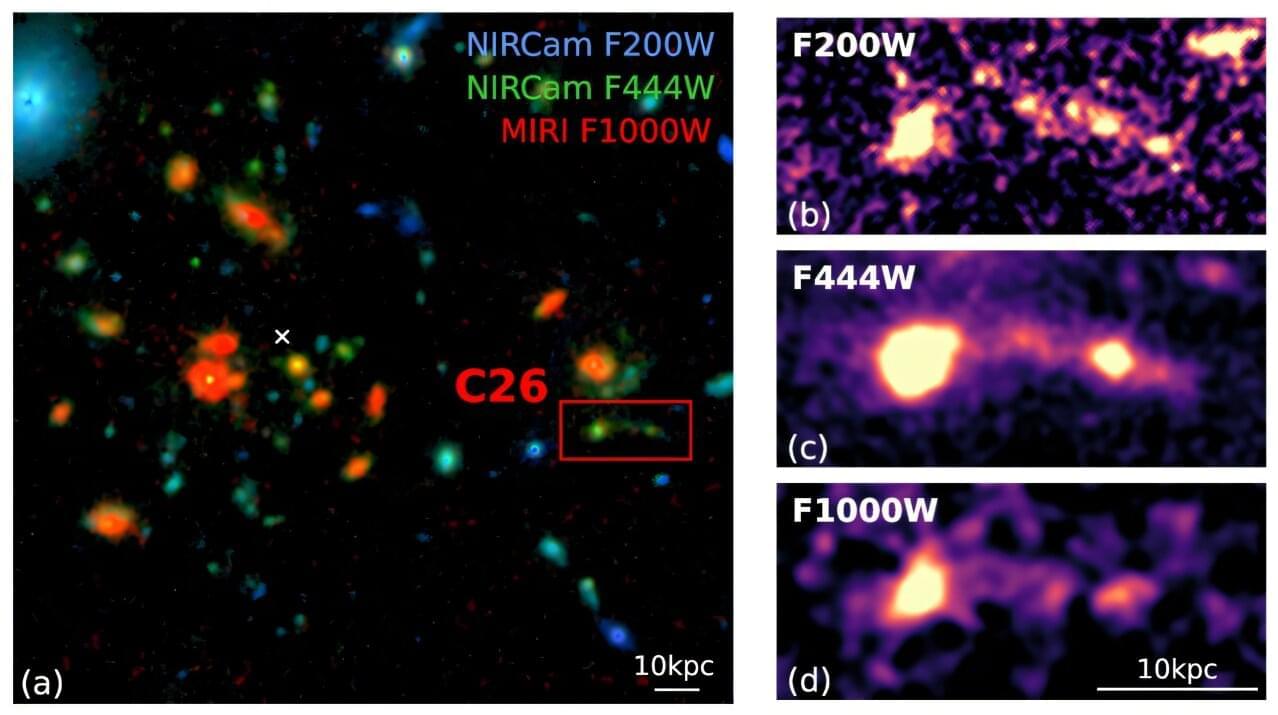
Astronomers have spotted many “red and dead” galaxies in the early universe. These are massive systems that stopped forming stars surprisingly early in cosmic history. Now, they may have found evidence of one in the act of becoming dead: a massive galaxy being stripped of its starforming gas just 1.4 billion years after the Big Bang. The clues behind why it lost its star-forming material are detailed in a paper posted to the arXiv preprint server on June 16.
Comet-like galaxy SPT2349–56 is an emerging galaxy cluster, or “protocluster,” containing about 30 star-forming galaxies within a region 100 kiloparsecs wide. Among its members, C26 is particularly interesting because of its unusual shape. It has a head and a tail like a comet. It also has a dense, bright region called the “knot,” embedded within the tail. It was first detected in ALMA images.
In this new study, using observations from the Hubble Space Telescope and the James Webb Space Telescope, the team led by Dazhi Zhou of the University of British Columbia studied this galaxy’s head, tail and knot to estimate its mass and star-forming properties.