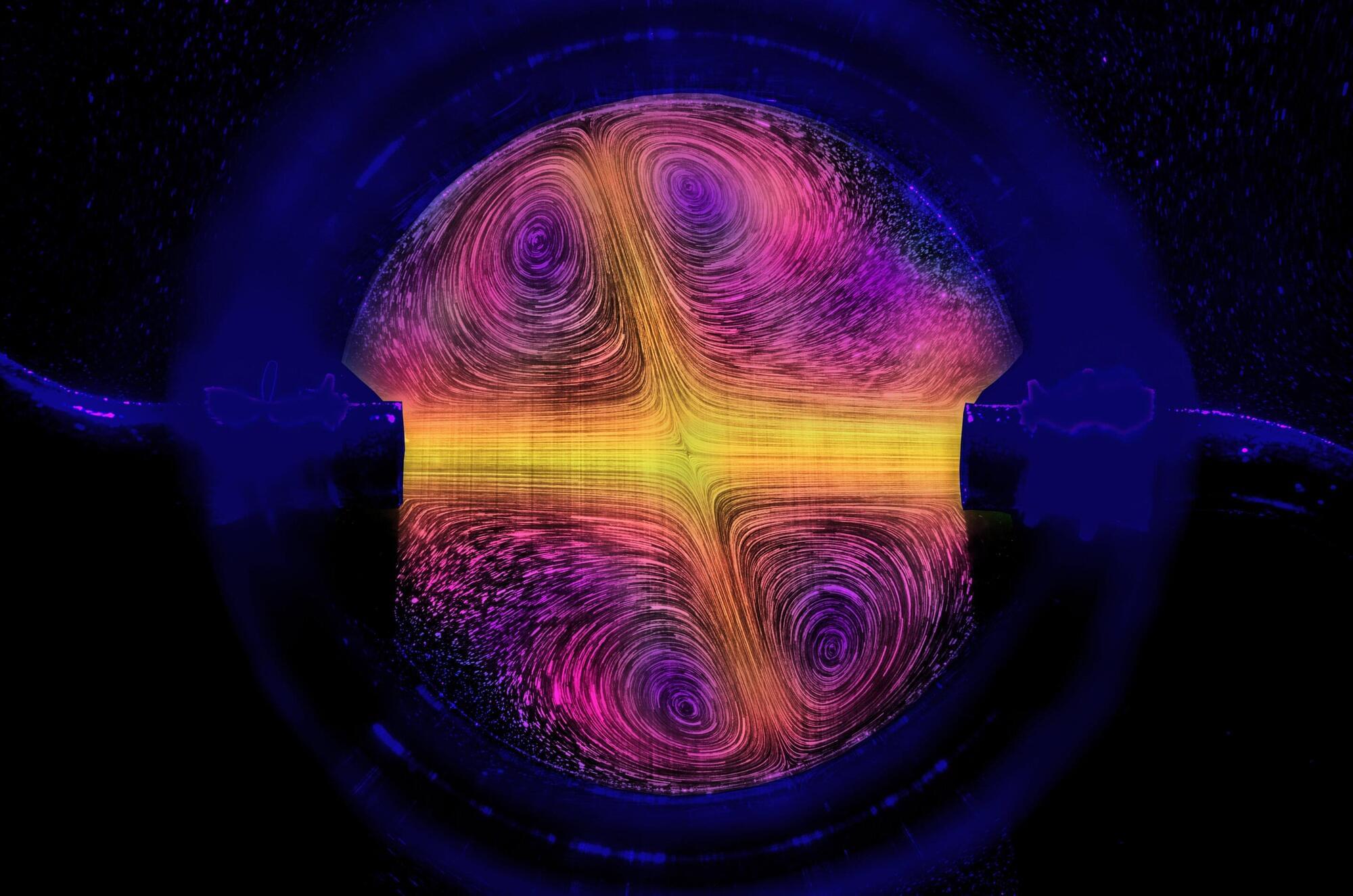
Each summer, lawns are marked by a familiar addition: “silly sprinklers,” whose loops and spirals spew water in creative ways. While seemingly frivolous in their construction, a team of mathematicians has used their design to address a long-standing mystery surrounding the laws of physics.
For decades, scientists have been trying to solve Feynman’s Sprinkler Problem: How does a sprinkler running in reverse—in which the water flows into the device rather than out of it—work? Through a series of experiments on custom-designed sprinklers with different shapes, the researchers arrived at a clear answer and, more generally, determined how flowing fluids exert forces and move structures.
“This work provides the experimental answer for Feynman’s Sprinkler Problem by showing, across several sprinkler types, how the angular momentum of water flows drives sprinklers’ rotation,” explains Leif Ristroph, an associate professor at New York University’s Courant Institute School of Mathematics, Computing, and Data Science and the senior author of the paper, which appears in the journal Proceedings of the National Academy of Sciences.