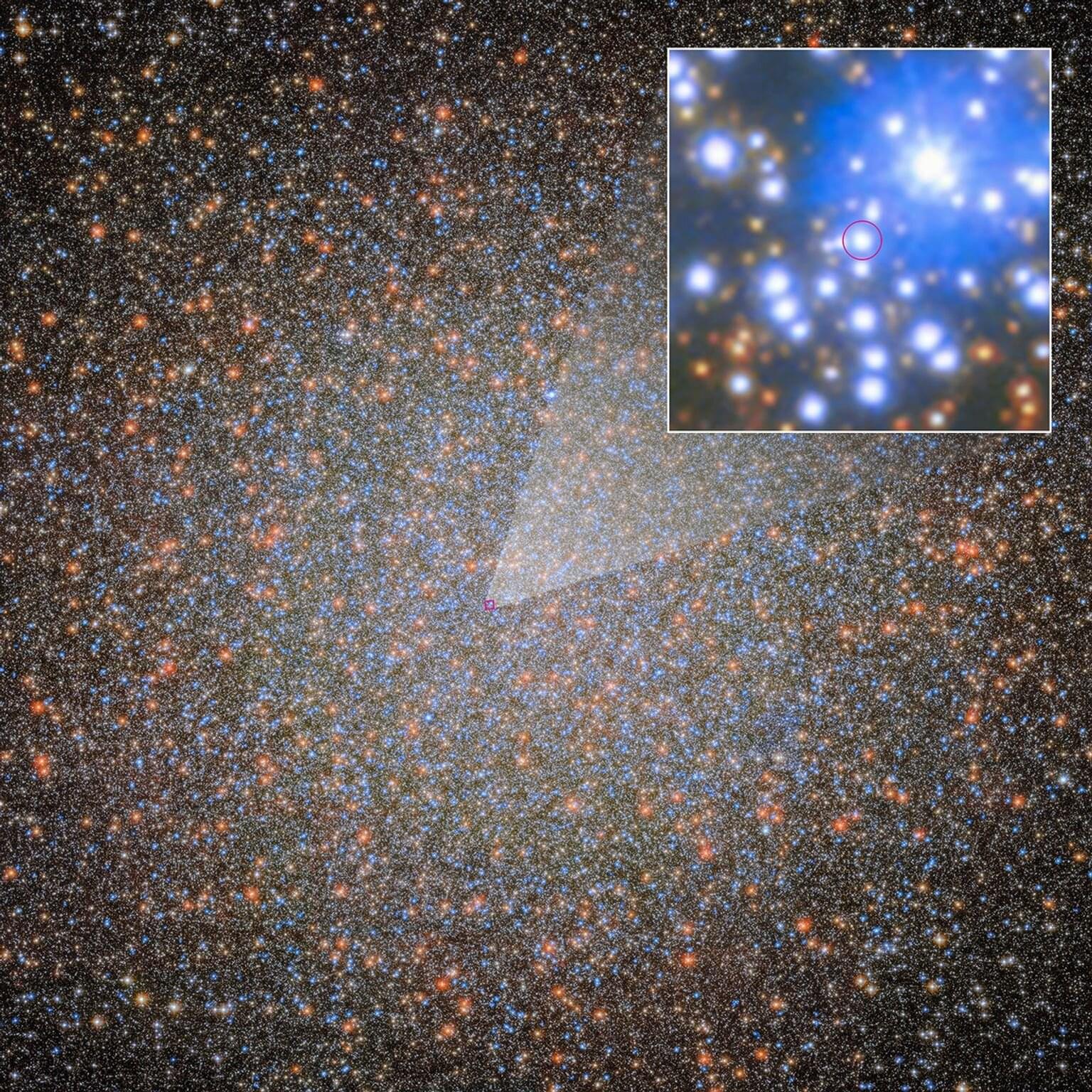
The massive globular star cluster Omega Centauri has puzzled astronomers for decades. It should be filled with black holes left behind by exploding stars, yet evidence for them is scarce. Now, astronomers using archival data from NASA’s Hubble Space Telescope and supporting observations from NASA’s James Webb Space Telescope have finally located the first stellar-mass black hole in this cluster. Discovering the first of this missing black hole population will help refine current theories on black hole formation within environments such as Omega Centauri. The team’s findings were published in The Astrophysical Journal Letters.
Omega Centauri consists of 10 million gravitationally bound stars. Though the astronomical community previously found evidence using Hubble that an intermediate-mass black hole lurks at its center, models suggest this star cluster should also contain about 10,000 smaller, stellar-mass black holes. This notable population of black holes evaded detection in previous observational studies, which used the radial velocity method or looked for radio and X-ray emission from material falling onto black holes.