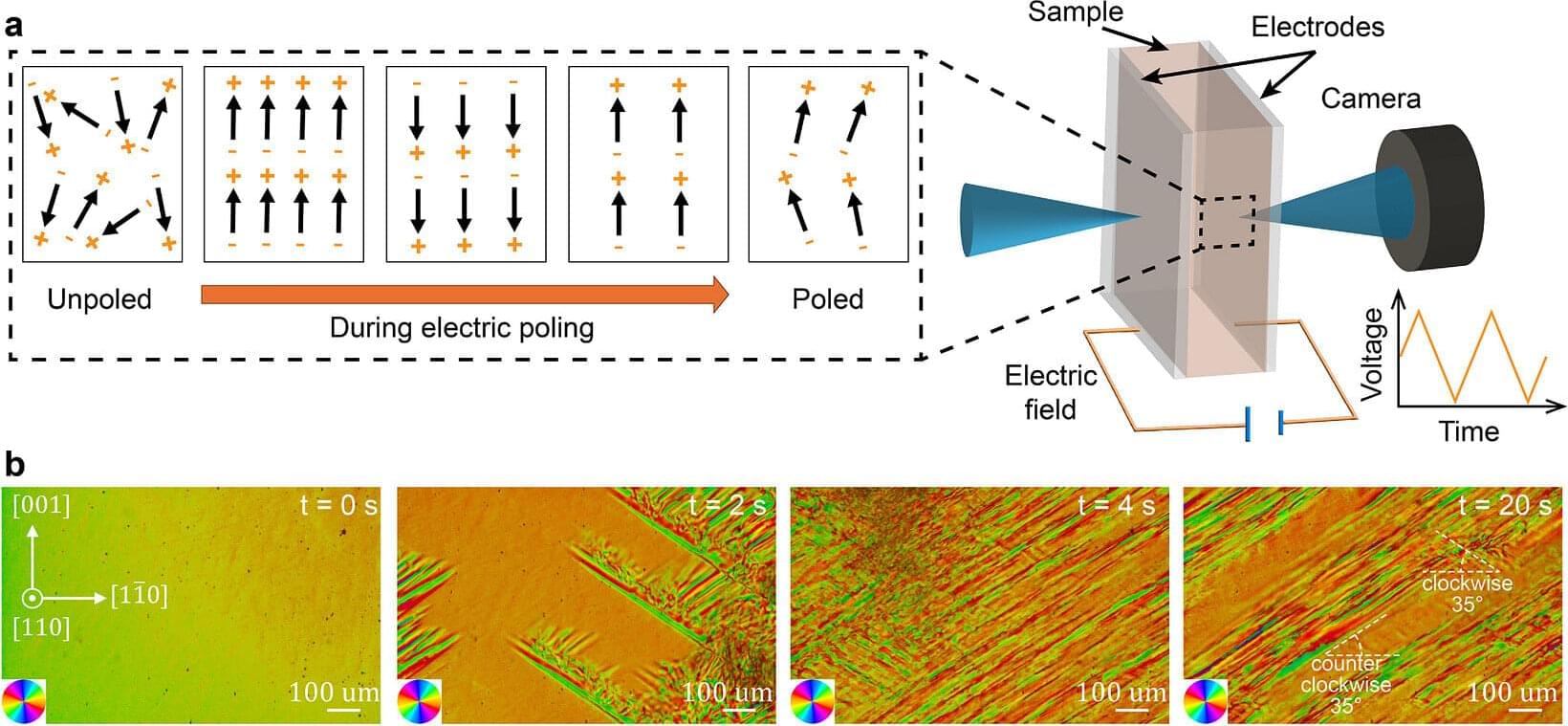
New research is shedding light on longstanding debates over the behavior of ferroelectric materials when those materials are exposed to electric fields. The findings stem from the use of a novel technique that allows researchers to observe the real-time behavior of domain walls in ferroelectric materials as they are “poled” and “depoled.”
Ferroelectric materials are used in a wide range of technologies, from sensors to actuators, and their electrical properties are critical to their utility. It’s well established that you can bring the various domains in a ferroelectric material into alignment by applying an electric field—either direct current (DC) or alternating current (AC). This is called “poling.” However, there has been significant debate about what exactly is taking place during the poling process.
“We’re now able to observe what is happening in real time, which gives us deeper insights into the mechanisms at play—which will inform our ability to engineer materials in order to produce the electrical characteristics we’re looking for,” says Jun Liu, co-corresponding author of two papers on the work and an associate professor of mechanical and aerospace engineering at North Carolina State University.