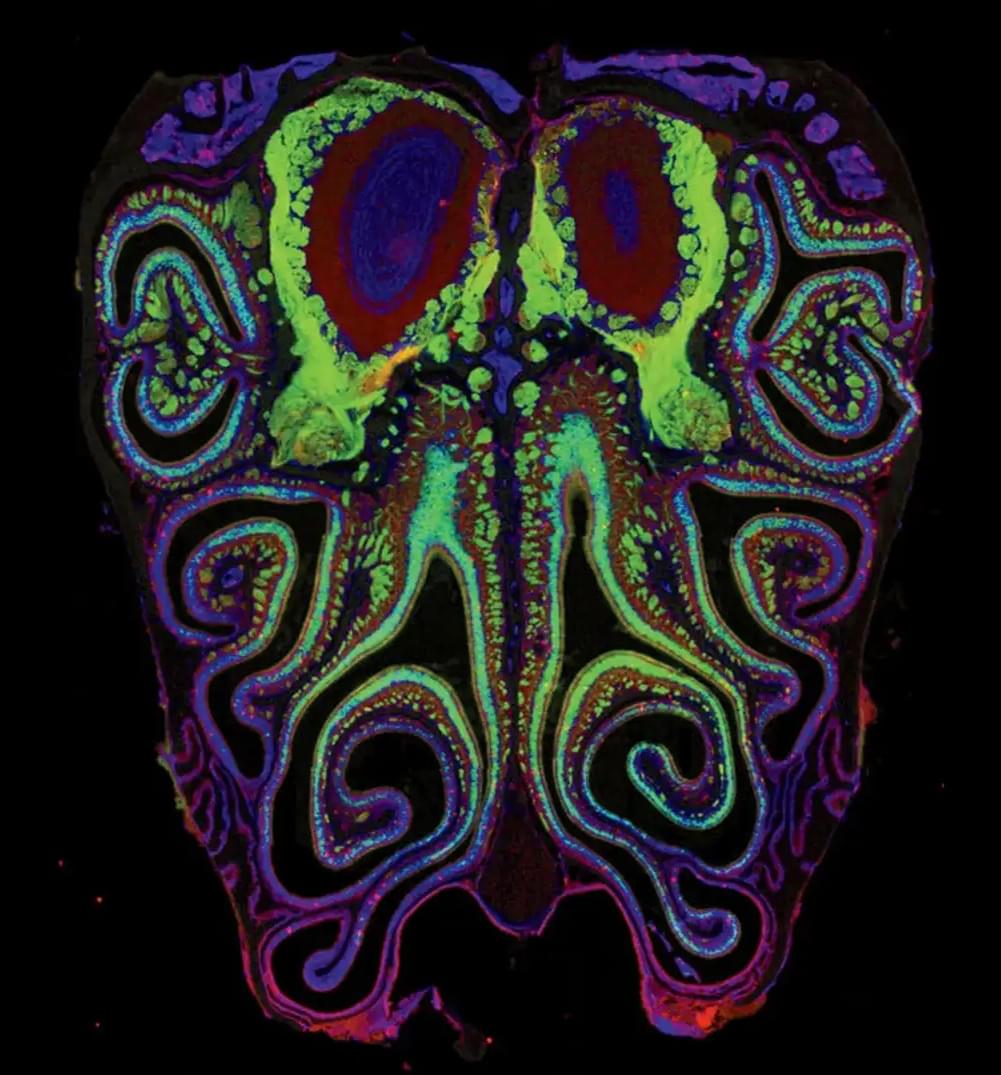
Scientists Reveal a Hidden “Smell Map” Connecting the Nose and Brain.
Harvard Medical School researchers have created the first detailed spatial map of how more than 1,100 types of olfactory receptors are organized in the mouse nose. Contrary to the long-standing idea that smell receptors are scattered somewhat randomly within broad regions, the team found that receptor-expressing neurons occupy precise, overlapping bands across the olfactory epithelium.
Using single-cell RNA sequencing, spatial transcriptomics, and advanced microscopy, researchers analyzed millions of olfactory sensory neurons from hundreds of mice. Each sensory neuron expresses one receptor type, and its position within the developing nasal tissue helps influence which receptor it selects. The signaling molecule retinoic acid appears to help establish this spatial organization.
Remarkably, this map in the nose aligns with the organization of corresponding neurons in the olfactory bulb—the brain’s first major processing center for smell. This suggests that olfaction, like vision, hearing, and touch, relies on an orderly topographic system linking sensory receptors to specific neural destinations.
The findings provide a new framework for studying how odors are encoded, how olfactory circuits develop, and why the sense of smell may be disrupted by infections, aging, injury, medications, or cancer treatments. The research could eventually inform strategies for treating anosmia and other smell disorders, although the work was conducted in mice and researchers have not yet established whether the same detailed organization exists in humans.
Study: Brann et al., Cell DOI: 10.1016/j.cell.2026.03.
#Neuroscience #Olfaction #SenseOfSmell #BrainResearch #SensoryNeuroscience #HarvardMedicalSchool #Neurobiology #SpatialTranscriptomics
Growing liver implants, mapping the sense of smell, and journalism at risk.