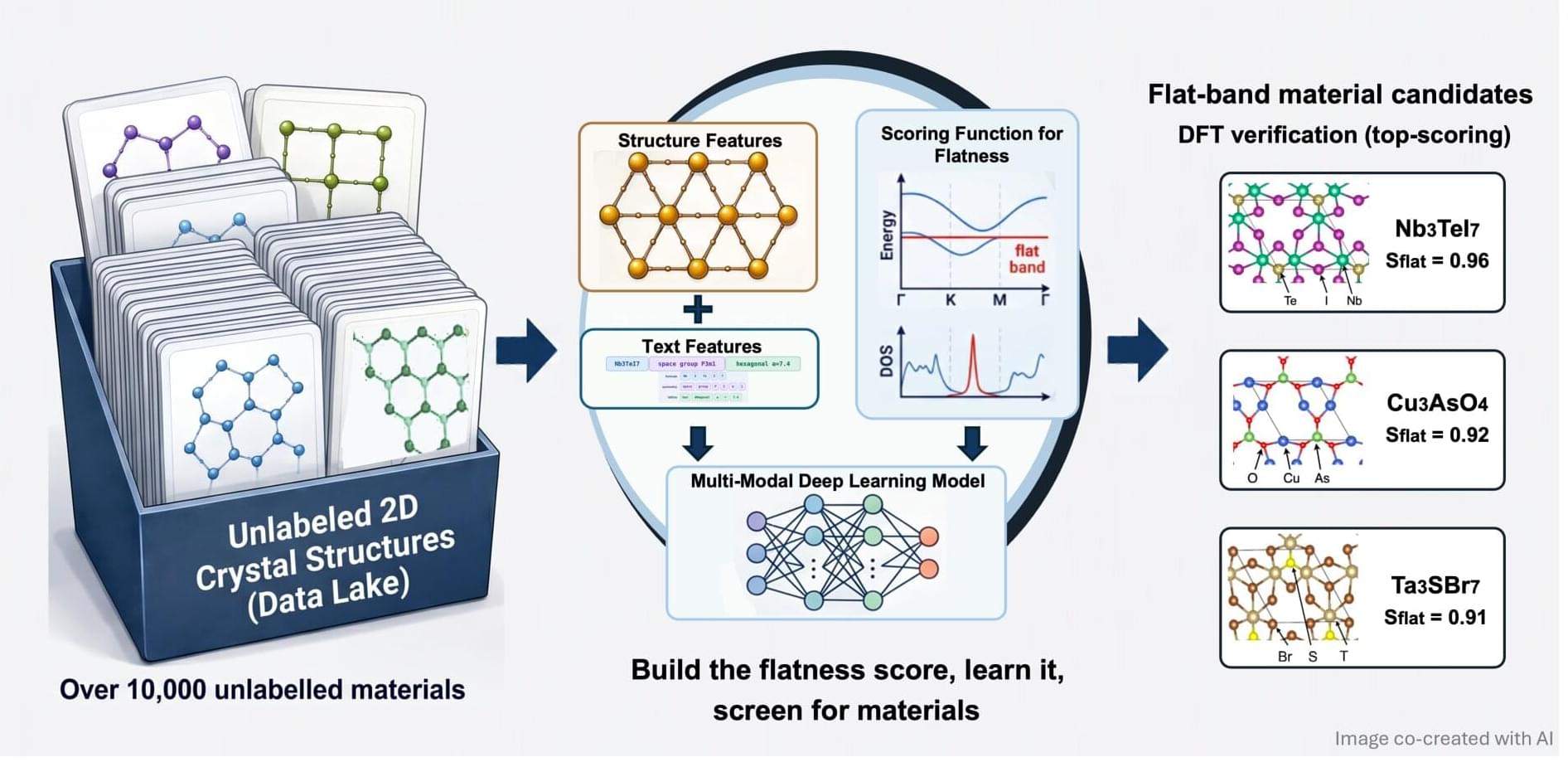
Researchers at The University of Manchester have developed a new computational approach to help identify two-dimensional materials that may host unusual quantum behavior. The work, published in Science Advances, focuses on materials with “flat bands,” electronic states where electrons have very little kinetic energy. In these materials, interactions between electrons can become much more important, creating conditions linked to phenomena such as magnetism, unconventional superconductivity and topological electronic behavior.
Finding real materials with flat bands from large datasets is difficult. Conventional searches often rely on density functional theory calculations, which can reveal a material’s electronic structure but are time-consuming when applied across thousands of possible candidates.
The Manchester team took a different route. They developed a physics-informed scoring system that captures two signatures of flat-band behavior, low band dispersion and a strong peak in the density of states, then trained a model to estimate that score directly from atomic structure.