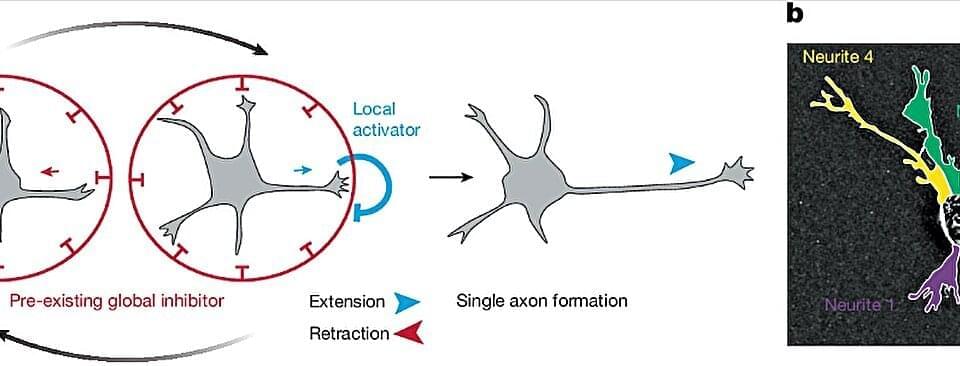
DZNE researchers have uncovered a mechanism that determines why a neuron usually forms a single, long extension called an “axon”—a phenomenon that is fundamental to how our brain functions. Contrary to the common view that external cues drive axon formation, the team of scientists concluded that its growth originates primarily inside the cell. Their work, based on cell cultures and published in the journal Nature with collaborators from other institutions in Germany, Austria and Japan, reveals how a neuron’s structure is remodeled to generate the axon.
Neurons in the brain and spinal cord form a vast network in which each cell receives many inputs but sends output through only a single, long extension: the axon. “If our neurons had multiple axons, this would cause chaos in the brain,” says Frank Bradke, a neurobiologist and research group leader at DZNE. “Nature has therefore found a clever way to make sure that neurons generate only one axon. This applies not only to humans, but across the entire animal kingdom. So, we’re dealing with very fundamental processes that shape the wiring of the brain and nervous system.”