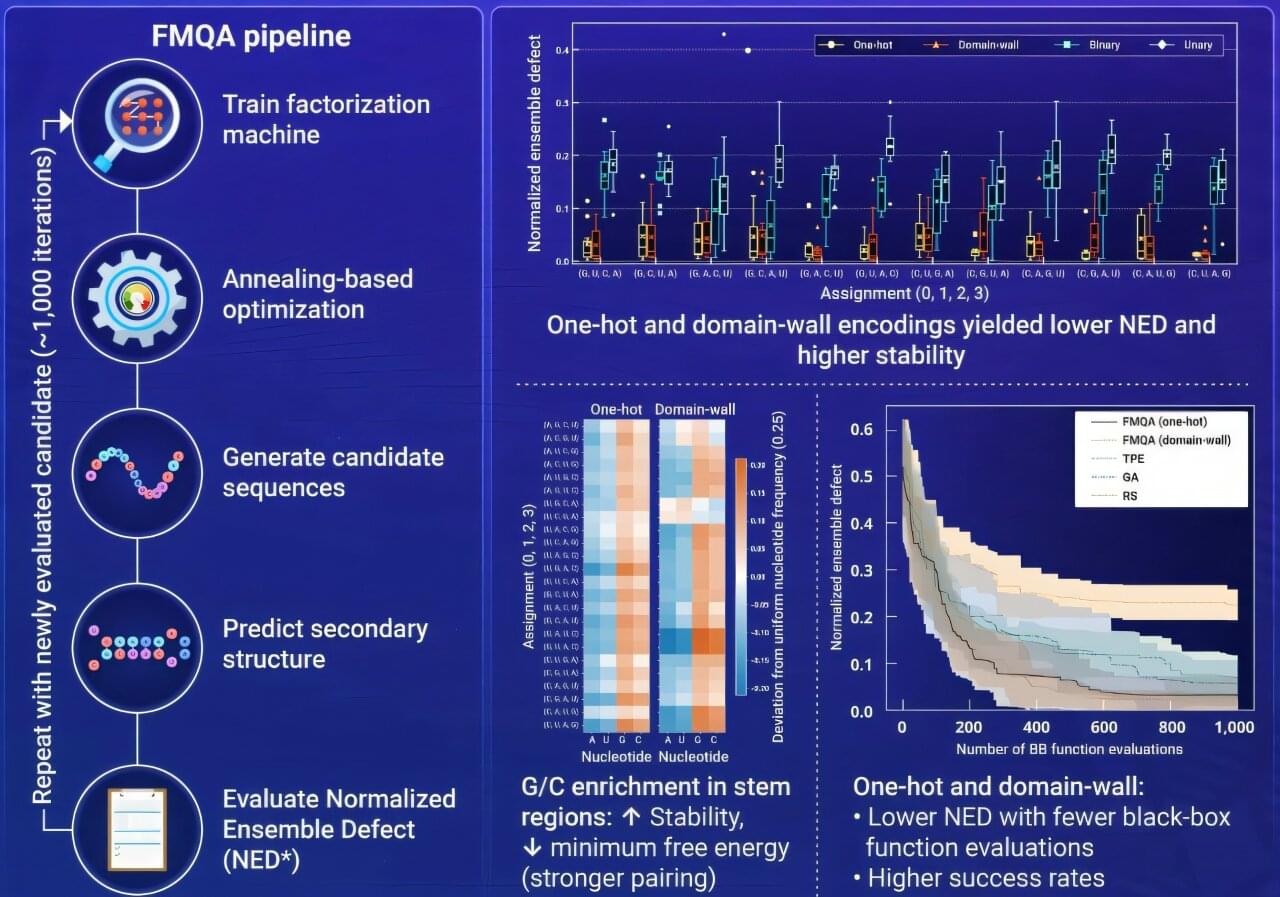
RNA has emerged as one of the most promising molecules in modern medicine, enabling advances from mRNA vaccines and gene therapies to genome editing and synthetic biology. However, designing RNA molecules that reliably fold into a desired secondary structure remains a major challenge. Even for relatively short sequences, the number of possible nucleotide combinations grows exponentially, making it difficult to identify optimal candidates. As a result, conventional computational methods often require extensive candidate evaluations, creating a significant bottleneck when experimental validation is both time-consuming and costly.
To address this challenge, researchers from Keio University, led by Project Lecturer Shuta Kikuchi of the Graduate School of Science and Technology and Professor Shu Tanaka of the Department of Applied Physics and Physico-Informatics, developed a novel RNA inverse folding framework based on factorization machine with quadratic optimization annealing (FMQA). This machine learning– and Ising machine–driven black-box optimization approach is designed to identify high-quality RNA sequence candidates with relatively few evaluations.
“We investigated a new application of FMQA in biomolecular design, where its potential remains relatively unexplored. Since RNA, DNA and protein sequences are inherently categorical in nature, it is unclear how converting them into binary representations affects optimization performance. In this study, we examined RNA inverse folding and the influence of different encoding and assignment choices within FMQA,” says Dr. Kikuchi. The findings are published in Scientific Reports.