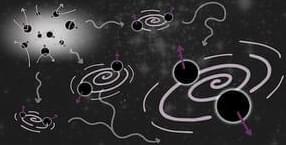
Different analyses of gravitational-wave observations are converging on evidence for a distinct population of massive black hole binaries produced through repeated mergers.
Throughout the Universe, pairs of orbiting black holes emit ripples in spacetime that propagate across the cosmos. These gravitational waves carry away orbital energy, causing the black holes to slowly spiral closer together. This process is extremely slow, but, in a minority of cases, it leads to a cataclysmic merger within the age of the Universe. Since the historic detection of gravitational waves in 2015 (see Viewpoint: The First Sounds of Merging Black Holes), the LIGO, Virgo, and KAGRA gravitational-wave detectors have advanced to the point of recording a signal from merging black holes every few days of operation, yielding a cumulative catalog of hundreds [1]. Understanding how, when, and where the Universe produces these extreme astrophysical collisions remains an open question, with implications spanning physical scales from the subatomic to the cosmological.
Now, two teams led, respectively, by Cailin Plunkett at MIT [2] and Sharan Banagiri at Monash University in Australia [3] present evidence that a subset of binary black hole observations can be connected to a particular origin story: that of hierarchical mergers, in which at least one member of the pair is not the remnant of a dead star but instead the product of an earlier black hole merger (Fig. 1). The fact that these and other analyses [4– 10], based on markedly different assumptions, converge on a similar conclusion strengthens the case that hierarchical mergers constitute an important contribution to the binary black hole population.