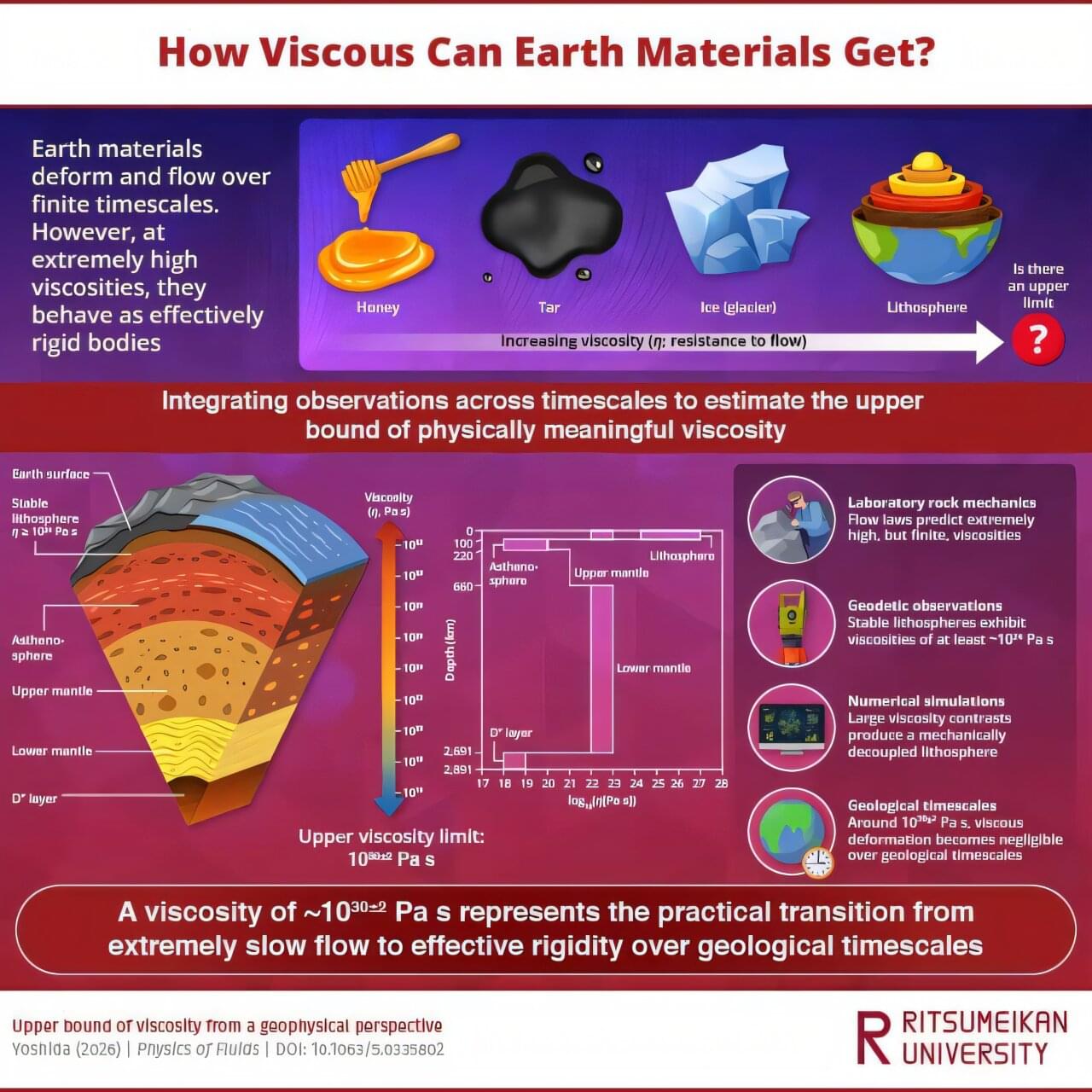
Viscosity is one of the most fundamental physical properties used to describe how materials flow. It governs the movement of liquids, molten rocks and even slowly deforming regions deep inside the Earth. While scientists have long studied materials with low or moderate viscosities, a simple but important question has remained largely unexplored: Is there a physically meaningful upper limit to viscosity?
Extremely high-viscosity materials are usually composed of rock-forming minerals, which are rarely discussed within the traditional framework of fluid dynamics, leaving this question largely unanswered.
To address this question, a study by Professor Masaki Yoshida from the Department of Physical Sciences, College of Science and Engineering, Ritsumeikan University, Japan, investigated whether the Earth’s interior could provide a natural constraint on the highest physically meaningful viscosity over finite timescales.