Magnetic storage devices, like a computer’s hard disk drive, utilize magnets to represent binary data. However, as these devices are downsized, stray magnetic fields generated by individual magnetic components can interact with neighboring elements to cause operational malfunctions, limiting how much data we can densely pack into memory devices.
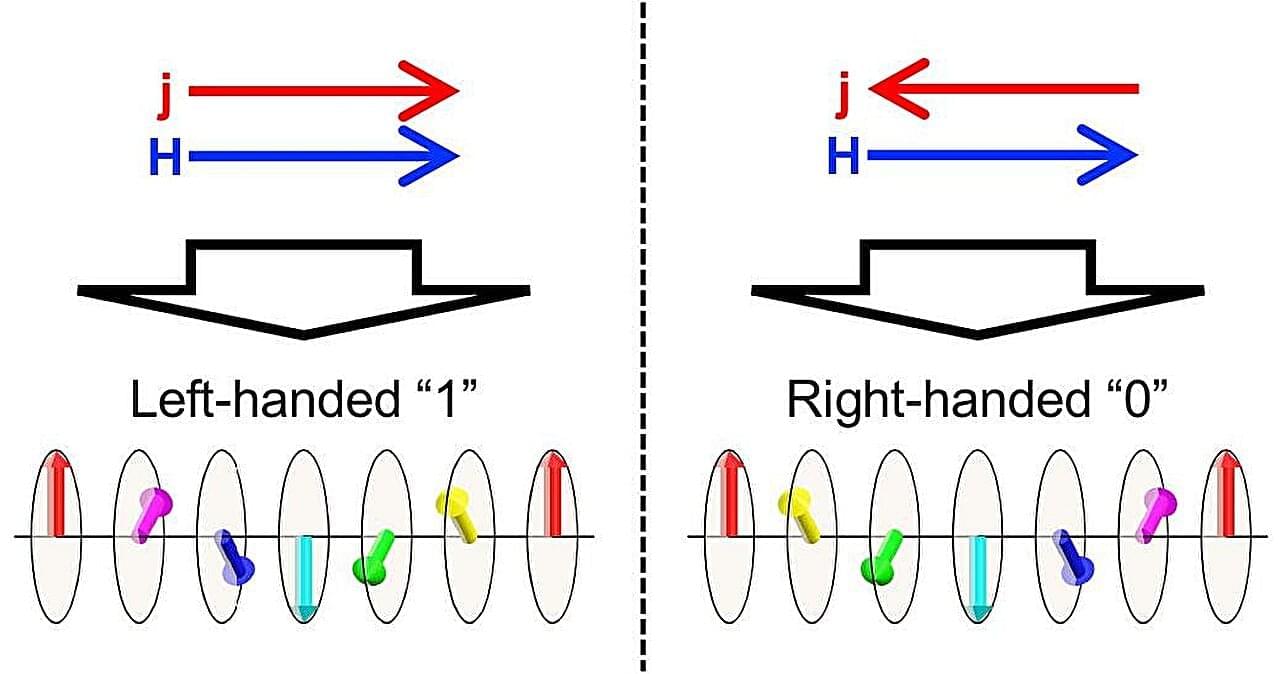
A joint research team led by Hidetoshi Masuda and Yoshinori Onose from Tohoku University’s Institute for Materials Research—in collaboration with CROSS, J-PARC, Keio University, and Kyoto University—has successfully demonstrated precise, deterministic control over the spiral-handedness (magnetic chirality) in a metallic helimagnet, a material that inherently avoids malfunction-causing crosstalk. Details of their findings were published in the Proceedings of the National Academy of Sciences on June 16, 2026.
A helimagnet features microscopic atomic magnets arranged in a twisted, spiral pattern. Utilizing its chirality (right-or left-handed mirror images) to represent binary data (“0” and “1”) could enable ultra-high-density storage. While some experiments suggested that this chirality could be controlled by simultaneously applying an electric current and a magnetic field, previous confirmations relied on indirect, macroscopic electrical measurements highly susceptible to experimental artifacts.