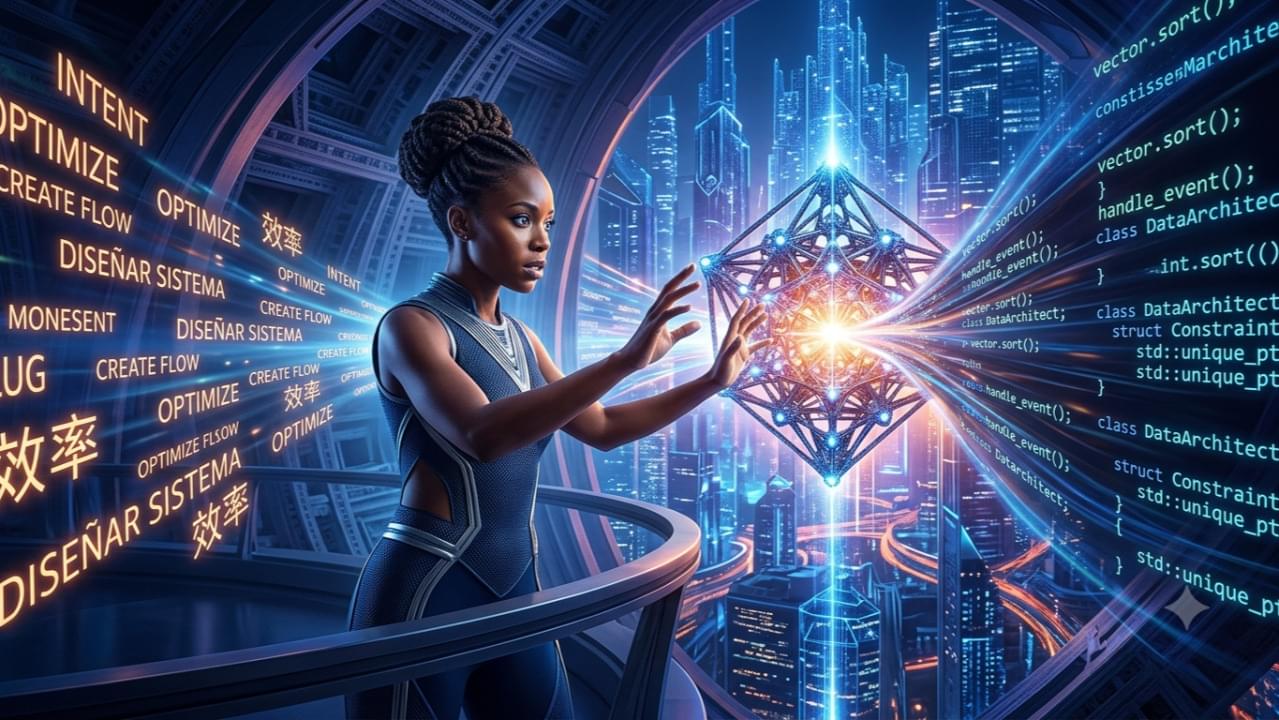
The barrier between human thought and machine code is officially gone. 🤯
In my last deep dive, we explored “Vibecoding” and how creators are bypassing traditional development bottlenecks using pure vision. But how does AI actually turn your spoken intent into architecture?
AI doesn’t just use a massive translation dictionary. Instead, it operates in a hidden mathematical geometry known as the Latent Space.
In this invisible architecture, an English phrase and a complex Python script are mapped into the exact same coordinate of pure logic. This triggers a massive paradigm shift called Decision Compression—completely erasing the buggy, high-friction “Telephone Game” of traditional software development by binding your raw idea directly to execution.
If AI completely bypasses the need for manual translation, what happens to traditional coding syntax like Java or C++?
And more importantly, who becomes the ultimate builder in this new paradigm?
Read the full deep dive into the engine of the AI revolution!
(https://www.linkedin.com/pulse/rosetta-manifold-how-ai-erase…urke-jaure)
In our last deep dive into the architecture of Vibecoding, we explored the concept of “Holographic Intent”—how advanced AI agent architectures don’t just pass text files back and forth, but instead superpose global project goals into every step of the execution cycle.
We challenged the industry notion that vibecoding is just a lazy shortcut for people who do not want to write syntax. Instead, we proved that it represents an industrial-grade liberation for creators, turning the human builder into a High-Dimensional Intent Architect.
But within that exploration, we briefly touched on a concept that requires a much deeper, standalone investigation: the idea that the computer has finally spent enough time working with both human language and programming language that it has completely translated the two.