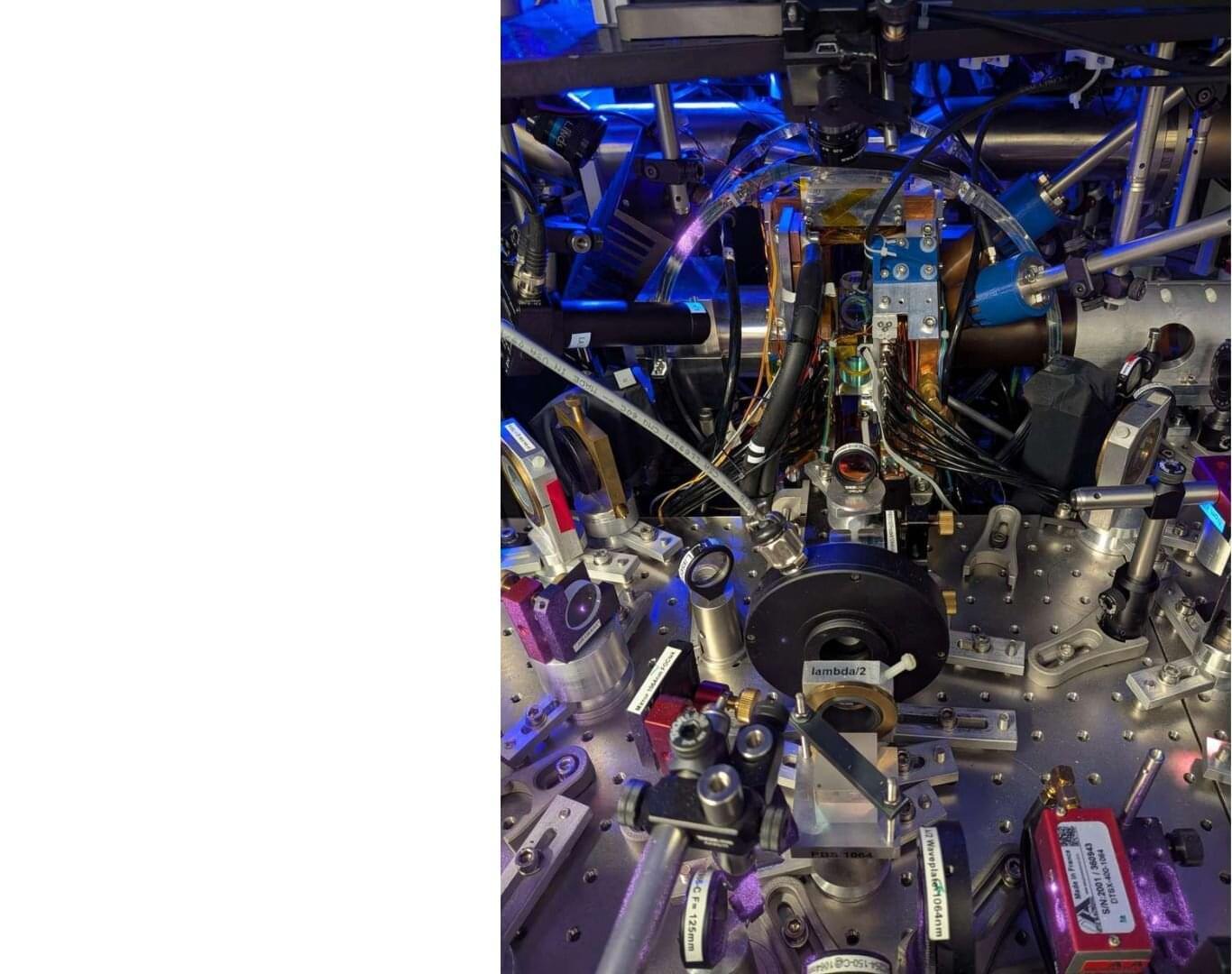
In a new study published in Nature Physics, researchers have demonstrated the Hong–Ou–Mandel (HOM) effect with up to 12 indistinguishable neutral atoms—an effect that has been predominantly observed in photonic systems.
The Hong–Ou–Mandel effect is a quantum phenomenon rooted in particle indistinguishability. When two identical bosons meet at a 50:50 beam splitter, they always exit together through the same output port. In other words, they “bunch up.” A single particle at each output is never found, even though that is the statistically expected outcome if the beam splitter were simply distributing particles at random.
First observed with pairs of photons in 1987, the HOM effect has since become central to quantum information and quantum metrology. For two particles, the physics is well established. However, extending it to many particles is a different challenge.