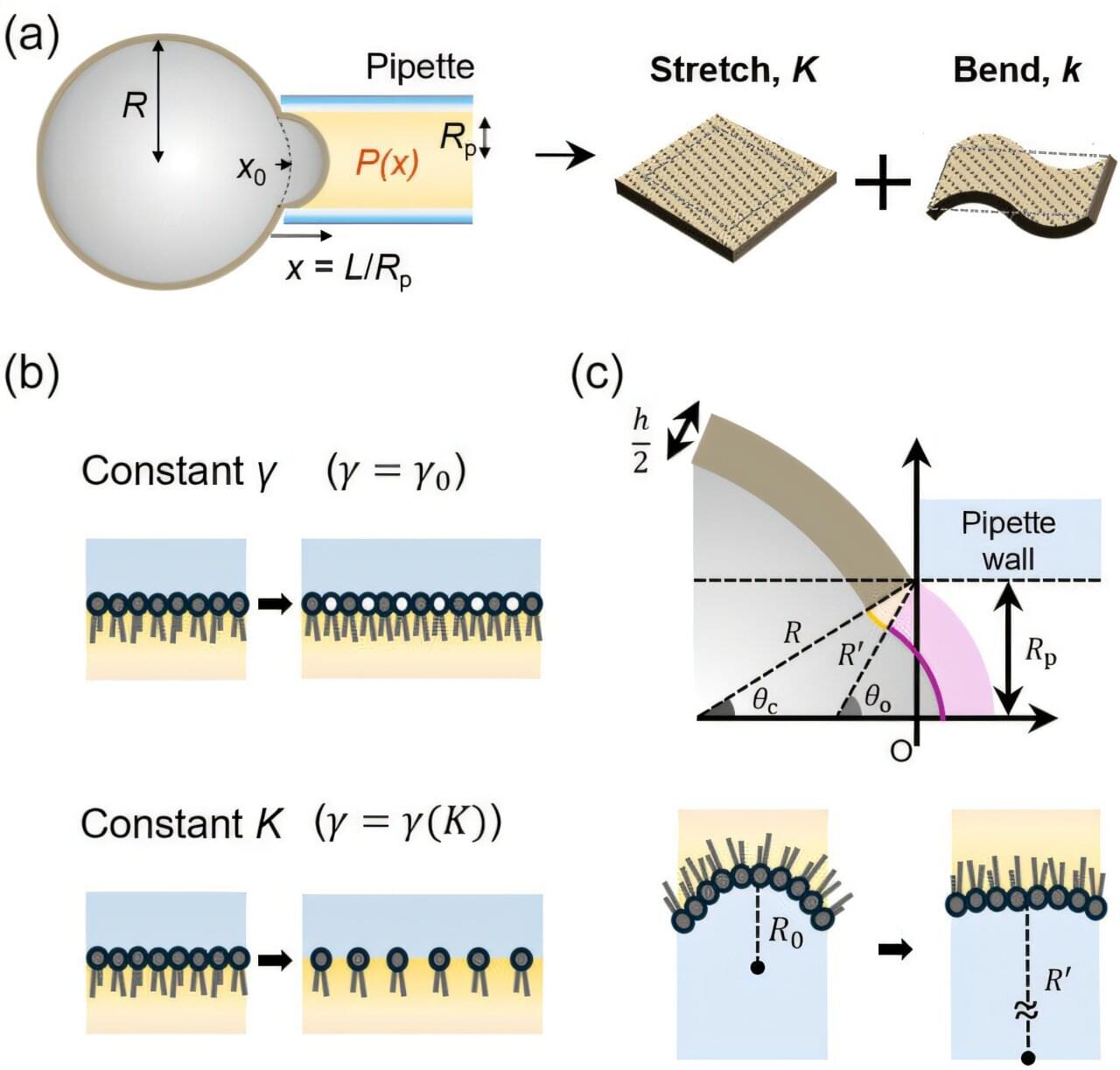
What if the mechanical properties of a cell could be programmed like the components of a machine? Researchers at the University of Tokyo have discovered that two fundamental modes of cellular deformation—stretching and bending—can be independently controlled using different molecular building blocks. The finding provides a new strategy for engineering artificial cells, drug-delivery capsules and adaptive soft materials with precisely tailored mechanical functions.
Miho Yanagisawa, an associate professor at the University of Tokyo, and Kazutoshi Masuda, a Ph.D. student, developed a new framework for dissecting the mechanics of artificial cells. Using lipid-coated microdroplets as simplified cell models, they combined micropipette aspiration experiments with a theoretical model that separates membrane mechanics into stretching and bending contributions. The approach successfully captured nonlinear deformation behaviors that conventional models could not explain. The work is published in the journal Small Science.
The researchers found that lipid molecular geometry primarily determines membrane stretching elasticity. In contrast, when Y-shaped DNA motifs were interconnected to form a three-dimensional network, they created a nanoscale scaffold that dramatically enhanced resistance to bending while leaving stretching elasticity largely unchanged.