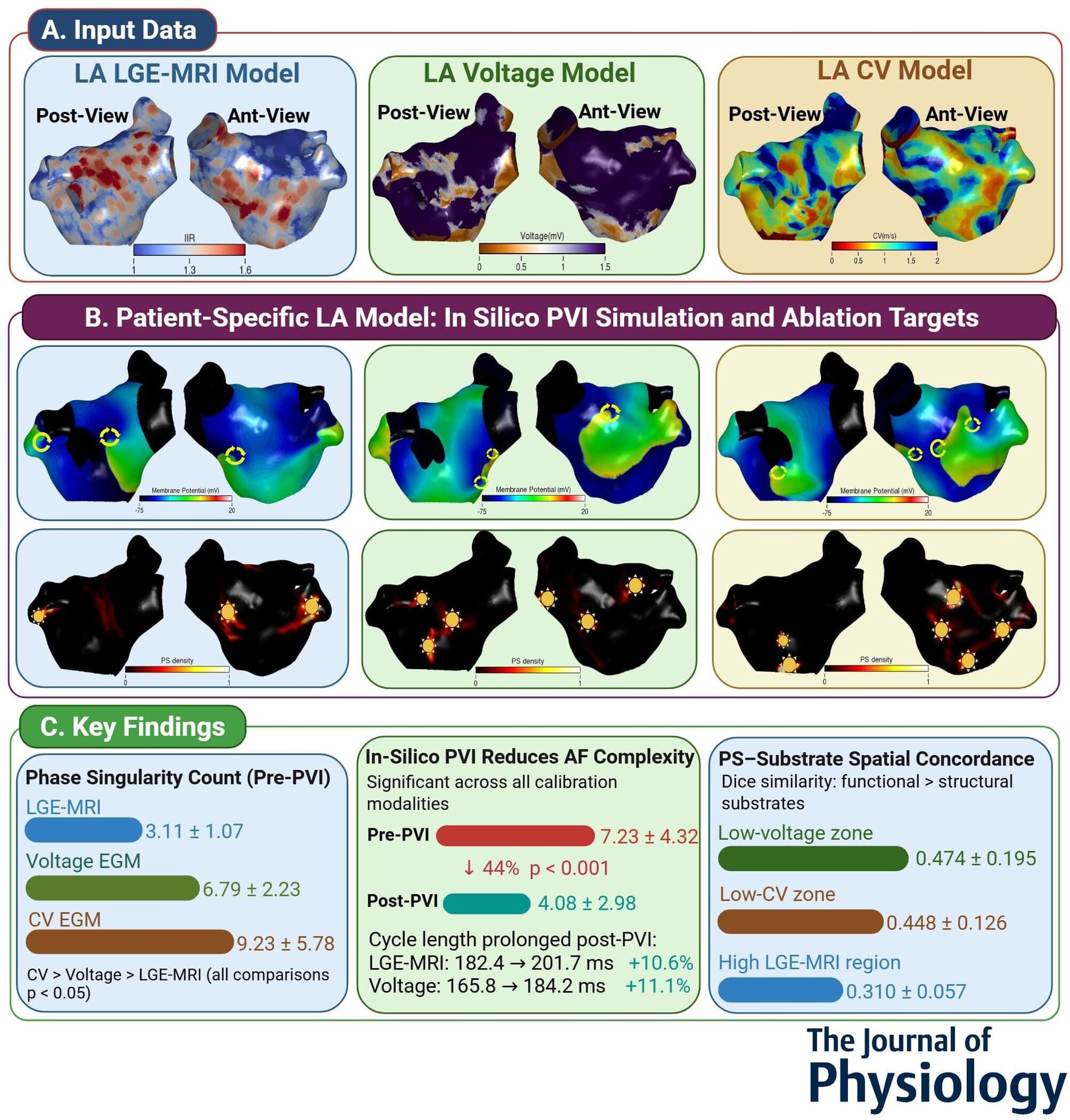
A cross-university paper led by researchers at Queen Mary University of London, published in the Journal of Physiology, shows how better “digital twins” could help doctors treat people with atrial fibrillation.
One of the leading causes of stroke, atrial fibrillation (AF) is an erratic, quivering heartbeat that affects more than 1.5 million people in the U.K. The most common treatment is a procedure called ablation, in which doctors use heat or cold energy to destroy the small patches of heart tissue that trigger the chaotic rhythm. It works, but not for everyone and not always the first time.
Repeat ablation is common in persistent AF partly because the condition involves complex, distributed electrical changes that are hard to map in a single procedure.