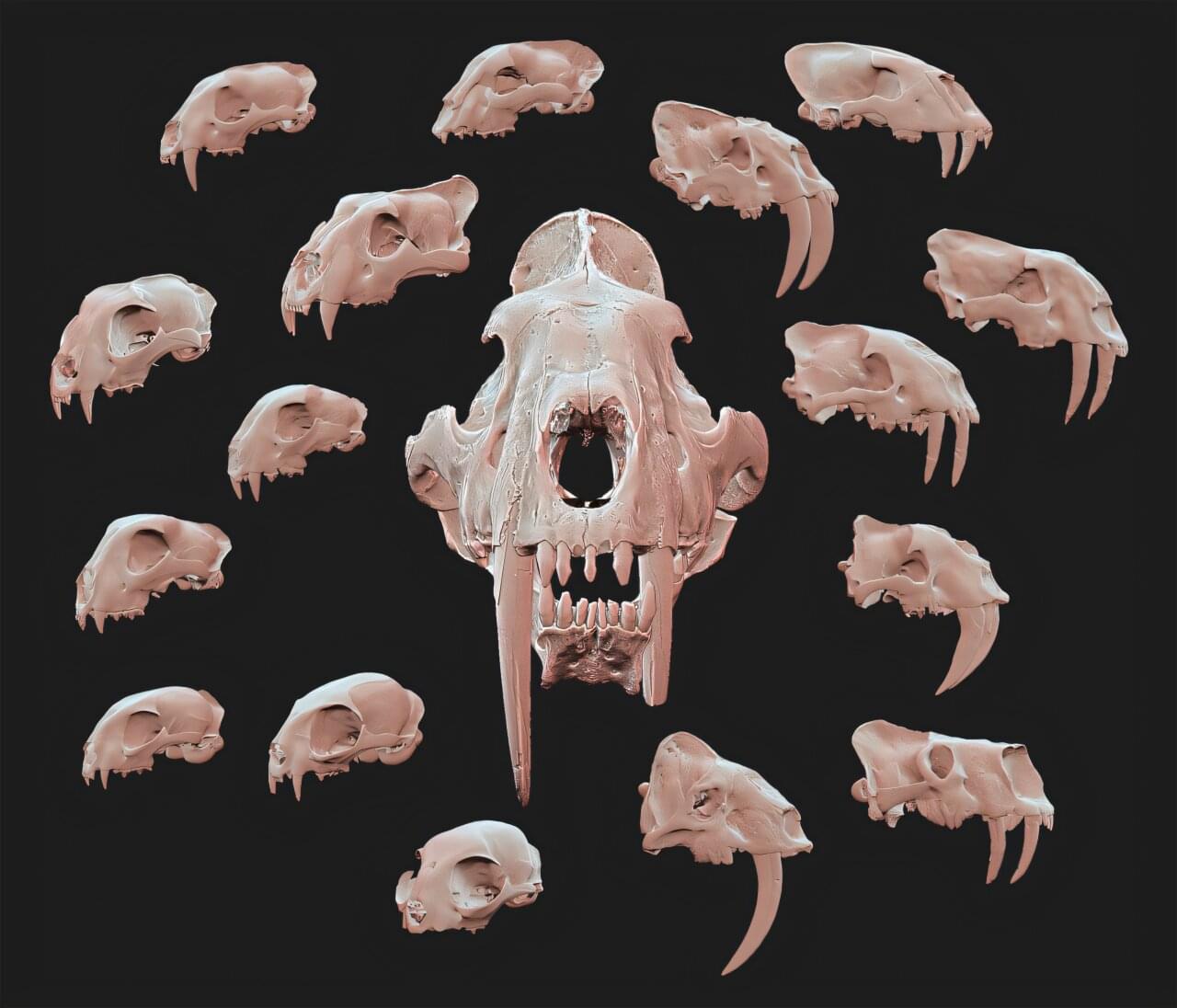
Fossils tucked away in a museum drawer and identified merely as “feline” are actually from a very ancient and enigmatic saber-toothed cat that inhabited North America more than 5 million years ago. Newly identified by a UC Berkeley paleontologist, the nearly complete skull helps clarify how these large-fanged felines evolved over millennia before going extinct about 10,000 years ago.
One clear takeaway is that these cats started out with smaller fangs—the upper canines—but evolved increasingly longer ones that may have led to their ultimate demise. California’s state fossil, Smilodon fatalis (originally called S. californicus), was the culmination of that trend. It had some of the largest upper canines of any saber-toothed animal—up to 7 inches (18 centimeters) long—but was the last saber-toothed animal to survive.
According to Berkeley postdoctoral fellow Narimane Chatar, the cranium, teeth and lower jaw (or mandible) she stumbled upon in the American Museum of Natural History in New York are from the species Adelphailurus kansensis, originally discovered in Kansas and known only from jaw fragments and teeth. Now, with the first complete skull of the cat, she has been able to tentatively place the animal within the family tree of saber-toothed carnivores and contrast it with the most recognizable saber-toothed cat, Smilodon, which ranged throughout the Americas.